Learn How to Make Fast Money by Learning diffrent Strategies in Forex Trading and Different Investment Options
Automated Forex Trading
Automated forex trading uses computer programs to analyze markets and execute trades without constant human supervision. Instead of sitting at your computer watching charts and clicking buy or sell buttons manually, you set up rules and let software handle the trading while you focus on other activities.
The appeal is obvious: trade 24/7 without emotional interference, execute complex strategies consistently, and potentially free yourself from screen time. However, automation isn’t a shortcut to easy profits. It requires understanding how different automation methods work, realistic expectations about performance, and ongoing monitoring to ensure systems operate correctly.
This guide explains what automated forex trading actually means, the main types of automation available to retail traders, how to get started safely, and the critical mistakes that destroy most automated forex trading accounts.
Automated forex trading means using software to make trading decisions and execute trades based on predefined rules. You’re not eliminating human involvement entirely—you’re shifting your role from active trader to system designer and monitor.
At minimum, automation handles trade execution. At maximum, it handles analysis, decision-making, position sizing, risk management, and execution entirely without human input for each individual trade.
The automation spectrum includes simple tools that just execute your manual decisions faster, semi-automated systems that generate signals you approve before execution, and fully automated systems that operate independently once configured.
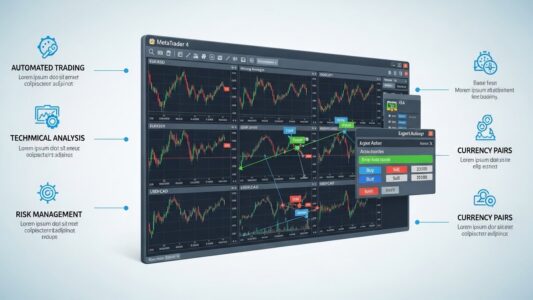
Retail traders access automation primarily through Expert Advisors on MetaTrader platforms, copy trading services that replicate other traders’ positions, signal services that send trade alerts, and custom-coded algorithms for those with programming knowledge.
Understanding where automation helps and where it creates problems separates successful automated traders from those who lose money systematically through poorly designed systems.
Types of Automated Forex Trading
Different automation approaches serve different purposes and require different skill levels to use effectively.
Expert Advisors (Trading Robots)
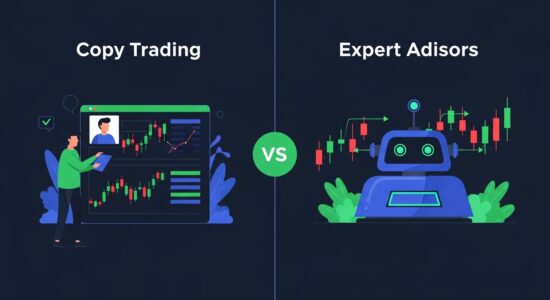
These are software programs that run on MT4 or MT5 platforms, analyzing price data and executing trades according to programmed logic. You can purchase commercial EAs, download free ones, or code your own if you have programming skills.
EAs range from simple moving average crossover systems to complex algorithms using multiple indicators, time filters, and sophisticated money management. The quality varies dramatically—some are legitimate trading tools while others are scams promising unrealistic returns.
For comprehensive EA information including installation, testing, and risk management, see our Expert Advisors guide
Copy Trading
Copy trading platforms connect you with experienced traders whose positions are automatically replicated in your account. When the trader you’re copying opens a position, your account opens the same position proportionally based on your account size.
Popular copy trading platforms include eToro, ZuluTrade, and broker-specific solutions. You select traders based on their performance history, risk profile, and trading style, then allocate a portion of your capital to copy their trades.
The advantage is accessing trading expertise without developing your own strategy. The disadvantage is dependence on someone else’s decisions and the risk they change their approach or start taking excessive risks.
Signal Services
Signal providers analyze markets and send trade alerts via email, SMS, app notifications, or platform integrations. Signals typically include entry price, stop loss, take profit, and reasoning behind the trade.
You receive the signal and decide whether to execute the trade manually or connect the signal service to your platform for automatic execution. This semi-automated approach gives you control while leveraging others’ analysis.
Quality varies enormously. Many signal services show profitable track records in marketing but perform poorly in real-time. Always verify track records through third-party monitoring services before trusting signals with real money.
Algorithmic Trading (Custom Coded)
This involves writing your own trading algorithms in languages like MQL4, MQL5, Python, or platform-specific languages. You’re creating custom automation tailored to your exact strategy rather than using off-the-shelf solutions.
Algorithmic trading requires programming knowledge and deep understanding of both markets and software development. The learning curve is steep, but you gain complete control over logic, risk management, and system behavior.
Automation addresses several challenges that plague manual traders, though it creates new challenges of its own.
Eliminates Emotional Decision-Making
Fear and greed destroy more trading accounts than bad strategies. Automation executes rules consistently without hesitation, revenge trading, or euphoria-driven position sizing. If your rules say enter when conditions X, Y, and Z align, the system enters regardless of how scary the setup looks.
This consistency is automation’s biggest advantage. A mediocre strategy executed perfectly often outperforms a great strategy executed inconsistently.
Enables 24/7 Trading
Forex markets trade around the clock through different global sessions. Manual traders can only monitor markets during waking hours, missing opportunities in other time zones. Automated systems monitor markets continuously, capitalizing on setups whenever they occur.
This is particularly valuable for strategies that trade specific sessions like the Tokyo open or for capturing moves during news releases that occur at inconvenient hours.
Handles Complex Strategies
Some strategies require monitoring multiple currency pairs, timeframes, or indicators simultaneously—mentally exhausting for manual traders. Automated systems handle complexity easily, analyzing dozens of inputs and managing multiple positions across different pairs without missing signals.
Provides Backtesting Capabilities
Before risking real money, you can test automated strategies on years of historical data to see how they would have performed. This backward-looking analysis helps identify obviously flawed approaches before they damage your account.
Automated systems execute orders at exact prices with millisecond precision. No hesitation, no fumbling with order entry, no missed opportunities because you were away from your computer. When conditions trigger, trades execute immediately.
Disadvantages and Risks of Automated Trading
Traders building automated systems should review regulatory guidelines from the CFTC, NFA, and the FCA, while also exploring the official MQL4 documentation for developing Expert Advisors.
Automation solves some problems while creating others that catch unprepared traders off guard.
Technology Dependency
Your trading depends entirely on technology functioning correctly. Internet outages, platform crashes, computer failures, or broker server problems can leave your automated system unable to manage positions or execute planned trades.
Using a Virtual Private Server (VPS) reduces but doesn’t eliminate these risks. For VPS setup and why automated traders need them, see our VPS guide..
Over-Optimization and Curve Fitting
The biggest killer of automated forex trading accounts is creating systems perfectly fitted to historical data that fail in live trading. It’s easy to adjust parameters until backtests show amazing results, but those optimized settings often represent random historical quirks rather than genuine market edge.
Systems that work beautifully in backtests frequently fail when markets change character or when slippage and spread costs in live trading exceed backtest assumptions.
Lack of Adaptability
Markets change. Volatility shifts, correlations break down, and strategies that worked for months suddenly stop working. Automated forex trading systems continue executing their programmed logic even when market conditions no longer suit the strategy.
Manual traders can sense when market character has changed and adjust their approach. Automated forex trading systems require human intervention to recognize changed conditions and modify or disable strategies accordingly.
False Sense of Security
Many traders set up automated forex trading systems and assume they can ignore them completely. This neglect leads to disaster when systems malfunction, market conditions shift, or unexpected events trigger behavior the trader never anticipated.
Automated trading requires less minute-by-minute attention than manual trading but demands regular monitoring to ensure systems operate as intended.
Scams and Misleading Marketing
The automated trading industry attracts scammers promising easy money through “proven” systems. Advertisements show fabricated backtests, cherry-picked results, or demo account performance that doesn’t translate to live trading.
Many traders lose substantial money buying worthless commercial EAs or subscribing to fraudulent signal services before learning to evaluate systems critically.
How to Start with Automated Trading Safely
Beginning automated forex trading with realistic expectations and proper preparation dramatically improves your chances of success.
Start with Education, Not Systems
Before running any automated system with real money, understand how forex markets work, basic technical analysis, risk management principles, and trading psychology. Automated forex trading systems won’t compensate for fundamental knowledge gaps.
Master MT4 or MT5 manually before adding automation. Understand how to place trades, set stop losses, manage positions, and navigate the platform. When problems occur with automated forex trading systems, you need manual trading competency to intervene.
Never run untested automation on live accounts. Even if a system has verified performance from others, test it on your demo account for at least one month to understand its behavior, confirm it works with your broker, and verify you can manage it effectively.
Demo testing reveals technical issues, unexpected behavior, and whether the system matches your risk tolerance before real money is at stake.
Start Small with Live Trading
After successful demo testing, begin live trading with the smallest position sizes your broker allows. Run the system for several weeks at micro lot sizes to confirm demo performance translates to live conditions.
Many systems behave differently in live trading due to slippage, spread widening during news, or execution delays that don’t appear in demo environments.
Maintain Proper Risk Management
Automated forex trading systems need the same risk management as manual trading. Risk only 1-2% of your account per trade, use appropriate position sizing, set maximum daily loss limits, and never allocate your entire account to one automated strategy.
Successful automated traders actively monitor their systems rather than setting and forgetting them.
Daily Performance Checks
Review your automated systems daily, even if just for five minutes. Check that trades executed as expected, positions are being managed correctly, and account equity is moving within normal ranges for your system.
Catching problems early—a malfunctioning EA, unexpected losing streak, or changed broker conditions—prevents small issues from becoming account-destroying disasters.
Weekly Performance Analysis
Once weekly, analyze your automated forex trading performance in detail. Compare results to backtest expectations, calculate key metrics like win rate and profit factor, and assess whether the system is performing within expected parameters.
Significant deviation from expected performance might indicate changed market conditions, technical problems, or that the system needs adjustment or retirement.
Keep Detailed Records
Maintain logs of system changes, parameter adjustments, issues encountered, and performance over time. These records help you identify patterns, understand what works, and make informed decisions about continuing or modifying strategies.
Stay Informed About Updates
Brokers change trading conditions, platforms release updates, and market regulations evolve. Stay informed about changes that might affect your automated systems and adjust accordingly.
Platform updates sometimes break EA functionality, requiring code updates or temporary manual trading until issues are resolved.
Common Automated Forex Trading Mistakes
Avoid these errors that trap most beginning automated traders.
Mistake 1: Unrealistic Performance Expectations
No automated system produces consistent 10% monthly returns with minimal drawdowns. If marketing claims sound too good to be true, they are. Realistic automated trading might produce 15-30% annual returns with 15-25% maximum drawdowns if you’re doing well.
Chasing systems promising extraordinary returns leads to scams, over-optimized strategies, or high-risk approaches that eventually blow up.
Mistake 2: Running Multiple Uncoordinated Systems
Traders often run several different EAs or copy multiple traders simultaneously without considering how they interact. Systems might trade the same pairs in opposite directions, creating hidden risks or simply paying double spreads for net-zero positions.
Coordinate your automated strategies to ensure they complement rather than conflict with each other.
Mistake 3: Ignoring Correlation Risk
Copying three traders who all trade EUR/USD long doesn’t provide diversification—it triples your EUR/USD exposure. Similarly, running EAs on highly correlated pairs creates concentrated risk even though it appears diversified.
Understand correlation between your automated forex trading positions and manage total exposure across your entire automated portfolio.
Mistake 4: Neglecting Ongoing Monitoring
Automated trading reduces screen time but doesn’t eliminate the need for oversight. Systems malfunction, market conditions change, and unexpected events occur. Regular monitoring catches problems before they become catastrophic.
Mistake 5: Trusting Backtests Blindly
Backtests provide useful information but don’t guarantee future performance. They’re based on historical data that won’t repeat exactly, often use optimistic assumptions about execution, and can’t account for future market regime changes.
Always forward test on demo accounts and small live accounts before trusting backtest results with significant capital.
Choosing Between Automation Types
Different automation approaches suit different trader profiles and goals.
Choose Expert Advisors if:
You want complete control over strategy logic
You’re comfortable with technology and platform setup
You can evaluate strategies critically or code your own
You prefer trading specific strategies consistently
Choose Copy Trading if:
You lack time or interest in developing strategies
You want to learn by observing successful traders
You’re comfortable delegating trading decisions to others
You can tolerate someone else’s risk management approach
Choose Signal Services if:
You want trade ideas while maintaining execution control
You’re learning technical analysis and want guidance
You prefer semi-automated rather than fully automated trading
You want flexibility to skip signals that don’t fit your risk tolerance
Choose Custom Algorithmic Trading if:
You have programming skills or willingness to learn
You want unique strategies not available commercially
You need complete transparency into system logic
You’re willing to invest significant time in development and testing
Final Thoughts on Automated Forex Trading
Automated trading offers genuine advantages for traders who approach it realistically and implement it carefully. It eliminates emotional interference, enables consistent execution, and allows trading strategies that would be impractical manually.
However, automation isn’t easier than manual trading—it’s different. You trade screen time and emotional challenges for technical challenges, system monitoring requirements, and the need to evaluate strategies critically.
The key to automated trading success is treating it as a business requiring ongoing attention rather than passive income requiring no effort. Successful automated traders test thoroughly, monitor continuously, manage risk conservatively, and maintain realistic expectations about performance.
Start small, learn the technology, understand the strategies you’re automating, and scale up gradually as you prove systems work in your hands with your broker under real market conditions.
Automation is a powerful tool that amplifies both good and bad trading approaches. A sound strategy executed through automation can produce consistent results with less stress than manual trading. A flawed strategy automated simply loses money faster and more consistently than manual trading would.
Build your foundation properly, approach automation with skepticism toward marketing claims, and invest time in education and testing before risking significant capital. Automated trading can serve as a valuable component of your trading approach when used intelligently and maintained diligently.
For traders ready to explore specific automation methods, our platform tutorials provide the technical foundation: MT4 guide and MT5 guide..
Complete Automated Trading Resource Library
Ready to dive deeper into automated forex trading? Explore our comprehensive guides:
Automated forex trading involves substantial risk of loss and is not suitable for all investors. Expert Advisors and trading robots do not guarantee profits and past performance is not indicative of future results. Many automated systems fail in live market conditions despite positive backtesting results. Before using any automated trading system, carefully consider your financial situation, risk tolerance, and experience level. US-based traders should review guidelines from the CFTC and NFA. International traders can refer to the FCA for applicable regulations. This article is for educational purposes only and should not be considered investment advice.