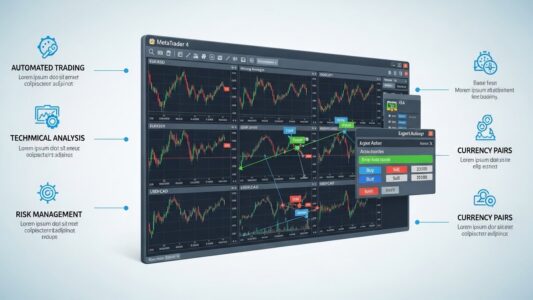
Expert Advisors, commonly called EAs, are automated trading programs that run on MetaTrader platforms. They analyze markets, generate trading signals, and execute trades automatically without human intervention. For traders seeking to automate their strategies or trade while away from their computers, EAs offer compelling possibilities.
However, Expert Advisors are also surrounded by hype, scams, and unrealistic promises. Understanding how they actually work, their legitimate uses, and their significant limitations will help you use them intelligently rather than falling victim to the “set and forget” fantasy that many vendors promote.
This guide explains what Expert Advisors are, how to install and use them, the different types available, and the critical risks you need to understand before trusting your money to automated trading.
This guide is part of our comprehensive Automated Forex Trading & Expert Advisors series, which covers everything from programming to testing and optimizing your own EAs.
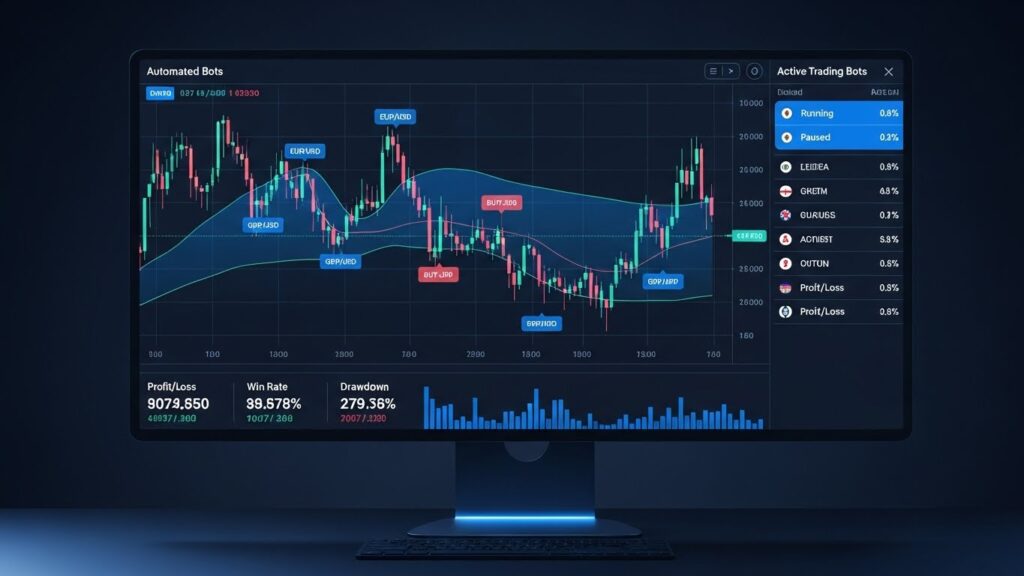
What Are Expert Advisors?
An Expert Advisor is a software program written in MQL4 (for MT4) or MQL5 (for MT5) that connects to your trading platform and executes predefined trading logic. Think of an EA as a robot trader that follows specific rules you or a programmer have coded.
EAs can perform various functions. Simple EAs might just send alerts when certain conditions occur. More complex ones analyze multiple indicators, calculate position sizes, place trades with stop losses and take profits, and manage open positions by trailing stops or closing at specific profit targets.
The key advantage of EAs is consistency. They follow their programmed rules exactly, without the emotional interference that plagues human traders. Fear, greed, hesitation, and impulsive decisions don’t affect an EA. If the code says enter a trade when RSI crosses above 30, the EA enters the trade every single time those conditions are met.
The key disadvantage is that EAs lack adaptability. Markets change character, and strategies that worked in trending conditions may fail in ranging markets. An EA continues executing its programmed logic regardless of changing market dynamics unless someone manually turns it off or adjusts parameters.
How Expert Advisors Work
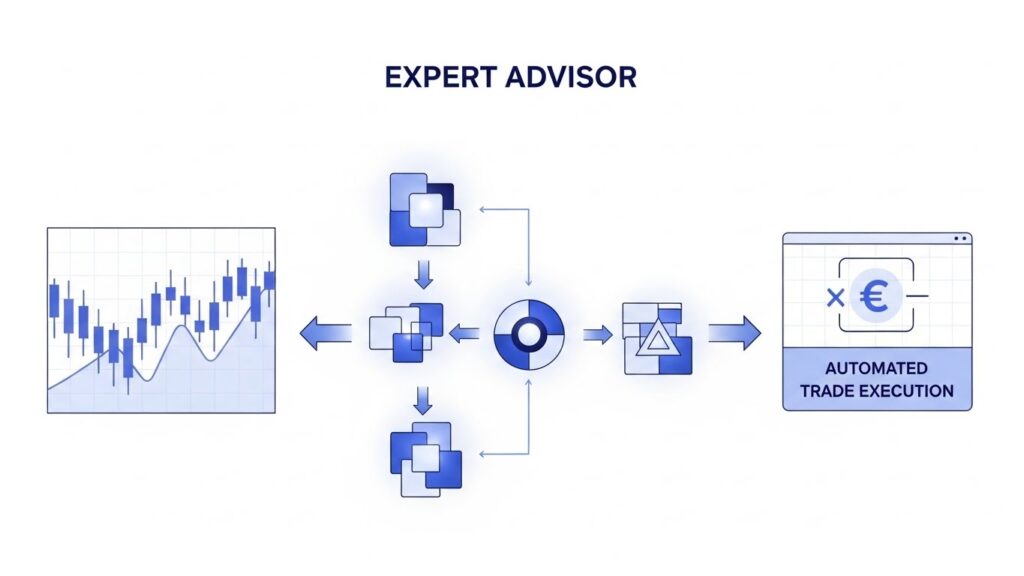
An EA runs continuously while your MetaTrader platform is open. Every time a new price tick arrives, the EA’s code executes, checking whether its entry or exit conditions are met.
Let’s say you have a simple moving average crossover EA. The code might specify: “When the 20-period moving average crosses above the 50-period moving average, buy. When it crosses below, sell or close the buy position.”
Each time price updates, the EA recalculates the moving averages and checks for a crossover. When the conditions trigger, the EA sends a buy or sell order to your broker through the MT4 or MT5 platform. The trade executes just as if you had clicked the buy or sell button manually.
More sophisticated Expert Advisors incorporate money management rules. They might calculate position size based on account balance and risk percentage, ensuring you risk the same dollar amount per trade regardless of stop loss distance. For position sizing principles, see our position sizing guide
Some Expert Advisors manage multiple currency pairs simultaneously, diversifying across different markets to reduce overall portfolio risk. Others focus on a single pair but use complex entry logic combining multiple indicators, time filters, and volatility checks.
The critical point is that an EA can only do what it’s programmed to do. It’s not artificially intelligent in the true sense. It follows IF/THEN logic: IF these conditions are true, THEN execute this action. The quality of an EA depends entirely on the quality of the strategy coded into it and how well that strategy matches current market conditions.
Types of Expert Advisors
Expert Advisors come in various types, each designed for different trading approaches.
Trend Following EAs identify and trade in the direction of established trends. They typically use moving averages, MACD, or ADX to confirm trend direction, then enter trades with the trend. These EAs perform well during sustained trending periods but struggle in choppy, ranging markets. For trend-following strategies, see our moving averages guide
Scalping EAs execute many small trades, aiming for quick 5-20 pip profits. They enter and exit rapidly, often holding positions for just minutes. Scalping EAs require low-spread accounts and fast execution. They’re vulnerable to broker spread widening during news events and can generate substantial trading costs through commissions.
Grid Trading EAs place multiple orders at set intervals above and below the current price, creating a grid. As price moves, the EA adds positions in the same direction or opposite direction depending on the grid logic. Grid EAs can be profitable in ranging markets but carry catastrophic risk during strong trends, potentially blowing up accounts if not properly limited.
Martingale EAs double position size after each losing trade, attempting to recover all losses plus profit with one winning trade. This approach is mathematically doomed in trading due to limited capital and the possibility of extended losing streaks. Avoid Martingale EAs—they appear to work in backtests but destroy accounts in live trading.
News Trading EAs attempt to capitalize on volatility spikes around economic data releases. They place pending orders above and below price before a news event, hoping to catch the breakout. These EAs face significant slippage risk and broker restrictions, as many brokers widen spreads dramatically during news releases.
Arbitrage EAs exploit price differences between brokers or between related instruments. True arbitrage opportunities are rare and short-lived in modern forex markets. Most “arbitrage” EAs are actually latency arbitrage, which exploits price feed delays and often violates broker terms of service.
How to Install an Expert Advisor
Installing an EA on MT4 or MT5 is straightforward once you understand the process.
Step 1: Locate Your Data Folder
In MetaTrader, click File → Open Data Folder. This opens your MT4 or MT5 installation directory.
Step 2: Navigate to the MQL Folder
Inside the data folder, find the MQL4 folder (for MT4) or MQL5 folder (for MT5). Open it.
Step 3: Place the EA File
Inside the MQL folder, find the Experts folder. Copy your EA file (with .ex4 or .ex5 extension) into this Experts folder. If you have the source code (.mq4 or .mq5 file), you can place it here as well, though the compiled .ex4/.ex5 file is what actually runs.
Step 4: Restart MetaTrader
Close MetaTrader completely and restart it. This is crucial—new EAs don’t appear until you restart the platform.
Step 5: Enable Automated Trading
In MetaTrader, find the “AutoTrading” button on the toolbar (it looks like a play button or has an “Auto” label). Click it to enable automated trading. The button should highlight or turn green when active.
Step 6: Attach the EA to a Chart
Open the Navigator window (View → Navigator or Ctrl+N). Expand the Expert Advisors section. You should see your newly installed EA in the list. Drag it onto a chart of the currency pair you want to trade. A settings window appears where you can adjust parameters like lot size, stop loss, take profit, and strategy-specific variables.
Step 7: Verify It’s Running
After clicking OK, a small smiley face icon appears in the top right corner of your chart. If the face is smiling, the EA is running. If it’s frowning or X’d out, check that AutoTrading is enabled and that you’ve allowed DLL imports and trading permissions in the EA settings.
For detailed platform instructions, see our MT4 tutorial and MT5 tutorial
Testing an Expert Advisor Before Live Trading
Testing Expert Advisors thoroughly in the MT4 Strategy Tester before going live is one of the most important steps any trader can take.
Never run an EA on a live account without testing it first. The testing process has three stages.
Stage 1: Strategy Tester (Backtesting)
MetaTrader includes a Strategy Tester that runs EAs on historical data. Access it by clicking View → Strategy Tester or pressing Ctrl+R.
Select your EA from the dropdown, choose the currency pair and timeframe, select a date range (at least several months), and click Start. The tester runs through historical data, executing trades according to the EA’s logic.
Review the results carefully. Don’t just look at total profit. Check maximum drawdown (the largest peak-to-valley decline), win rate, profit factor (gross profit divided by gross loss), and the distribution of wins and losses.
Be skeptical of perfect backtest results. Real trading includes spread costs, slippage, and execution delays that backtests often ignore. If an EA shows 95% win rate and minimal drawdown in backtesting, it’s likely overoptimized for historical data and will fail in live conditions.
Stage 2: Demo Account Testing
After satisfactory backtest results, run the EA on a demo account for at least one month. Demo trading includes real-time price feeds and order execution, revealing issues that backtests miss.
Monitor the EA daily. Check that it’s entering trades as expected, that stop losses and take profits are being set correctly, and that position sizing is appropriate. Watch for unexpected behavior during news events or at market open/close.
Demo testing also reveals whether your broker’s execution quality supports the EA’s strategy. Scalping EAs, for example, need tight spreads and fast fills. If your broker’s demo account shows wide spreads or significant slippage, the EA won’t perform well on a live account.
Stage 3: Small Live Account Testing
If demo results are positive, test on a small live account with minimal capital. Live trading sometimes behaves differently than demo due to order execution priorities and liquidity.
Start with the smallest position sizes possible. Run the EA for several weeks, monitoring performance and comparing it to demo results. Only after successful small-live testing should you consider scaling up to meaningful position sizes.
The Risks and Realities of Expert Advisors
Understanding the real risks of Expert Advisors is essential before committing real capital to any automated trading system.
The Expert Advisor industry is filled with scams, false promises, and traders who’ve lost substantial money to automated systems. Understanding these risks is essential.
Overfitting and Curve Fitting
Many commercial EAs are optimized on historical data to produce impressive backtest results. The programmer adjusts parameters until the backtest shows amazing returns with minimal drawdown. This is curve fitting—tailoring the EA to past data rather than creating a genuinely robust strategy.
Curve-fit EAs fall apart in live trading because markets never repeat exactly. The specific conditions that produced those backtest profits don’t recur, and the EA generates losses instead.
Black Box Systems
Most commercial EAs don’t reveal their trading logic. You’re trusting your money to code you can’t see or verify. The EA might use Martingale position sizing, excessive leverage, or other dangerous techniques hidden behind impressive marketing claims.
Market Condition Dependency
Every trading strategy performs differently in trending versus ranging markets, high versus low volatility, and during different market sessions. An EA that profits in trending EUR/USD conditions may lose consistently when the pair enters a prolonged range.
EAs don’t adapt automatically to changing conditions. Someone must monitor performance and turn the EA off when market conditions shift away from what the strategy requires.
Technical Failures
EAs depend on your computer and internet connection running continuously. A power outage, internet disconnection, or computer crash can leave the EA unable to manage open positions or execute planned trades. Many traders use Virtual Private Servers (VPS) to keep EAs running 24/7, but this adds monthly costs.
Platform updates sometimes break EA functionality. An EA working perfectly on one MT4 build may malfunction after an update, requiring code fixes that you might not be able to implement.
Broker Restrictions
Some brokers prohibit certain EA types, particularly scalping EAs, arbitrage EAs, or high-frequency strategies. Using prohibited EA types can result in trade rejections, account restrictions, or even account closure.
Always check your broker’s terms of service regarding automated trading before running an EA with real money.
How to Choose a Legitimate Expert Advisor
Traders evaluating Expert Advisors should verify their broker is regulated by the CFTC and NFA in the US, or the FCA internationally, and consult the official MQL4 documentation for technical EA specifications.
If you decide to use an EA, whether purchased or custom-built, apply these criteria to separate legitimate tools from scams.
Verified Live Results
Demand verified live trading results from a third-party monitoring service like Myfxbook or FX Blue. Anyone can show backtest results or demo results. Only live results with real money prove the EA actually works.
Check that the results span at least six months, ideally a year or more. Short-term results might reflect a lucky streak rather than consistent performance.
Reasonable Performance Claims
Be immediately skeptical of EAs promising 100% monthly returns, zero losing months, or “guaranteed profits.” No legitimate trading strategy produces such results consistently.
Realistic EAs might target 10-30% annual returns with 15-25% maximum drawdown. These numbers aren’t exciting, but they’re achievable and sustainable.
Transparent Strategy Description
The seller should explain, at least in general terms, what strategy the EA uses. You don’t need the exact code, but you should understand whether it’s trend following, mean reversion, breakout trading, or something else.
If the seller refuses to explain the strategy, claiming it’s a “secret system,” walk away. Legitimate strategies have logical explanations.
Realistic Backtesting
Review backtest results for warning signs. Extremely high win rates (above 85%) usually indicate Martingale or grid strategies that will eventually blow up. Smooth equity curves with no meaningful drawdowns suggest curve fitting.
Check the backtest settings. Was spread accounted for? Were slippage and commission included? If the backtest used “every tick” modeling rather than “control points,” it’s more reliable.
Money-Back Guarantees and Support
Reputable EA vendors offer 30-60 day money-back guarantees and provide actual customer support. They answer questions, help with installation, and stand behind their product.
Vendors who ghost after purchase or refuse refunds even when the EA demonstrably doesn’t work as advertised should be avoided.
Expert Advisors and Risk Management
Even the best Expert Advisors require strict risk management settings to protect your account during unexpected market conditions.
Even legitimate EAs require proper risk management. Never let an EA trade without safeguards.
Position Sizing Limits
Configure the EA to risk a maximum of 1-2% of your account per trade. Many EAs have risk percentage settings; use them conservatively.
If the EA doesn’t include position sizing controls, manually set maximum lot sizes to limit risk exposure.
Maximum Daily Loss Limits
Some EAs allow you to set maximum daily or weekly loss limits. If losses hit the limit, the EA stops trading until the next period. This prevents runaway losses during adverse conditions.
If your EA lacks this feature, monitor daily and manually disable it after substantial losses.
Account Balance Limits
Never allocate your entire trading capital to one EA. Even with verified results, unexpected market conditions can cause significant drawdowns. Limit EA exposure to a portion of your total capital, diversifying across different strategies or manual trading.
Regular Monitoring
Check EA performance at least daily, even if it’s fully automated. Watch for unusual behavior, unexpected losses, or failure to execute trades. Catching problems early prevents small issues from becoming account-destroying disasters.
For comprehensive risk management principles, see our risk management guide
The Truth About “Holy Grail” EAs

The forex EA market is saturated with vendors promising automated wealth through “holy grail” systems. These claims are fantasy, not reality.
No EA eliminates trading risk. Markets are inherently uncertain, and all trading strategies experience losing periods. An EA might reduce emotional decision-making, but it doesn’t guarantee profits.
Most traders who succeed with EAs either code their own based on tested strategies or invest significant time learning to evaluate and optimize purchased EAs. Simply buying an EA and running it without understanding its logic rarely produces long-term success.
The best use of EAs is automating a strategy you’ve already traded manually with success. If you have a rules-based approach that works when you execute it manually, an EA can help you execute it consistently without emotional interference. But the EA doesn’t create a profitable strategy from nothing—it only automates what you give it.
Final Thoughts on Expert Advisors
Expert Advisors can be powerful tools when chosen carefully, tested properly, and used with realistic expectations and solid risk management.
Expert Advisors are powerful tools when used appropriately. They can automate execution, remove emotional decision-making, and allow you to trade more consistently than manual trading. For traders with sound strategies and realistic expectations, EAs offer genuine value.
However, EAs are not magic. The overwhelming majority of commercial EAs lose money in live trading despite impressive backtests or demo results. The “set it and forget it” promise is a lie that costs naive traders substantial losses.
If you’re serious about using EAs, invest time in learning MQL4 or MQL5 programming to create your own. Alternatively, hire a competent programmer to code a custom Expert Advisor based on a strategy you’ve developed and tested manually. These approaches give you control over the logic and confidence in what the Expert Advisors are actually doing.
Avoid commercial Expert Advisors promising unrealistic returns. Avoid anything using Martingale or grid strategies unless you fully understand and accept their catastrophic failure risks. Never trust an EA with significant capital until you’ve tested it thoroughly in backtests, demo accounts, and small live accounts over several months.
Used intelligently with realistic expectations, EAs can be valuable additions to your trading. But they’re tools, not solutions, and they require the same discipline, risk management, and realistic expectations as any other trading approach.
For traders building systematic trading approaches, understanding backtesting is essential. Learn how to properly test strategies before automation in our backtesting guide