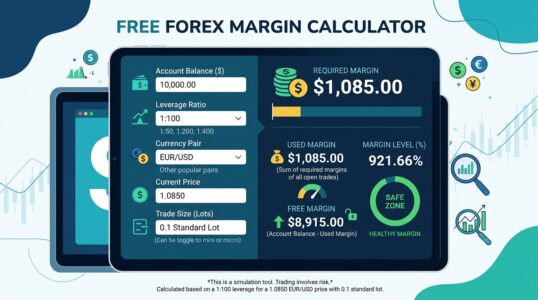
Use this free margin calculator to find out exactly how much margin your broker requires before you open any forex position. Enter your account currency, currency pair, lot size, leverage, and current market price — the calculator returns your required margin instantly.
How to Use This Margin Calculator
Step 1 — Select your account currency. Choose USD, EUR, GBP, or AED depending on the currency your trading account is denominated in. This ensures the required margin is displayed in the right currency.
Step 2 — Select your currency pair. Choose the pair you intend to trade. The calculator covers all major pairs plus Gold (XAU/USD).
Step 3 — Select your lot size. Choose from a standard lot (100,000 units), half lot (50,000), mini lot (10,000), or micro lot (1,000). If you are a beginner, start with micro or mini lots.
Step 4 — Select your leverage. Use the leverage your broker offers on your account. Common retail leverage levels are 1:50, 1:100, and 1:200. Higher leverage means lower required margin but higher risk.
Step 5 — Enter the current market price. Use the current bid or ask price for your chosen pair. For EUR/USD this would be something like 1.0850. For USD/JPY it would be around 155.00.
Step 6 — Click Calculate. The calculator returns your required margin, the notional value of the position, the leverage used, and the margin level at open.
What Is Margin in Forex Trading?
Margin is the amount of money your broker sets aside from your account balance as collateral when you open a leveraged position. It is not a fee or a cost — it is a deposit that is returned to your account when the position is closed.
Think of it this way: if you want to control a $100,000 position (one standard lot of EUR/USD) with 1:100 leverage, your broker only requires you to have $1,000 in your account as margin. The broker effectively lends you the remaining $99,000 for the duration of the trade.
This is what makes forex accessible with relatively small amounts of capital — but it is also what makes risk management so critical. A small adverse move on a large leveraged position can wipe out your margin quickly. See our guide on margin trading in forex for a full explanation of how margin calls work and how to avoid them.
The Margin Formula
The calculator uses this formula:
Required Margin = (Lot Size × Market Price) ÷ Leverage
Example: You want to trade 1 standard lot of EUR/USD at 1.0850 with 1:100 leverage.
Required Margin = (100,000 × 1.0850) ÷ 100 = $108,500 ÷ 100 = $1,085
That means your broker will hold $1,085 from your account as margin for this one trade. If your account balance is $5,000, this trade uses 21.7% of your available margin.
Margin vs. Free Margin vs. Margin Level
These three terms appear in every trading platform and are essential to understand:
Margin (Used Margin) — the amount currently held by your broker as collateral for your open positions. This money is locked and cannot be used to open new trades.
Free Margin — your account equity minus your used margin. This is the amount available to open new positions or absorb floating losses. If your free margin drops to zero, you cannot open new trades.
Margin Level — expressed as a percentage: (Equity ÷ Used Margin) × 100. Most brokers issue a margin call when your margin level falls below 100% and will automatically close your positions (stop out) at around 50%. Always monitor your margin level when you have multiple positions open.
How Leverage Affects Required Margin
Higher leverage means lower required margin — but it also means your account is more exposed to adverse price movements. Here is how leverage affects the margin required for one standard lot of EUR/USD at 1.0850:
| Leverage | Required Margin (1 Standard Lot EUR/USD at 1.0850) |
|---|---|
| 1:500 | $217 |
| 1:200 | $543 |
| 1:100 | $1,085 |
| 1:50 | $2,170 |
| 1:30 | $3,617 |
| 1:10 | $10,850 |
Understanding leverage and its relationship to margin is one of the most important concepts in forex trading. Our leverage in forex guide covers this in full detail.
Margin Management Tips
Never use more than 20–30% of your available margin. Using too much margin leaves no buffer for adverse moves and increases the risk of a margin call.
Calculate margin before every trade. Use this calculator before opening any position so you always know how much of your account is at risk.
Use stop losses on every position. A stop loss limits your loss on a trade and protects your remaining margin. Never trade without one. See our Stop Loss and Take Profit guide for proper placement techniques.
Size your positions correctly. Use our Position Size Calculator alongside this margin calculator to make sure each trade fits within your risk management plan.
Monitor your margin level continuously. When you have multiple open positions, your margin level can change quickly. Keep it above 200% to give yourself sufficient buffer against market volatility.
Our Free Forex Calculators
- Margin Calculator (this page) — calculate required margin for any position
- Position Size Calculator — find the correct lot size based on your account risk
- Pip Value Calculator — find the dollar value of one pip for any pair
- Risk/Reward Calculator — evaluate whether a trade setup is worth taking
- Profit/Loss Calculator — project potential profit or loss before placing a trade
Related Educational Guides
Risk Warning: Forex trading involves substantial risk of loss and is not suitable for all investors. Margin trading amplifies both gains and losses. Never risk more than you can afford to lose. Always trade with brokers regulated by the CFTC, NFA, or FCA.