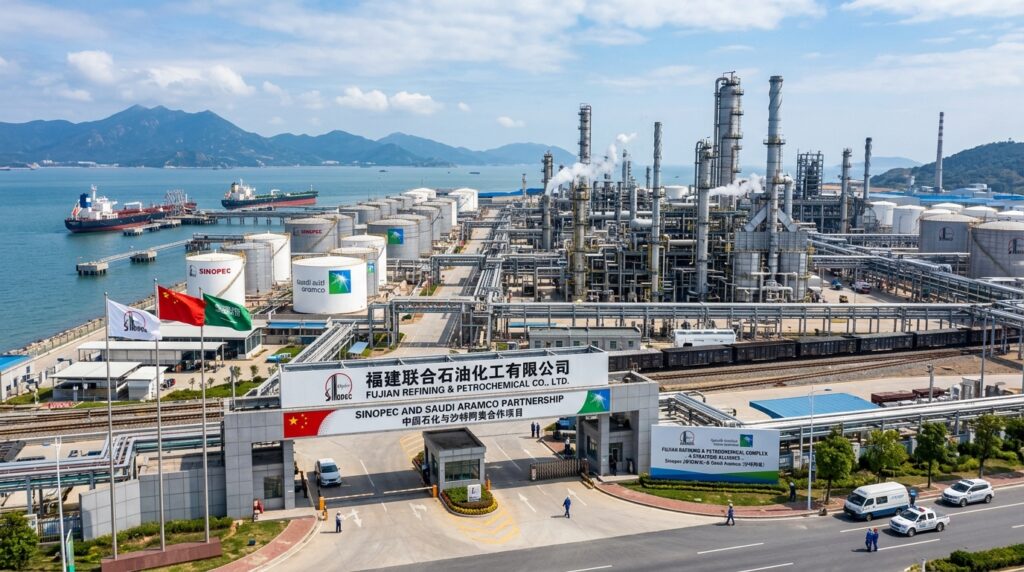
The Saudi Arabia China oil partnership reached a new milestone in November 2024 when Saudi Aramco and Sinopec broke ground on a $9.82 billion petrochemical complex in Fujian province. The facility — located in the Gulei industrial park — will process 320,000 barrels of crude oil per day when it reaches full capacity. Alongside the refinery, the complex includes a 1.5 million ton per year ethylene plant and a 2 million ton per year paraxylene facility. Expected to be operational by 2030, it will produce 5 million tons of petrochemical feedstock annually.
The ownership split tells part of the story: Fujian Petrochemical holds 50%, with Saudi Aramco and Sinopec each holding 25%. This is not a buyer-seller relationship. Saudi Arabia is embedding itself directly into Chinese refining infrastructure — a meaningful distinction from simply selling crude oil and collecting payment.
This project is the largest downstream investment Saudi Aramco has made in China. It is unlikely to be the last.
What the Petrodollar System Is
In 1973, the United States and Saudi Arabia struck a deal that shaped the global financial system for the next fifty years. Saudi Arabia agreed to price its oil exclusively in U.S. dollars. In exchange, the U.S. provided military protection and weapons. By 1975, every OPEC member had followed suit.
The practical consequence was enormous. Any country that wanted to buy oil — and every country needed oil — first had to acquire U.S. dollars. This created a permanent baseline demand for the dollar that had nothing to do with the U.S. economy’s performance. It allowed the U.S. to run persistent trade deficits without the dollar collapsing, because the world always needed dollars to buy energy.
The system also created a feedback loop for U.S. debt. Countries accumulated dollar surpluses from their export earnings, then parked those surpluses in U.S. Treasury bonds. That demand kept U.S. borrowing costs lower than they otherwise would have been. The arrangement functioned as an invisible subsidy for American consumers and the U.S. government simultaneously.
How the Trade Relationship Has Shifted
The Saudi Arabia China oil partnership has been building for over a decade. China surpassed the United States as Saudi Arabia’s largest oil customer some years ago and has extended that lead considerably since. In early 2024, China was importing approximately 1.76 million barrels of Saudi crude per day — roughly double what the U.S. was taking. When your biggest customer buys twice as much as your second biggest, the question of which currency to settle in becomes a live conversation rather than a theoretical one.
Saudi Arabia joined the Shanghai Cooperation Organisation as a dialogue partner in 2023. In the same year, reports emerged that Saudi officials had held discussions with Chinese counterparts about accepting yuan for some oil transactions. Riyadh has not made any formal announcement committing to yuan settlement, and Saudi Arabia’s economic and military ties with the United States remain strong. But the direction of travel is being watched closely.
The Fujian refinery adds a different dimension. Saudi Aramco is not just selling oil to China — it is now a direct stakeholder in Chinese refining capacity. That changes the commercial calculus. An equity partner in a Chinese refinery has more reasons to accommodate Chinese preferences on payment and pricing than a straightforward crude oil exporter does.
What It Means for the U.S. Dollar
A full collapse of the petrodollar system is not imminent and probably not inevitable in any near-term timeframe. Saudi Arabia’s foreign reserves are heavily dollar-denominated, its sovereign wealth fund invests substantially in U.S. assets, and its currency remains pegged to the dollar. Unwinding those dependencies would be costly and complicated.
What is changing is the margin. Saudi Arabia is diversifying its partnerships in ways that reduce its exclusive reliance on the U.S. relationship. The 1973 arrangement was built on a specific power dynamic — the U.S. was the world’s dominant economy, its largest oil customer, and Saudi Arabia’s primary security guarantor. None of those conditions holds as cleanly today as they did fifty years ago.
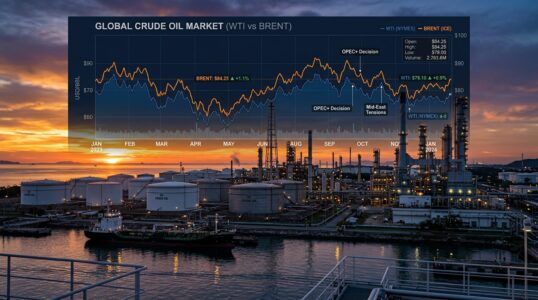
When the dollar weakens on petrodollar concerns, USD/CAD and other oil-linked pairs tend to show amplified moves. Canada exports roughly 3.9 million barrels of crude per day, making the Canadian dollar one of the most sensitive developed-market currencies to shifts in the global oil pricing structure. A softening dollar combined with sustained high oil prices — the scenario that petrodollar erosion would likely produce — tends to be favorable for CAD relative to USD.
The USD/JPY relationship also bears watching in this context. Japan imports virtually all of its oil and prices it in dollars. Any shift in how oil is denominated would affect Japan’s external payment flows and potentially the yen’s behaviour in risk-off environments.
How the Petrodollar Connects to Forex Markets Directly
The mechanism is straightforward. When oil is priced in dollars, every oil-importing country must hold dollar reserves to pay for energy. That demand supports the dollar’s value regardless of U.S. economic conditions. If a portion of global oil trade moves to yuan or other currencies, dollar demand decreases at the margin, and the dollar faces more downward pressure than it would otherwise.
Gold is one of the clearest proxies for petrodollar stress. When confidence in dollar dominance weakens, gold tends to benefit. In 2024, gold hit successive all-time highs partly driven by central bank buying — much of it from emerging-market central banks reducing dollar exposure. Our gold trading guide covers how to trade this relationship.
The Chinese yuan is not yet freely convertible and does not currently function as a reserve currency in the way the dollar does. That limits how quickly any transition away from dollar oil pricing could occur. But the direction of Chinese policy — gradual internationalisation of the yuan, bilateral currency swap agreements, the Belt and Road infrastructure network — points toward a longer-term effort to reduce dollar dependency in emerging-market trade.
What Forex Traders Should Watch
The Fujian refinery will not be operational until 2030. The petrodollar is not collapsing this year or next. But the structural shift in Saudi Arabia’s economic relationships is worth monitoring because it provides context for medium-term dollar positioning.
Three things to watch specifically. First, any formal announcement from Saudi Arabia about accepting yuan for oil — this would be a significant market event that would move USD pairs sharply. Second, the pace of central bank gold buying globally, which functions as a leading indicator of reserve diversification away from the dollar. Third, the trajectory of Chinese crude oil imports from Saudi Arabia — sustained increases reinforce the commercial logic for yuan settlement discussions.
The CFTC, NFA, and FCA all require brokers to provide risk disclosures on geopolitical trading — and for good reason. Positions tied to oil market shifts can move fast and hard when headlines break unexpectedly.
Risk Disclaimer: Trading forex and commodities involves significant risk of loss and is not suitable for all investors. The analysis above is for informational purposes only and does not constitute investment advice.