Crude oil trading means speculating on the price of oil without owning physical barrels. Nobody trading oil through a retail broker is arranging delivery of actual crude. Instead, traders take positions on oil futures contracts or CFDs — financial instruments that track the price of oil and settle in cash.
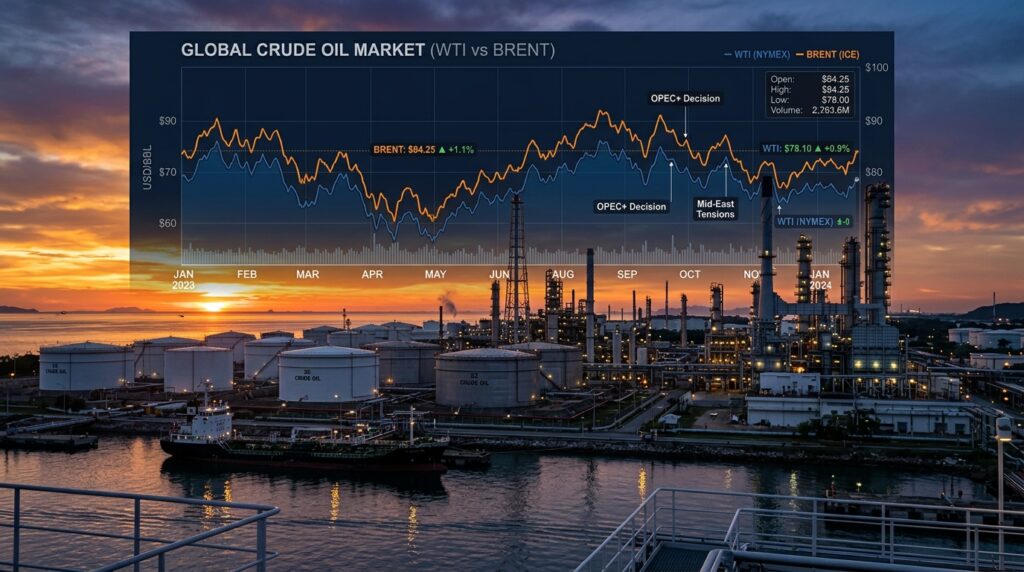
The two benchmarks you’ll encounter are West Texas Intermediate (WTI) and Brent Crude. WTI is produced in the United States and trades on the New York Mercantile Exchange (NYMEX). Brent comes from the North Sea and trades on the Intercontinental Exchange (ICE). Most of the world’s oil is priced against Brent — roughly two-thirds of global supply — which makes it the more internationally relevant benchmark. WTI tends to trade at a slight discount to Brent, though the spread between them shifts based on U.S. inventory levels and production.
When you see “oil” quoted on a trading platform, check which benchmark you’re looking at. The price difference between WTI and Brent is usually between $2 and $5 per barrel under normal conditions. In April 2020, that spread blew out dramatically when WTI briefly turned negative — a function of storage constraints at the Cushing, Oklahoma delivery point — while Brent stayed positive. Traders who didn’t understand the mechanics of that difference got badly caught out.
What Moves Crude Oil Prices
OPEC production decisions are the single most powerful lever on oil prices. When OPEC — and since 2016, the expanded OPEC+ group that includes Russia — cuts production, supply falls and prices tend to rise. When they increase output or fail to agree on cuts, prices drop. The November 2014 decision by Saudi Arabia to maintain production rather than cut, in an attempt to squeeze out U.S. shale producers, sent WTI from around $80 to below $30 within eight months. Every OPEC+ meeting is a market event worth paying attention to.
The growing partnership between Saudi Arabia and China adds another layer to this dynamic — for a deeper look at how that relationship is reshaping global energy trade, see our analysis of the Saudi Arabia China oil partnership and what it means for currency markets
U.S. inventory data moves oil weekly. The U.S. Energy Information Administration publishes crude oil inventory figures every Wednesday at 10:30 AM Eastern. A bigger-than-expected build in inventories signals weaker demand or oversupply and typically pushes prices lower. A larger-than-expected draw signals the opposite. Traders position around this number every week — it’s the oil market’s equivalent of the weekly jobs report.
Geopolitical risk affects oil more directly than almost any other asset. The Strait of Hormuz handles about 20% of global oil trade. Any tension in the Persian Gulf — sanctions on Iran, Houthi attacks on Saudi infrastructure, conflict in Iraq — shows up in oil prices within hours. In September 2019, drone attacks on the Abqaiq processing facility in Saudi Arabia knocked out roughly 5% of global supply overnight and sent Brent up nearly 15% in a single session before markets opened.
The U.S. dollar has an inverse relationship with oil. Since oil is priced in dollars globally, a stronger dollar makes oil more expensive for non-dollar buyers, which reduces demand and weighs on prices. A weaker dollar has the opposite effect. This is why oil and the USD/CAD pair tend to move together — Canada is a major oil exporter, so a rising oil price typically strengthens the Canadian dollar and pushes USD/CAD lower.
Seasonal demand adds a predictable layer to oil price movements. Gasoline demand peaks in summer in the Northern Hemisphere as driving increases. Heating oil demand peaks in winter. Refineries undergo maintenance in spring and autumn, temporarily reducing crude demand. These patterns don’t override supply shocks or macro moves, but they provide useful context when positioning for longer-term trades.
The Instruments Available for Trading Oil
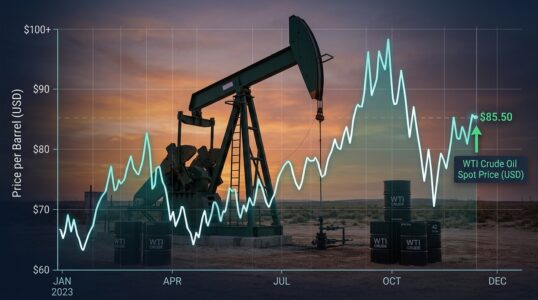
Oil futures are the original instrument. A standard WTI futures contract on NYMEX covers 1,000 barrels of crude. At $80 per barrel, one contract has a notional value of $80,000. Futures have expiry dates — most retail traders close positions before expiry to avoid physical delivery obligations. The rollover from one contract month to the next can create price gaps that catch traders off guard.
Oil CFDs are what most retail traders actually use. A CFD (contract for difference) tracks the price of an underlying futures contract without the expiry complexity or delivery mechanics. The position closes in cash — you pay or receive the difference between your entry and exit price. CFDs are available through forex brokers, often alongside currency pairs, with the same leverage and margin mechanics. The CFTC and NFA regulate oil CFD trading in the United States. UK and European traders operate under brokers supervised by the FCA.
Oil ETFs and oil company stocks are alternatives for traders who want exposure to oil price movements without using leverage. The United States Oil Fund (USO) tracks WTI futures, though the rolling mechanism means it doesn’t perfectly mirror spot price performance over time. Energy company stocks like ExxonMobil, Shell, and Chevron move with oil prices but also respond to company-specific factors — earnings, dividends, capital allocation decisions.
How to Read an Oil Chart
Oil price charts use the same technical analysis tools as forex. Support and resistance levels at psychologically significant prices — $50, $60, $80, $100 per barrel — carry real weight because a large number of market participants make decisions around round numbers.
Moving averages work well for identifying trend direction. When WTI is trading above its 200-day moving average, the long-term trend is up. Below it, the trend is down. The 50-day moving average acts as a medium-term reference point and frequently provides support or resistance during pullbacks within trends.
RSI and MACD apply the same way as in forex — RSI above 70 suggests overbought conditions, below 30 suggests oversold. MACD crossovers signal momentum shifts. In a commodity as prone to sharp moves as oil, these indicators are more useful as confirmation tools than as primary signals — the fundamental picture usually needs to align with the technical setup for a trade to make sense.
Our technical analysis guide covers the core indicators in detail. The same principles apply directly to oil charts.
When to Trade Oil
The most liquid window for WTI is the U.S. market session, particularly between 9:00 AM and 2:30 PM Eastern — when NYMEX is open and U.S. traders are active. Wednesday mornings are the most volatile window of the week due to the EIA inventory report.
Brent is most active during European trading hours, from the London open at 3:00 AM Eastern through mid-afternoon. The overlap between European and U.S. sessions produces the highest overall volume.
Avoid trading oil in thin overnight sessions unless you have a specific position reason. Price gaps can be larger, spreads wider, and a geopolitical headline can move the market before you can react.
Risk Management for Oil Trading
Oil is volatile. A daily range of 2-3% is common during normal market conditions. During geopolitical events or supply shocks, 10-15% moves in a single session are not unusual. That volatility means position sizing matters more in oil than in most assets.
The standard rule applies: risk no more than 1-2% of your account on any single trade. Use our position size calculator to calculate the right lot size based on your stop-loss distance and account size. Our full risk management guide covers the mechanics in detail.
Set stops based on technical levels rather than arbitrary dollar amounts. If the next significant support level is $3 below your entry, your stop needs to be below that level — not at $1 below entry because that’s all you feel comfortable risking. Undercapitalized stops get hit by normal volatility before the trade has a chance to develop.
Leverage amplifies both gains and losses in oil exactly the same way it does in forex. A 2% move against a 50:1 leveraged position wipes out the deposit. Use leverage at a fraction of the maximum available. Experienced oil traders often operate at effective leverage of 5:1 or lower even when their broker offers 50:1.
The Relationship Between Oil and Other Markets
Oil and gold sometimes move together during risk-off events, as both respond to geopolitical stress. But they diverge during dollar-driven moves — a strong dollar tends to weigh on both, while a weak dollar lifts both. Understanding the correlation helps avoid double exposure.
The Canadian dollar is one of the most direct oil proxies in the forex market. Canada exports roughly 4 million barrels per day, making the CAD highly sensitive to oil price movements. A sustained oil rally typically strengthens CAD and pushes USD/CAD lower. Traders who monitor oil often use USD/CAD as a more liquid, lower-spread alternative for expressing oil price views.
The Norwegian krone (NOK) and Russian ruble (RUB) also carry significant oil sensitivity, though RUB trading is restricted at many brokers following 2022 sanctions.
Choosing a Broker for Oil Trading
Not all forex brokers offer oil CFDs, and among those that do, the conditions vary considerably. Key factors to check: the spread on WTI and Brent during active hours, the overnight financing cost for positions held beyond the trading day, whether the platform uses rolling contracts or has expiry dates, and whether the broker is regulated by a recognized authority.
Our guide on how to choose a forex broker covers the vetting process in full. The same criteria apply to brokers offering commodity CFDs.
Risk Disclaimer: Trading crude oil and other commodities involves significant risk of loss and is not suitable for all investors. Leverage can work against you as well as for you. Only trade with capital you can afford to lose. Always use a regulated broker.