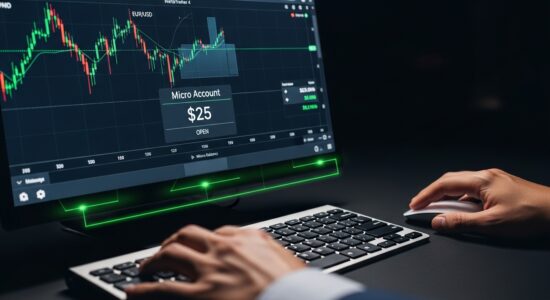
Forex trading vs penny stock — both markets attract traders with limited capital looking for outsized returns. Both involve significant risk. But they are fundamentally different markets with different structures, different risks, and very different profiles of who succeeds in each.
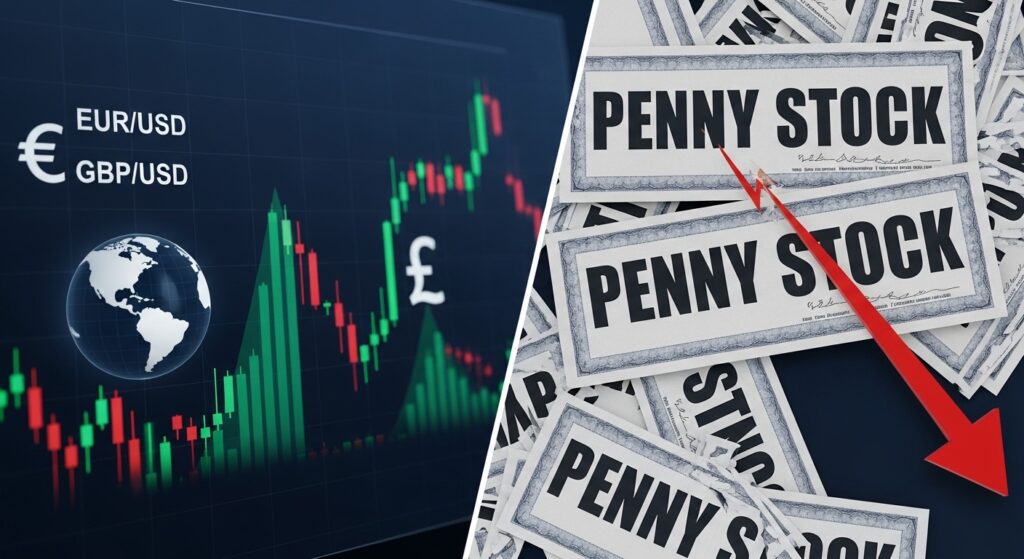
This guide compares forex trading vs penny stock across every key dimension — regulation, liquidity, leverage, risk, and potential returns — so you can make an informed decision about which market fits your goals.
Penny Stocks and Forex Trading in 2026
Forex trading vs penny stock remains one of the most common comparisons new investors make when deciding where to start.
In 2026, both penny stocks and forex trading continue to attract traders due to their potential for high returns, but they differ significantly in terms of risk, trading environment, and strategies. Here’s a detailed comparison of the two.
Market Structure and Accessibility
Penny Stocks: These are shares of small-cap companies typically priced below $5. They are traded primarily on over-the-counter (OTC) markets and are known for their speculative nature. While they can be accessible to beginners due to low entry costs, they often come with challenges such as lower liquidity and higher volatility, making them susceptible to price manipulation and scams.
Forex Trading: The forex market operates 24 hours a day, five days a week, allowing traders to engage in currency trading at any time. It is characterized by high liquidity and large trading volumes, with over $7.5 trillion exchanged daily. This market requires an understanding of economic indicators and geopolitical factors that influence currency values. See our What Is Forex Trading: Complete Beginner’s Guide for a full introduction.
Volatility and Risk
Penny Stocks: Known for extreme volatility, penny stocks can experience significant price swings based on rumors or market sentiment. This volatility can lead to substantial profits but also poses a high risk of loss. Traders need to be adept at cutting losses quickly due to the unpredictable nature of these stocks.
Forex Trading: While forex also exhibits volatility, it tends to be more stable compared to penny stocks. Price movements are influenced by macroeconomic factors rather than company-specific events. However, the use of leverage in forex can amplify both gains and losses, requiring traders to have a solid forex risk management strategy in place.
Trading Strategies
Penny Stocks: Traders often rely on technical analysis, volume trends, and news catalysts to make quick trades. The focus is typically on short-term gains through rapid buying and selling. Successful penny stock trading requires a keen understanding of market sentiment and the ability to react swiftly.
Forex Trading: Forex traders utilize a variety of strategies based on technical indicators like MACD or RSI, and fundamental analysis such as interest rate changes or GDP reports. The goal is often to capture price movements across different timeframes. See our Forex Trading Strategies guide for a full breakdown of approaches.
Potential Returns
Penny Stocks: The potential for high returns exists as these stocks can surge dramatically if the right conditions are met. However, this potential is accompanied by significant risks, including the possibility of total loss due to lack of liquidity or company failure.
Forex Trading: Forex offers substantial profit potential through leverage but requires careful management of positions due to the inherent risks involved. Traders can realize profits from price movements in currency pairs, making it possible to earn consistently with disciplined trading strategies.
2026 Outlook: Penny Stocks and Forex
Penny Stocks in 2026: High Risk, High Reward
Several factors are shaping the penny stock market in 2026:
- Sector growth in Green Energy and AI — Green energy companies and AI-driven startups continue to attract speculative interest
- Regulatory changes — New SEC regulations aim to increase transparency in OTC markets, making it easier for investors to access reliable information
- Key risks remain — Penny stocks remain highly speculative, with limited liquidity and ongoing susceptibility to pump-and-dump schemes. Conducting thorough due diligence is essential
Forex Trading in 2026: Navigating Volatility
The forex market continues to be one of the most dynamic financial arenas. Key themes for 2026 include:
- Global economic shifts — The U.S. dollar remains dominant, but currencies like the Chinese yuan and euro are gaining momentum amid geopolitical developments
- Interest rate policies — Central banks worldwide are adopting varying interest rate strategies, creating unique trading opportunities across major currency pairs
- Technology and AI — Algorithmic trading and AI-driven analytics are becoming essential tools. Automated trading and Expert Advisors provide a competitive edge for systematic traders
Forex Trading vs Penny Stock: Side-by-Side Comparison
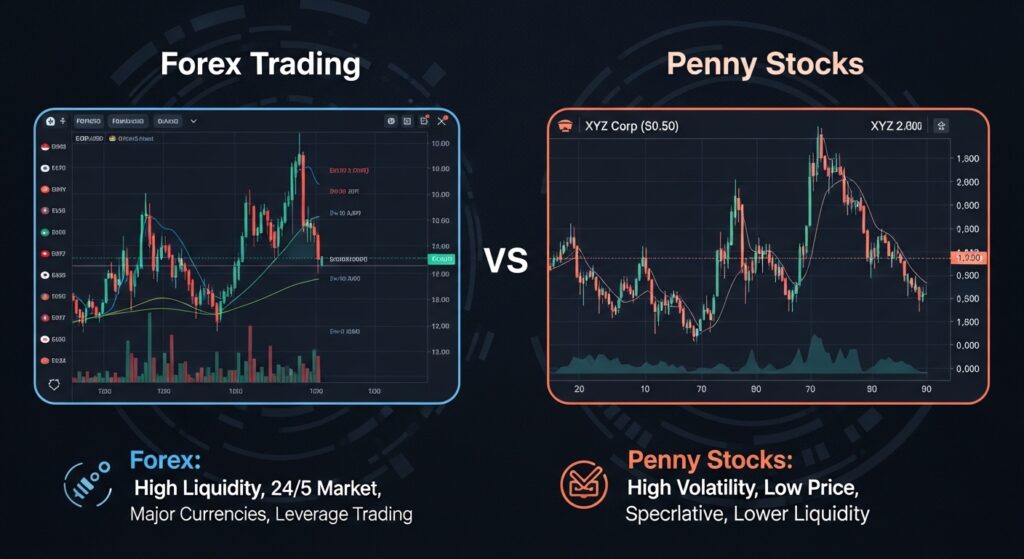
A direct forex trading vs penny stocks comparison reveals fundamental differences in regulation, liquidity, leverage, and risk profile.
| Factor | Forex Trading | Penny Stocks |
|---|---|---|
| Daily volume | $7.5 trillion | Varies (often very low) |
| Regulation | High (CFTC, NFA, FCA) | Low (minimal disclosure) |
| Leverage | Up to 50:1 (US retail) | Limited |
| Market hours | 24/5 | 9:30AM–4PM ET |
| Transparency | High | Low |
| Manipulation risk | Low | High (pump & dump) |
| Minimum capital | Low ($100–$500) | Low ($100+) |
| Information availability | High — public data | Low — limited disclosure |
Penny Stocks: The Speculation Market
Penny stocks are a great fit for investors with limited capital that are familiar with speculative, high-risk investments and have both the time and the inclination to do all the essential research required for successful penny stock trading.
Although penny stocks are typically defined as any stock trading at a share price under $5, most individuals think of penny stocks as those very-low-priced stocks traded through the over-the-counter bulletin board (OTCBB) or pink sheets markets.
The significant difference between investing in penny stocks and higher-priced stocks on regular exchanges is that successfully trading penny stocks requires significantly more effort to acquire reliable, up-to-date information. Pink sheet traded stocks are not required to register with the Securities and Exchange Commission (SEC) and are therefore much less stringently regulated concerning the public information they have to provide.
Penny stock investors also have to be familiar with the fact they’re making high-risk, very speculative investments.
Can You Make Money in Penny Stocks?
There was a well-known story about a trader who turned $1,500 into $1 million in 3 years trading penny stocks — not by buying large companies like Apple or Ford, but by trading very small companies with prices below $1. The longest he ever held shares was a few days. “I’ve been trading every single day for almost three years, and it’s been a slow, day-to-day process,” he said.
The SEC warns that “investors in penny stocks should be prepared for the possibility that they may lose their whole investment.” Penny stocks are also notorious for pump-and-dump schemes — where scammers buy shares, artificially inflate the price through promotion, then sell their stake, leaving other investors with significant losses.
Forex Trading: The Leverage Market
The forex market is concerned with the buying and selling of currencies. It is the largest, most liquid market in the world, with over $7.5 trillion traded daily. There is extensive information and training available both online and through regulated forex brokers.
Trading and pricing run 24 hours a day. Spreads are incredibly narrow on major pairs. Virtually all the information that affects trading — central bank decisions, economic data, inflation reports — is publicly available.
The other significant appeal of forex trading is the enormous leverage available. Investors are generally required to put up as little as 1% of the total value of a forex contract at margin. This gives an investor the opportunity to begin trading with a small amount of capital and have a reasonable opportunity to make substantial returns. Learn more about how leverage works in our Understanding Leverage in Forex Trading guide.
Can You Make Money in Forex Trading?
The history of forex trading includes legendary figures who built extraordinary careers in currency markets:
George Soros (#22 on the World Billionaires List, net worth over $20 billion) — famous for “breaking the Bank of England” by shorting the British pound in 1992, generating over $1 billion in profit in a single day.
Bruce Kovner — started trading in 1977 after driving a taxi in New York. He turned $3,000 into $45,000 (and then back down to $20,000 — a lesson in risk management) before founding Caxton Associates in 1983. His net worth reached $5.3 billion.
Stanley Druckenmiller — founded Duquesne Capital at age 28 in 1981 and delivered some of the highest annual returns in the industry until 2010. Worked alongside Soros on the pound trade.
Bill Lipschutz — started his trading journey with a $12,000 inheritance while in college and built a career as one of the most successful forex traders of all time. He founded and directs portfolio management at Hathersage Capital.
Andrew Krieger — conducted a famous one-man assault on the New Zealand dollar in 1987 while at Bankers Trust, with a short position that reportedly exceeded the entire New Zealand money supply, making several hundred million in profit.
These traders all have one thing in common: an unshakable discipline combined with meticulous risk management. None of them made their fortunes by accident.
Penny Stock vs Forex Regulation
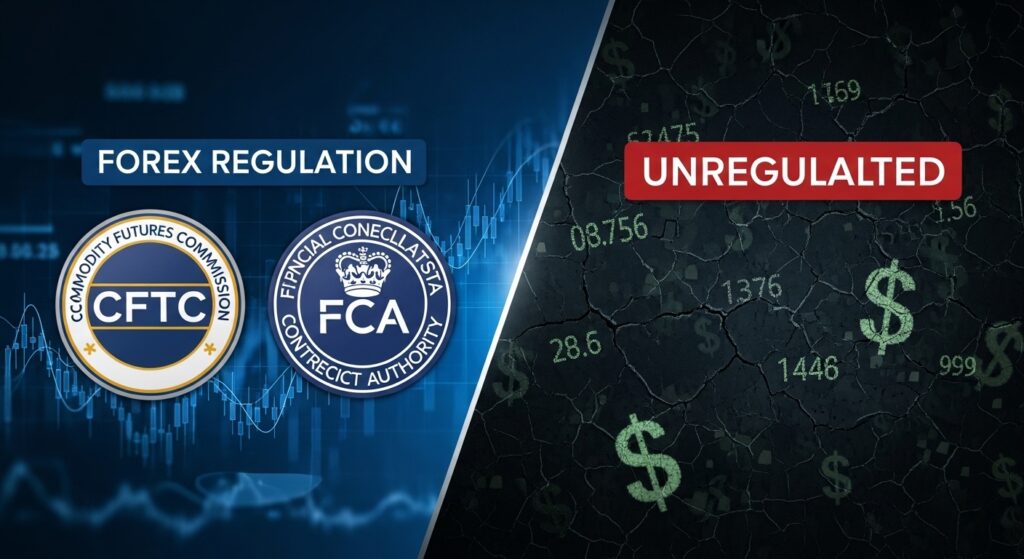
When evaluating forex trading vs penny stocks, regulation is one of the most important factors to consider for investor protection.
Unlike penny stocks, the forex market is tightly regulated by the Commodity Futures Trading Commission (CFTC) and the National Futures Association (NFA) in the United States, and by the Financial Conduct Authority (FCA) in the United Kingdom. Information regarding the many currencies traded is freely and readily available.
Penny stocks are more appealing to investors who enjoy doing extensive research on speculative companies. Forex trading is more suitable for investors who prefer trading on regulated markets, with transparent pricing and the maximum degree of leverage available.
Investment Strategies for Both Markets
Whether you’re trading penny stocks, forex, or both, a well-structured strategy is essential:
- Diversification — Spread your investments across different sectors and currencies to mitigate risks
- Use of technology — For penny stocks, use screening tools to identify undervalued companies. In forex, implement automated trading strategies and analytical tools
- Education and research — Stay informed about economic trends, industry news, and regulatory updates. Use demo accounts to practice forex strategies without risking real money
- Risk management — Set stop-loss orders to limit potential losses. Avoid overexposing yourself to a single penny stock or currency pair. Review our Forex Risk Management: Complete Guide
Conclusion
Choosing between penny stocks and forex trading depends on your individual trading goals and risk tolerance.
When comparing forex trading vs penny stock trading, it’s important to understand how each market aligns with your experience level and financial objectives.
Penny stocks may appeal to those looking for high-risk, high-reward opportunities with lower capital requirements — but require extreme vigilance against scams and market manipulation.
Forex trading is better suited for those who prefer a structured, regulated approach with a focus on global economic trends and who can manage the complexities of currency trading with proper risk management.
Both markets offer unique opportunities but come with distinct challenges. For traders serious about building a sustainable trading career, forex trading’s regulated environment, deep liquidity, and wealth of available information give it a structural advantage over the speculative penny stock market.
Ready to get started with forex? Explore our full Forex Education Hub for everything from beginner basics to advanced strategies.
In the end, the forex trading vs penny stocks comparison comes down to your risk tolerance, available capital, and long-term trading goals.
Start Your Forex Trading Journey Today
After comparing forex trading vs penny stocks, the next step is choosing the right market and tools to get started.
If you’re leaning toward forex trading, make sure you begin with the right foundation:
- What is Forex Trading? Complete Beginner’s Guide
- Understand risk management
- Explore beginner-friendly trading strategies
- Choose a reliable and regulated broker
Visit our Forex Education Hub to access beginner guides, proven strategies, and tools designed to help you trade with confidence.