Learn How to Make Fast Money by Learning diffrent Strategies in Forex Trading and Different Investment Options
Ethereum Trading Guide: How to Trade ETH Successfully
Ethereum represents the second-largest cryptocurrency by market capitalization and the foundation for thousands of decentralized applications, smart contracts, and blockchain innovations. While Bitcoin functions primarily as digital money and store of value, Ethereum operates as a programmable blockchain enabling developers to build decentralized finance (DeFi) protocols, non-fungible tokens (NFTs), decentralized autonomous organizations (DAOs), and countless other applications transforming how we interact with money, ownership, and digital systems.
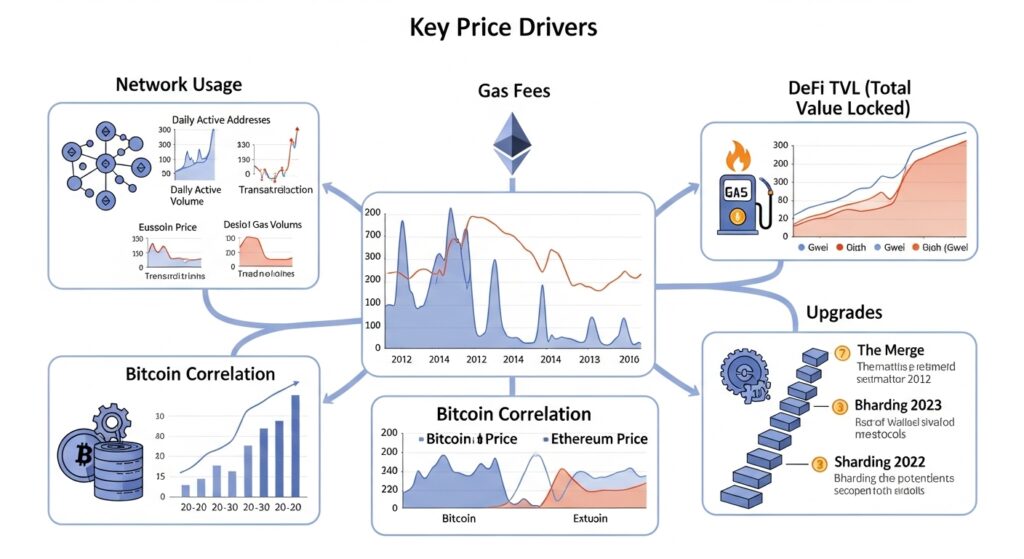
For traders, Ethereum trading offers unique opportunities and challenges distinct from Bitcoin and traditional assets. ETH price movements correlate with network usage, DeFi ecosystem growth, technological upgrades, gas fee dynamics, and adoption metrics beyond simple supply-demand economics. Trading Ethereum successfully requires understanding both cryptocurrency market fundamentals and Ethereum’s specific technological characteristics.
This comprehensive guide explains everything you need to trade Ethereum effectively: what makes Ethereum valuable, how smart contracts and DeFi drive demand, major price catalysts specific to ETH, proven trading strategies for different market conditions, technical analysis approaches, risk management essentials, and critical mistakes that destroy beginner Ethereum traders’ accounts.
Ethereum functions as a global, decentralized computing platform enabling anyone to write code that controls digital value, runs applications exactly as programmed, and operates without possibility of downtime, censorship, or third-party interference. This fundamental capability separates Ethereum from Bitcoin and creates its unique value proposition.
Ethereum’s Core Innovation: Smart Contracts
Smart contracts represent self-executing agreements written in code that automatically enforce terms without intermediaries. When predetermined conditions are met, smart contracts execute transactions or actions automatically, eliminating the need for lawyers, banks, or other middlemen.
Real-World Example: A traditional home purchase requires title companies, escrow agents, banks, and lawyers coordinating paperwork and fund transfers. A smart contract-based home purchase could automatically transfer property ownership when payment arrives, eliminating intermediaries, reducing costs, and preventing fraud—all enforced by code rather than institutions.
This capability enables unprecedented innovation. Developers build decentralized exchanges (DEXs) allowing peer-to-peer cryptocurrency trading without centralized companies controlling funds. Lending protocols enable anyone to borrow or lend cryptocurrency without banks. NFT marketplaces let creators sell digital art directly to collectors without auction houses taking percentages.
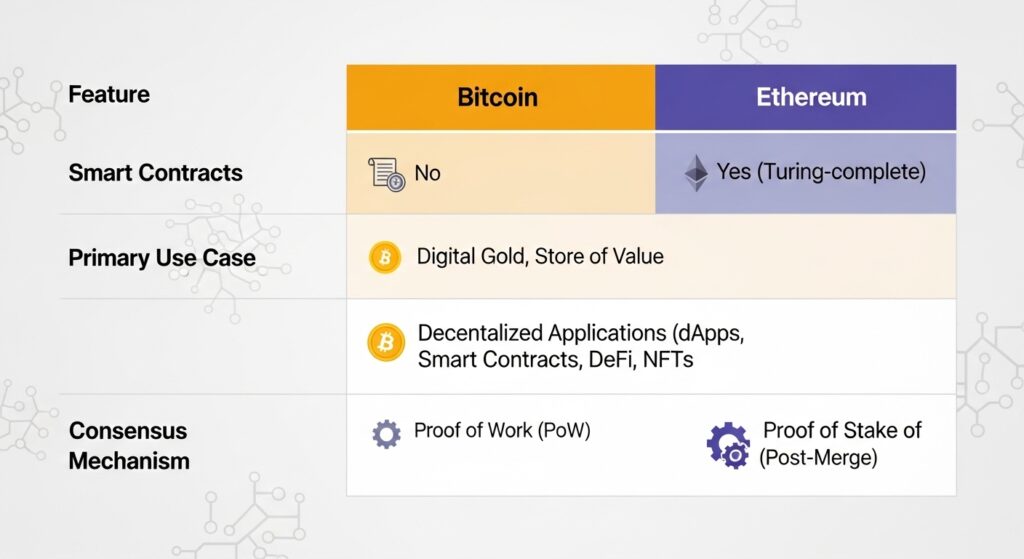
Ethereum vs Bitcoin: Key Differences
While both are cryptocurrencies built on blockchain technology, their purposes and capabilities differ significantly:
Bitcoin: Digital money designed for transactions and value storage. Limited programmability. One primary use case: peer-to-peer payments and store of value.
Ethereum: Programmable blockchain designed as platform for decentralized applications. Extensive smart contract capabilities. Unlimited use cases: DeFi, NFTs, gaming, identity, supply chain, and more.
Trading Implications: Bitcoin’s price primarily responds to macroeconomic factors, institutional adoption, and store-of-value narratives. Ethereum’s price additionally responds to network usage metrics, DeFi protocol growth, NFT market activity, technological upgrades, and developer ecosystem expansion.
Understanding Ethereum as programmable infrastructure rather than just digital currency helps traders identify unique catalysts missed by those treating ETH as “Bitcoin alternative.”
Smart Contracts and the DeFi Ecosystem
Ethereum’s value proposition centers on enabling DeFi—financial services operating without centralized intermediaries like banks, brokers, or clearinghouses.
How DeFi Creates ETH Demand
Every DeFi transaction on Ethereum requires paying gas fees (transaction costs) in ETH. As DeFi adoption grows, demand for ETH increases because:
Gas Fee Payments: All smart contract interactions require ETH for gas
Collateral Requirements: Many DeFi protocols require ETH as collateral
Liquidity Provision: ETH pairs dominate decentralized exchange liquidity
Staking Requirements: Ethereum 2.0 validators must stake 32 ETH
Trading Insight: Monitor Total Value Locked (TVL) in DeFi protocols as a leading indicator of ETH demand. When TVL increases significantly, it often precedes ETH price rises as more ETH gets locked in protocols.
Major DeFi Categories on Ethereum
Decentralized Exchanges (Uniswap, SushiSwap):
Enable cryptocurrency trading without centralized exchanges
Use automated market makers (AMMs) instead of order books
Generate billions in monthly trading volume
All transactions require ETH gas fees
Lending Protocols (Aave, Compound):
Allow users to lend cryptocurrency and earn interest
Borrowers provide collateral to take loans
Interest rates adjust algorithmically based on supply/demand
ETH serves as primary collateral asset
Stablecoins (DAI, USDC on Ethereum):
Provide price-stable cryptocurrency pegged to dollars
Billions in stablecoin transactions occur on Ethereum
Each transaction requires ETH gas fees
NFT Marketplaces (OpenSea, Blur):
Enable buying, selling, and trading digital collectibles
Multi-billion dollar industry built on Ethereum
Every NFT purchase requires ETH for gas
Impact on Trading: DeFi ecosystem health directly impacts ETH demand. Tracking metrics like active DeFi users, transaction volume, and new protocol launches helps anticipate ETH price movements.
Ethereum 2.0 and The Merge
In September 2022, Ethereum completed “The Merge”—transitioning from energy-intensive proof-of-work mining (like Bitcoin) to efficient proof-of-stake validation. This represented blockchain’s largest-ever technological upgrade and fundamentally changed Ethereum’s economics.
Key Changes from The Merge
Reduced Energy Consumption:
99.95% reduction in energy usage
Addressed environmental criticisms
Improved ESG credentials for institutional investors
Changed ETH Issuance:
Proof-of-work issued ~13,000 ETH daily
Proof-of-stake issues ~1,700 ETH daily
87% reduction in new supply entering market
ETH Staking Introduction:
Validators stake 32 ETH to participate in consensus
Earn 3-5% annual yields on staked ETH
Millions of ETH locked in staking contracts
Deflationary Periods:
When network usage is high, ETH gets burned (permanently removed)
During peak usage, more ETH burns than gets issued
Creates deflationary supply dynamics
Trading Implications: The Merge transformed ETH from inflationary to potentially deflationary asset. This supply reduction, combined with continued demand growth, creates bullish long-term structural tailwinds that didn’t exist pre-Merge.
Ongoing Ethereum Upgrades
Ethereum development continues with planned upgrades improving scalability, reducing costs, and increasing throughput:
Sharding: Will dramatically increase transaction capacity
Layer 2 Solutions: Arbitrum, Optimism, and zkSync scaling Ethereum
Proto-danksharding: Reduces data costs for rollups
Monitoring Upgrades for Trading: Major Ethereum upgrades often drive price speculation. Traders should watch Ethereum Foundation announcements, testnet launches, and developer timelines for upgrade-driven trading opportunities.
Gas fees represent payments users make for Ethereum network computational resources. Higher demand increases gas fees, creating more ETH burn through EIP-1559 (Ethereum Improvement Proposal that burns portion of gas fees).
Trading Strategy: Monitor gas fee trends on platforms like Etherscan. Sustained high gas periods often correlate with increased ETH price as more gets burned.
Warning: Extremely high gas fees can paradoxically hurt ETH short-term by pricing out users and reducing network activity.
2. DeFi Total Value Locked (TVL)
TVL measures total cryptocurrency value locked in DeFi protocols. Higher TVL indicates:
More ETH locked as collateral
Increased network usage
Growing DeFi adoption
Higher gas fee revenue
Trading Strategy: Track TVL on DeFiLlama. Significant TVL increases (10%+ weekly) often precede ETH price rises as more ETH gets locked in protocols.
3. NFT Market Activity
NFT trading activity drives substantial Ethereum network usage. Major NFT launches or bull markets can:
Spike gas fees dramatically
Increase ETH burn rates
Drive mainstream attention to Ethereum
Generate millions in daily trading volume
Trading Strategy: Monitor NFT marketplace volumes on platforms like CryptoSlam. NFT volume spikes create short-term ETH buying pressure.
4. Ethereum Upgrades and Developments
Major technological improvements drive speculative trading:
Announcement of upgrades often triggers rallies
Successful testnet deployments create momentum
Mainnet activation dates drive volatility
Post-upgrade periods see “sell the news” corrections
Trading Strategy: Follow Ethereum Foundation blog and developer calls. Position ahead of major upgrade announcements but prepare for post-launch profit-taking.
5. ETH/BTC Ratio Dynamics
ETH often moves in relation to Bitcoin, but the ETH/BTC ratio indicates Ethereum’s relative strength:
Rising ratio: ETH outperforming BTC (Ethereum strength)
Falling ratio: BTC outperforming ETH (Bitcoin strength)
Historical range: 0.015 – 0.085
Trading Strategy: Trade the ratio itself on exchanges offering ETH/BTC pairs. Buy ETH when ratio approaches historical lows, sell when approaching highs.
Application: Use seasonality as context, not sole decision factor. Combine with technical and fundamental analysis.
Risk Management for Ethereum Trading
Ethereum’s volatility demands disciplined risk management to survive long enough to profit.
Position Sizing for High Volatility
ETH can move 5-15% daily during volatile periods. Position sizing must account for this:
Conservative: Risk 1-2% of account per trade Moderate: Risk 2-3% of account per trade Aggressive: Risk 3-5% of account per trade (only for experienced traders)
Use our position sizing calculator to determine appropriate trade sizes based on your account size and risk tolerance.
Stop Loss Strategies
Fixed Percentage Stops:
Set stop loss 5-10% below entry for swing trades
Use 2-4% stops for day trading
Wider stops for longer-term positions
Technical Stop Placement:
Below recent swing low for longs
Above recent swing high for shorts
Below key support levels
Account for ETH’s volatility with adequate room
Time-Based Stops:
Exit if price doesn’t move favorably within expected timeframe
Useful for upgrade speculation (exit if rally doesn’t materialize)
Protecting Profits
Trailing Stops:
Move stop loss up as price rises
Lock in minimum profits while allowing trend to continue
Typical trail: 5-10% below highest point since entry
Partial Profit Taking:
Sell 25-50% at first profit target
Let remainder run with trailing stop
Reduces psychological pressure, locks in gains
Managing Leverage
Many exchanges offer leveraged ETH trading:
2-3x leverage moderately increases exposure
5-10x leverage dramatically increases risk
20x+ leverage virtually guarantees liquidation eventually
Recommendation for Most Traders: Avoid leverage entirely or use maximum 2-3x. Ethereum’s natural volatility provides sufficient profit potential without leverage’s dangers.
Diversification Within Crypto Portfolio
Don’t concentrate exclusively in Ethereum:
Split between Bitcoin and Ethereum (60/40 or 50/50)
Add smaller cap altcoins (10-20% of crypto holdings)
Trading Ethereum offers unique opportunities unavailable with Bitcoin or traditional assets. ETH prices respond to network usage metrics, DeFi protocol growth, NFT market activity, technological upgrades, gas fee dynamics, and layer-2 scaling solutions—creating diverse catalysts beyond simple supply-demand economics. Understanding these Ethereum-specific drivers separates successful ETH traders from those applying Bitcoin strategies that miss Ethereum’s unique characteristics.
Most Ethereum traders fail not from lack of knowledge but from emotional mistakes, inadequate risk control during extreme volatility, and ignorance of Ethereum-specific metrics.
Start small, prioritize education over quick profits, build experience through documented trading with a trading journal, and never risk capital you can’t afford to lose. Ethereum represents a speculative, high-volatility asset despite growing institutional adoption, clear utility, and massive developer ecosystem.
Ethereum’s unique position as programmable money and infrastructure for decentralized finance makes it essential knowledge for modern crypto traders. Master Ethereum’s specific characteristics, apply strategies systematically, monitor network metrics diligently, and continuously learn from both successes and failures.