Learn How to Make Fast Money by Learning diffrent Strategies in Forex Trading and Different Investment Options
Best Cryptocurrency Exchanges: Complete Comparison Guide
Selecting the right cryptocurrency exchange determines trading costs, available cryptocurrencies, security of your funds, and overall investing experience. The cryptocurrency industry has witnessed devastating exchange failures—Mt. Gox’s $450 million hack, QuadrigaCX’s $190 million loss when the CEO died with sole access to keys, and FTX’s $8 billion fraud—demonstrating that exchange selection represents one of your most critical cryptocurrency decisions.
Beyond catastrophic failures, daily exchange choice impacts your success: high fees drain profits from every trade, limited cryptocurrency selection prevents diversification, poor security practices risk account compromise, and inadequate customer support leaves you stranded during problems. Meanwhile, reputable exchanges with competitive fees, robust security, extensive cryptocurrency offerings, and responsive support enable successful long-term investing.
This comprehensive guide compares the best cryptocurrency exchanges available, covering fees, security features, available cryptocurrencies, user experience, customer support quality, and critical factors determining which exchange suits your specific needs.
Whether you’re buying your first Bitcoin, actively trading cryptocurrencies, or building a diversified portfolio, understanding exchange differences helps you avoid costly mistakes and select platforms aligned with your investment goals.
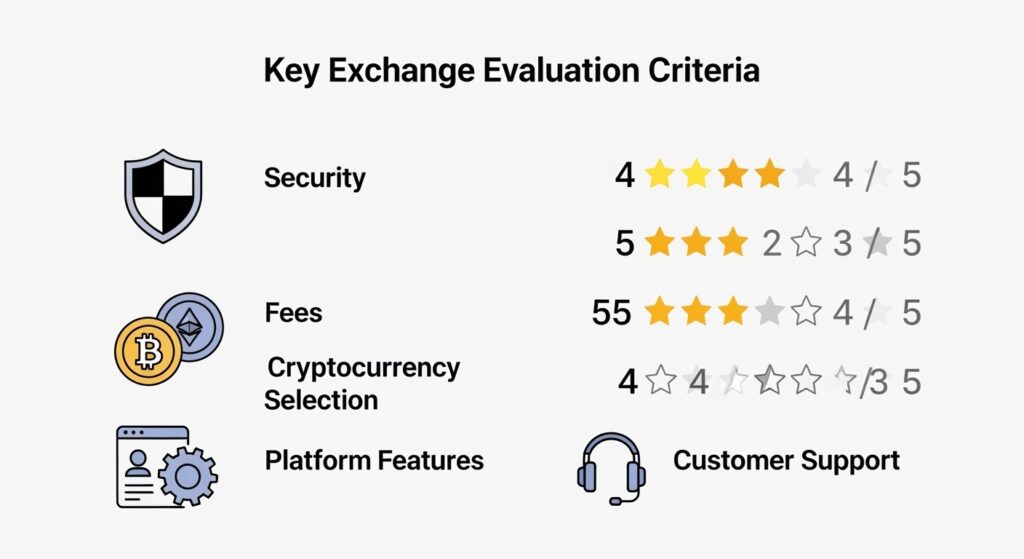
Quality exchanges balance multiple factors that together determine overall value and user experience.
Security and Regulatory Compliance
Licensed and Regulated: Legitimate exchanges operating in the United States comply with FinCEN regulations, state money transmitter licenses, and SEC oversight where applicable. This provides legal recourse and consumer protections absent from offshore platforms.
Insurance Coverage: The best exchanges insure digital assets held in hot wallets against breaches and hacking attempts. While this doesn’t protect against all scenarios, it demonstrates commitment to security and provides some loss protection.
Security Practices:
Cold storage for majority of funds (80-95%)
Two-factor authentication required
Withdrawal address whitelisting available
Regular security audits by third parties
Bug bounty programs
Fee Structure Transparency
Trading Fees: Exchanges charge fees on every buy/sell transaction, typically 0.1%-1.5% per trade. These fees compound significantly over time, making low-fee exchanges substantially more profitable for active traders.
Deposit and Withdrawal Fees: Some exchanges charge for deposits (especially credit cards), cryptocurrency withdrawals, and bank transfers. Hidden fees here can eliminate savings from competitive trading fees.
Spread Markups: Many “zero-fee” exchanges profit through spread markups—buying cryptocurrency below market price and selling above. The spread represents a hidden fee often exceeding stated trading fees at transparent platforms.
Cryptocurrency Selection
Major Coins: All quality exchanges offer Bitcoin, Ethereum, and major altcoins. Differences emerge in supporting smaller altcoins, DeFi tokens, and new projects.
Token Listing Standards: Exchanges with rigorous listing standards (Coinbase, Kraken, Gemini) provide better investor protection than platforms listing unvetted projects.
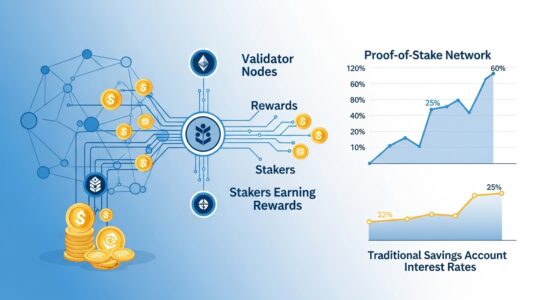
Staking and Earning Opportunities: Leading exchanges offer staking for proof-of-stake cryptocurrencies, enabling passive income on holdings.
User Experience and Platform Features
Interface Design: Beginners need simple, intuitive interfaces. Advanced traders require charting tools, order types, and API access.
Mobile Apps: Quality mobile apps enable portfolio monitoring and trading on the go without sacrificing security.
Educational Resources: The best platforms provide learning materials helping users understand cryptocurrency investing and specific platform features.
Customer Support Quality
Support Channels: Email-only support means multi-day waits during problems. Phone and live chat support resolve urgent issues faster.
Response Times: Leading exchanges respond to support tickets within 24-48 hours. Poor exchanges take weeks or never respond.
Knowledge Base: Comprehensive help centers with detailed articles reduce need for direct support.
Best Cryptocurrency Exchanges Compared
Coinbase – Best for Beginners
Overview: America’s largest cryptocurrency exchange, publicly traded (COIN), serving over 100 million users globally. Coinbase prioritizes simplicity and regulatory compliance, making it ideal for cryptocurrency beginners despite higher fees.
Pros:
Extremely user-friendly interface
Strong regulatory compliance and insurance
Excellent mobile app
Educational rewards program (earn crypto while learning)
Supports 250+ cryptocurrencies
FDIC insurance on USD balances
Instant purchases with debit card
Cons:
High fees (0.5% trading + spread markup)
Coinbase Pro (lower fees) being discontinued
Limited advanced trading features
Customer support can be slow
Fee Structure:
Trading: 0.6% for trades under $10,000 (includes spread)
Overview: San Francisco-based exchange founded 2011, Kraken combines advanced trading features with industry-leading security. Popular among experienced traders who value comprehensive tools and competitive fees.
Pros:
Never been hacked (13+ year track record)
Very competitive fees (0.16%-0.26% for most users)
Advanced order types (stop-loss, margin trading)
Excellent customer support with 24/7 live chat
Supports 200+ cryptocurrencies
High liquidity for major pairs
Extensive trading pairs including fiat currencies
Cons:
Interface less intuitive for beginners
Account verification can be slow
Wire transfer required for USD deposits (no ACH)
More complex for simple buy/hold strategies
Fee Structure:
Trading: 0.16% maker / 0.26% taker (reduces with volume)
ACH deposits: Not available (wire only)
Wire deposits: Free
Wire withdrawals: $5 USD
Crypto withdrawals: Network fees only
Security Features:
Majority of funds in cold storage
Full reserve verification
Global Settings Lock (prevent unauthorized changes)
Master Key (secondary password)
Two-factor authentication options
Regular security audits
Best For:
Experienced traders wanting advanced features
Security-conscious investors
Users needing margin trading and futures
International users (supports 50+ fiat currencies)
Website: Kraken.com App: iOS and Android
Binance.US – Best for Low Fees
Overview: American subsidiary of global exchange Binance, launched 2019 to serve US customers compliantly. Offers competitive fees and extensive cryptocurrency selection while maintaining regulatory compliance.
Pros:
Lowest fees among major US exchanges (0.1% trading)
150+ cryptocurrencies available
High liquidity on popular pairs
Binance.US Earn program for passive income
Advanced and simple trading modes
Staking available for multiple cryptocurrencies
Cons:
Not available in all US states (check availability)
Customer support below competitors
Less regulatory trust than Coinbase/Kraken -ややcomplex interface for complete beginners
Parent company Binance faces regulatory scrutiny
Fee Structure:
Trading: 0.1% maker and taker (0.075% with BNB discount)
ACH deposits: Free
Debit card: 4.5%
Wire deposits: $15
Wire withdrawals: $15
Crypto withdrawals: Network fees only
Security Features:
Cold storage for majority of assets
SAFU fund for emergency insurance
Two-factor authentication
Withdrawal address whitelisting
Anti-phishing code
Best For:
Cost-conscious traders (lowest fees)
Users wanting wide cryptocurrency selection
Active traders with frequent transactions
Those comfortable with slightly more complexity
Website: Binance.US.com App: iOS and Android
Important: Binance.US is separate from Binance.com. US citizens must use Binance.US.
Gemini – Best for Security-First Investors
Overview: Founded 2014 by Winklevoss twins, Gemini emphasizes regulatory compliance, security, and institutional-grade infrastructure. New York-based and regulated by NYDFS with strong consumer protections.
Overview: Mobile payment app by Block (formerly Square) offering simple Bitcoin buying integrated with payments, direct deposit, and investing features. Extremely beginner-friendly but limited to Bitcoin only.
Bitcoin withdrawals: Free (on-chain) or minimal (Lightning)
Security Features:
FDIC insurance on cash balances
Two-factor authentication
Face/Touch ID
PIN protection
Bitcoin withdrawals to cold storage supported
Best For:
Absolute beginners wanting only Bitcoin
Users already using Cash App for payments
Small dollar-cost averaging purchases
Those wanting simplicity over features
Website: Cash.app App: iOS and Android (mobile-only)
Crypto.com – Best for Rewards and Perks
Overview: Singapore-based exchange with major US operations, Crypto.com combines exchange services with Visa debit card offering cryptocurrency rewards. Growing rapidly with extensive marketing partnerships.
Pros:
Crypto.com Visa card with up to 5% cashback in crypto
250+ cryptocurrencies available
Competitive trading fees (0.075%-0.4%)
Crypto.com Earn for passive income
DeFi wallet integration
Extensive staking options
Cons:
Card rewards require CRO token stake (lock-up)
Customer support inconsistent
Some features not available in all US states
Complex fee structure
Regulatory scrutiny (offshore entity)
Fee Structure:
Trading: 0.075%-0.4% (depends on CRO stake)
ACH deposits: Free
Debit card purchases: 2.99%
Wire deposits: Free
Crypto withdrawals: Varies by cryptocurrency
Security Features:
Cold storage for majority of assets
$750 million insurance
Two-factor authentication
Withdrawal whitelisting
Anti-phishing code
Best For:
Users wanting cryptocurrency rewards on spending
Those comfortable staking CRO for benefits
Investors seeking passive income programs
Users wanting extensive altcoin selection
Website: Crypto.com App: iOS and Android
Swan Bitcoin – Best for Bitcoin-Only Investors
Overview: Bitcoin-only platform focused exclusively on long-term Bitcoin accumulation through automated purchases. Ideal for believers in Bitcoin maximalism who don’t want altcoin distractions.
Pros:
Laser-focused on Bitcoin only
Automated daily/weekly/monthly purchases
Very low fees (0.99%-1.49% depending on amount)
Excellent educational content
Automatic withdrawals to personal wallet
Premium customer support
Cons:
Bitcoin only (no altcoins, no Ethereum)
Not suitable for trading (accumulation only)
No mobile app (web only)
Limited features beyond buying
Fee Structure:
$0-$100: 1.49%
$100-$1,000: 1.29%
$1,000+: 0.99%
Withdrawals: Free
Security Features:
Cold storage partnerships
Automatic withdrawal to personal wallet encouraged
Two-factor authentication
Focused on self-custody education
Best For:
Bitcoin-only investors (maximalists)
Dollar-cost averaging strategies
Long-term holders (10+ years)
Users wanting to avoid altcoin temptation
Website: SwanBitcoin.com
Exchange Comparison by Use Case
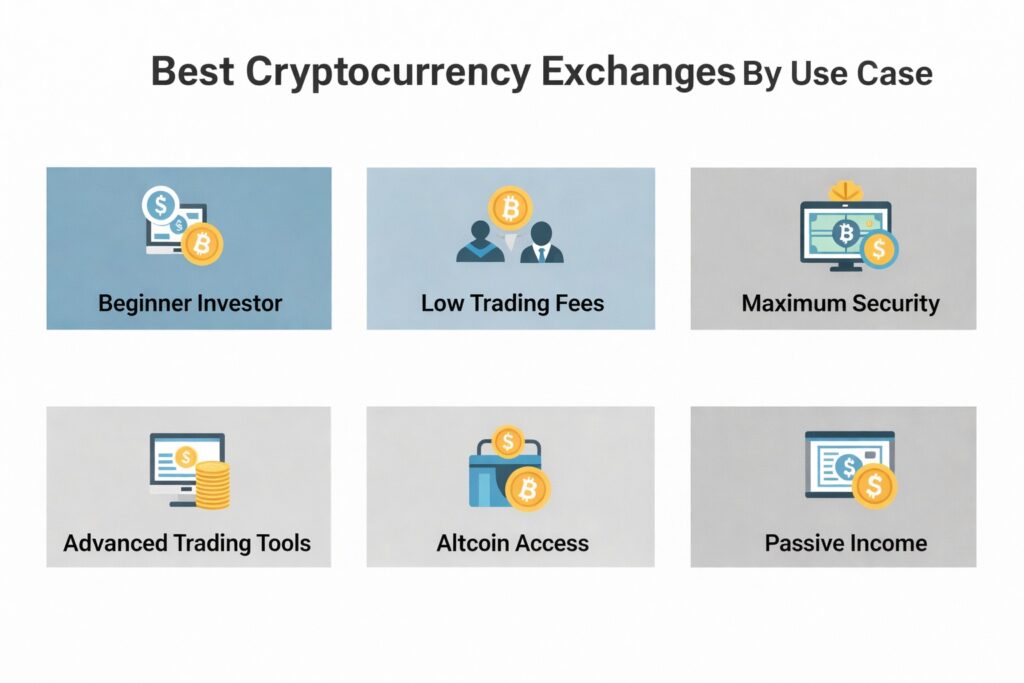
Best for Complete Beginners
1. Coinbase – Simplest interface, most guidance 2. Cash App – For Bitcoin-only simplicity 3. Gemini – Clean interface with strong security
Why: These platforms prioritize ease of use over advanced features, making first cryptocurrency purchases straightforward.
1. Crypto.com – Extensive Earn program 2. Kraken – Staking for multiple coins 3. Gemini – Gemini Earn program
Why: These platforms offer interest-earning and staking on idle cryptocurrency holdings.
Critical Factors When Choosing an Exchange
Available in Your State
Not all exchanges operate in every US state due to varying regulations.
State Restrictions:
Binance.US: Not available in Hawaii, Idaho, Louisiana, New York, Texas, Vermont
Kraken: Available in all states except New York, Washington
Coinbase: Available in all states
Gemini: Available in all states
Always verify exchange availability in your state before creating account.
Withdrawal to Personal Wallet
Can You Withdraw Cryptocurrency?
Some platforms (PayPal, Robinhood, Ventura) only allow buying/selling cryptocurrency without withdrawal to personal wallets. This means:
You don’t truly own the cryptocurrency
Cannot use it for payments or DeFi
Subject to platform policies and failures
Missing fundamental cryptocurrency benefit
All exchanges in this guide allow withdrawals to personal wallets.
Best Practice: Don’t keep large amounts on exchanges. Transfer to personal hardware wallet for long-term holdings.
Fiat On-Ramp and Off-Ramp
Deposit Methods:
ACH Transfer: Free, 3-5 day processing (most common)
Wire Transfer: Faster (1-2 days) but $15-30 fees
Debit Card: Instant but 3-4% fees
Credit Card: Rarely allowed, very high fees
Withdrawal Methods:
ACH Transfer: Free or minimal fee, 3-5 days
Wire Transfer: $15-30 fee, 1-2 days
PayPal: Some exchanges, instant, small fee
Recommendation: Use free ACH transfers for regular purchases. Reserve instant debit card for urgent situations only.
Tax Reporting
Form 1099-K: Exchanges must report to IRS when trading exceeds $20,000 annually and 200+ transactions.
Built-in Tax Tools:
Coinbase: Tax reporting dashboard
Gemini: Transaction history export
Kraken: Detailed tax reports
Third-Party Integration: All major exchanges export transaction data to services like CoinTracker, Koinly, or TurboTax for automated tax preparation.
Customer Support Quality
Support Response Times (Average):
Coinbase: 24-48 hours email
Kraken: Live chat 24/7, phone support
Gemini: 24-48 hours email
Binance.US: 3-5 days email
Cash App: 2-4 days in-app
During Problems: Quality support becomes critical. Kraken’s 24/7 live chat and phone support significantly outperforms email-only competitors during account issues.
Common Cryptocurrency Exchange Mistakes
Keeping Large Amounts on Exchanges
The Mistake: Treating exchanges like banks and storing entire cryptocurrency portfolio indefinitely.
Why It’s Dangerous:
Exchange hacks can wipe out holdings
Exchange bankruptcy means potential total loss
Account freezes can lock you out
Government seizure possible
Historic Examples:
Mt. Gox: $450 million lost (2014)
QuadrigaCX: $190 million lost (2019)
FTX: $8 billion lost (2022)
Solution: Transfer cryptocurrency to personal hardware wallet after purchasing. Only keep trading amounts on exchanges (5-10% of portfolio maximum).
Choosing Based Only on Fees
The Mistake: Selecting lowest-fee exchange without considering security, regulatory compliance, or user experience.
Why It’s Problematic: Saving 0.2% on fees means nothing if exchange gets hacked, goes bankrupt, or provides terrible support during problems.
Solution: Balance fees with security, regulation, and support quality. Paying slightly higher fees at Coinbase or Gemini may provide valuable protection and peace of mind.
Not Enabling Two-Factor Authentication
The Mistake: Using only password protection without 2FA.
Risk: Account compromise through phishing, password leaks, or credential stuffing attacks.
Solution: Enable 2FA immediately using authenticator apps (Google Authenticator, Authy) rather than SMS (which can be intercepted).
Falling for Phishing Scams
The Mistake: Clicking links in emails claiming to be from exchanges.
How It Works: Scammers send emails mimicking exchange notifications with links to fake login pages stealing credentials.
Protection:
Bookmark legitimate exchange URLs
Never click email links to login
Verify URLs carefully before entering credentials
Enable anti-phishing codes on exchanges offering them
Not Understanding Spread Markups
The Mistake: Using “commission-free” platforms without realizing spread markups cost more than stated fees.
Example: Platform shows no commission but buys Bitcoin at $42,000 while market price is $41,500. That $500 difference (1.2%) exceeds most exchange fees.
Solution: Compare total cost (fees + spread) rather than just stated commission. Transparent exchanges often cost less overall.
Panic Selling During Volatility
The Mistake: Selling entire position during market corrections from fear.
Result: Locking in losses and missing subsequent recovery.
Solution: Dollar-cost average during accumulation and hold through volatility. Only sell according to predetermined plan, not emotional reactions.
IMAGE 5 PROMPT: Warning poster showing common exchange mistakes with icons – open vault with money flying out (keeping crypto on exchange), phishing hook with email (falling for scams), single lock (no 2FA), panic button (emotional trading) – caution sign design with red accents
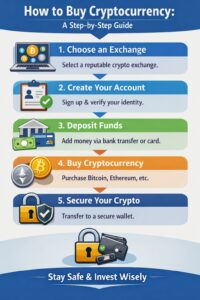
Getting Started: Step-by-Step
Step 1: Choose Your Exchange
Based on Your Priorities:
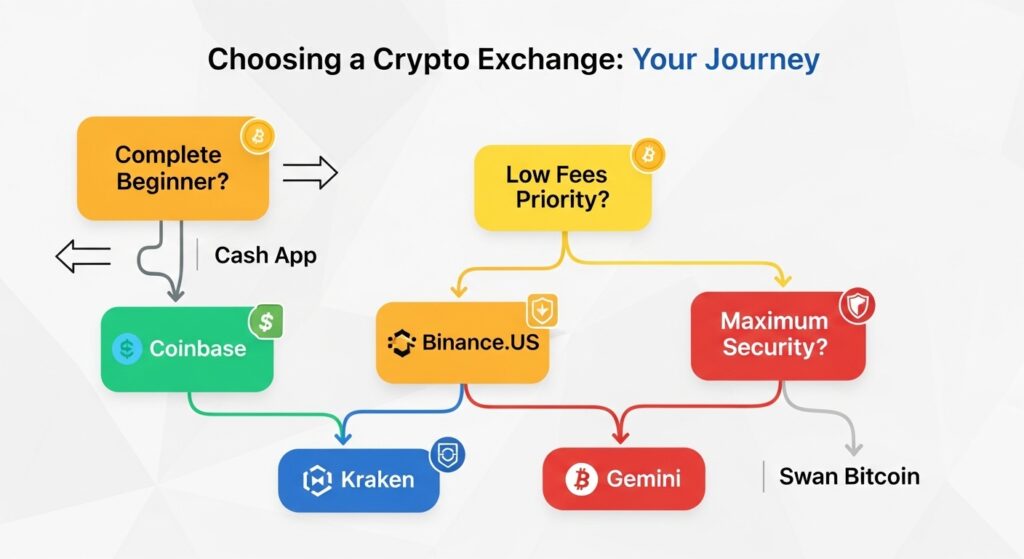
Complete Beginner: Start with Coinbase Low Fees: Choose Binance.US or Kraken Maximum Security: Select Kraken or Gemini Bitcoin Only: Use Cash App or Swan Bitcoin
Step 2: Create Account
Information Required:
Full legal name
Email address
Phone number
Date of birth
Social Security Number (for US tax reporting)
Government ID (driver’s license or passport)
Verification Process:
Photo of government ID
Selfie verification
Proof of address (sometimes required)
Processing time: Minutes to several days
Step 3: Secure Your Account
Immediately After Account Creation:
Enable two-factor authentication
Set strong, unique password (use password manager)
Enable withdrawal address whitelisting if available
Add anti-phishing code if offered
Bookmark legitimate exchange URL
Step 4: Link Payment Method
Recommended for Beginners: Link bank account via ACH for free deposits and withdrawals.
Process:
Navigate to payment methods or deposit section
Select “Link Bank Account”
Use Plaid or manual verification
Small test deposits verify account (1-2 days)
Alternative: Link debit card for instant purchases (but higher fees).
Step 5: Make First Purchase
Start Small: Purchase $50-200 for first transaction to learn process.
Keep small amounts on exchange for convenience, but majority in personal custody.
Step 7: Set Up Regular Purchases (Optional)
Dollar-Cost Averaging:
Most exchanges offer automated recurring purchases:
Daily, weekly, or monthly frequency
Set dollar amount ($50, $100, $200, etc.)
Automatically executes purchases
Reduces timing stress and emotional decisions
This strategy outperforms lump sum timing attempts for most investors.
Selecting appropriate cryptocurrency exchange represents one of your most consequential cryptocurrency decisions, determining trading costs, fund security, available investment options, and overall experience. The cryptocurrency industry’s devastating failures—billions lost to hacks, frauds, and bankruptcies—demonstrate that exchange reputation, security practices, and regulatory compliance matter far more than minor fee differences.
Most cryptocurrency investors fail not from poor trading decisions but from fundamental exchange mistakes: keeping entire portfolios on platforms that get hacked or go bankrupt, choosing based solely on lowest fees while ignoring security, falling for obvious phishing scams, or panic-selling during volatility. Meanwhile, successful long-term investors use reputable exchanges for purchasing, transfer holdings to personal hardware wallets promptly, and maintain consistent dollar-cost averaging regardless of market conditions.
Start with established, regulated exchanges (Coinbase for beginners, Kraken for features, Gemini for security), enable all available security features immediately, transfer significant holdings to personal wallets after purchasing, and resist emotional reactions during market volatility. Your exchange choice and security practices determine whether you build lasting cryptocurrency wealth or join the billions in losses from preventable mistakes.
Ready to Start Buying Cryptocurrency?
Begin by creating an account at Coinbase (beginners), Kraken (advanced), or Gemini (security-focused). Complete identity verification, enable two-factor authentication, link your bank account, and make a small first purchase ($50-200) to learn the process. After gaining comfort, implement dollar-cost averaging with regular automated purchases and transfer holdings exceeding $1,000 to personal hardware wallets for long-term security. Review our how to buy cryptocurrency guide, cryptocurrency wallet guide, and cryptocurrency trading fundamentals for comprehensive crypto education.