Learn How to Make Fast Money by Learning diffrent Strategies in Forex Trading and Different Investment Options
What is DeFi? Complete Guide to Decentralized Finance
Decentralized Finance (DeFi) represents the reconstruction of traditional financial services—lending, borrowing, trading, insurance, and complex derivatives—using blockchain smart contracts instead of banks, brokers, and centralized institutions. Unlike traditional finance requiring permission from intermediaries who control your money, DeFi operates through transparent, programmable code accessible to anyone with internet connection and cryptocurrency wallet.
The DeFi revolution has grown from virtually nothing in 2019 to over $45 billion locked in protocols by 2024, enabling millions of users worldwide to earn interest, borrow against crypto holdings, trade thousands of assets, and access financial services impossible in traditional systems. This growth demonstrates fundamental demand for financial services operating outside centralized control, censorship, and geographic restrictions.
For investors and traders, DeFi creates opportunities unavailable in traditional finance: earning 3-15% yields on stable cryptocurrency, borrowing against volatile assets without selling, trading any asset 24/7 without brokers, and participating in protocol governance. However, DeFi also introduces unique risks—smart contract vulnerabilities, impermanent loss, liquidations, and scams—that have cost billions in losses to those lacking proper understanding.
This comprehensive guide explains everything you need to understand what is DeFi: core concepts and how it works, major DeFi categories and protocols, earning opportunities and yields, critical risks and how to avoid them, practical steps for getting started safely, and the future evolution of decentralized finance.
Whether you’re exploring alternatives to traditional banking, seeking higher yields on savings, or building diversified cryptocurrency portfolio, understanding DeFi fundamentals determines whether you profit from financial innovation or lose capital to preventable mistakes.
Understanding fundamental DeFi concepts provides foundation for safely navigating decentralized finance.
What Makes DeFi Different from Traditional Finance
Traditional Finance (CeFi):
Banks and institutions control your money
Permission required for services (credit checks, account approvals)
Limited hours (branches close, markets close)
Geographic restrictions
Opaque operations (you don’t see what banks do with deposits)
Intermediaries take large cuts
Decentralized Finance (DeFi):
You control your cryptocurrency via private keys
Permissionless access (anyone can use protocols)
24/7/365 operation (no closing hours)
Global access (internet connection sufficient)
Transparent operations (all transactions visible on blockchain)
Automated smart contracts replace intermediaries
Smart Contracts: The Foundation
What They Are: Self-executing programs stored on blockchains that automatically execute when predetermined conditions are met.
Example: Traditional loan requires:
Apply to bank
Submit documents
Wait for approval
Bank holds collateral
Monthly payment processing
Bank enforces penalties
DeFi loan via smart contract:
Deposit cryptocurrency collateral
Smart contract automatically lends against it
No approval needed (code executes automatically)
Interest accrues automatically
If collateral value drops, automatic liquidation
Result: Smart contracts eliminate intermediaries, reduce costs, increase speed, and operate transparently with no human discretion or bias.
Liquidity Pools and Automated Market Makers
The Problem: Traditional exchanges use order books matching buyers with sellers. This requires both sides actively trading, creating liquidity problems for less popular assets.
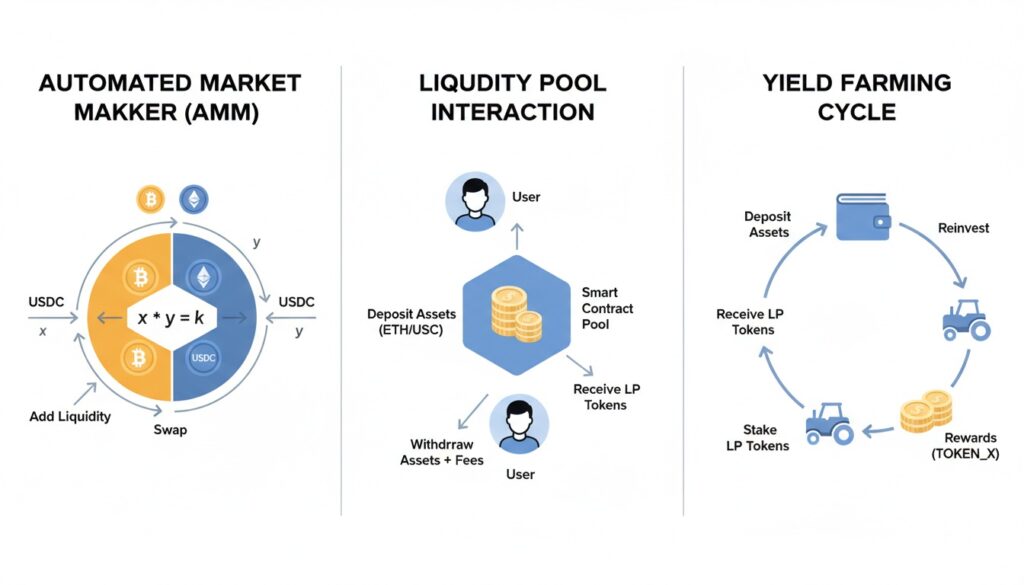
DeFi Solution: Liquidity pools are smart contracts holding two assets (e.g., ETH and USDC). Automated Market Makers (AMMs) use mathematical formulas to determine prices based on pool ratios.
How It Works:
Liquidity Providers (LPs):
Deposit equal value of both assets into pool
Receive LP tokens representing their share
Earn portion of trading fees (typically 0.3%)
Face impermanent loss risk
Traders:
Swap one asset for another directly from pool
Pay small fee (0.1-0.3%) distributed to LPs
Prices determined algorithmically (constant product formula: x * y = k)
Example: ETH/USDC pool contains 100 ETH and $200,000 USDC. Current price: $2,000 per ETH.
Trader buys 10 ETH:
Removes 10 ETH from pool (now 90 ETH)
Adds USDC to pool
Price automatically adjusts based on new ratio
LPs earn fee on transaction
This mechanism enables trading any asset without traditional order books or market makers.
Yield Farming and Liquidity Mining
Yield Farming: Moving cryptocurrency between DeFi protocols to maximize returns, often involving complex strategies across multiple platforms.
Liquidity Mining: Providing liquidity to pools in exchange for protocol tokens as rewards beyond trading fees.
How It Works:
Deposit assets in liquidity pool
Receive LP tokens representing your share
Stake LP tokens in farming contract
Earn rewards in protocol tokens (APY often 10-100%+)
Compound earnings by reinvesting rewards
Example: Provide $10,000 in ETH/USDC liquidity to Uniswap:
Earn 0.3% of trading fees (might be 5% APY)
Stake LP tokens in liquidity mining program
Earn additional 15% APY in protocol tokens
Total APY: 20%
Risk: High yields come with risks: impermanent loss, smart contract vulnerabilities, token price crashes.
Major DeFi Categories and Protocols
DeFi encompasses multiple financial service categories, each with leading protocols.
Decentralized Exchanges (DEXs)
What They Are: Platforms enabling cryptocurrency trading without centralized intermediaries.
Trading on DEXs: Unlike centralized exchanges requiring accounts, DEXs connect directly to your cryptocurrency wallet. You maintain custody throughout trades.
Lending and Borrowing Protocols
What They Do: Enable users to lend cryptocurrency earning interest or borrow against collateral.
Aave:
Supports 30+ cryptocurrencies
Variable and stable interest rates
Flash loans (borrow without collateral if repaid same transaction)
Yields: 1-8% on stablecoins, higher on volatile assets
Compound:
Algorithmic money market protocol
Supply assets to earn interest
Borrow against supplied collateral
Interest rates adjust based on supply/demand
MakerDAO:
Create DAI stablecoin by locking ETH or other assets as collateral
Decentralized stablecoin not controlled by company
Collateralization ratio requirements (typically 150%+)
How Lending Works:
As Lender:
Deposit cryptocurrency into protocol
Earn interest (paid in same asset)
Withdraw anytime
Interest compounds automatically
As Borrower:
Deposit collateral (must exceed borrowed amount)
Borrow different asset (up to ~75% of collateral value)
Pay interest on borrowed amount
Maintain collateralization ratio or face liquidation
Use Cases:
Earn passive income on holdings
Access liquidity without selling
Tax-efficient access to capital
Leverage for trading
Stablecoins
What They Are: Cryptocurrencies designed to maintain stable value (usually $1.00).
Types:
Fiat-Collateralized (USDC, USDT):
Backed by real dollars in bank accounts
Centralized (company controls reserves)
Most liquid and widely used
Trust required in issuer
Crypto-Collateralized (DAI):
Backed by cryptocurrency locked in smart contracts
Decentralized (no company control)
Over-collateralized (more crypto locked than stablecoins issued)
Transparent on-chain backing
Algorithmic (UST – failed):
Attempted to maintain peg through algorithms and incentives
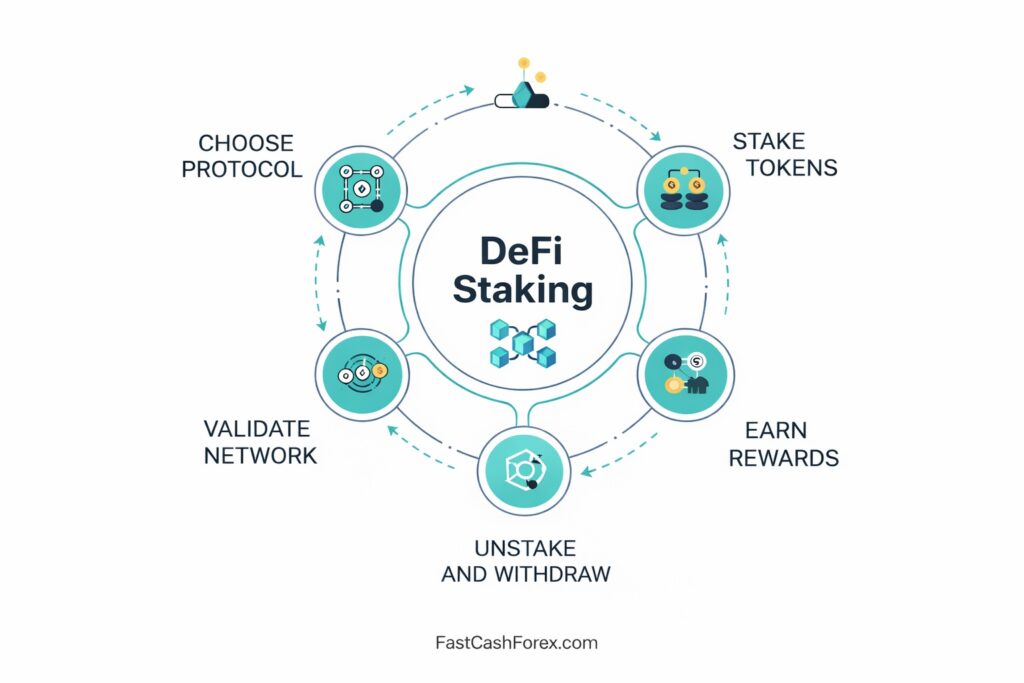
How It Works: Lock tokens in protocols to earn rewards or governance rights.
Returns:
Ethereum staking: 3-5% APY
Other proof-of-stake chains: 5-20% APY
Governance token staking: Variable
Pros:
Relatively simple and safe
Predictable returns
Supports network security
Cons:
Lock-up periods (can’t access funds)
Slashing risk on some chains
Inflation offsets some yield
Best For: Long-term holders wanting passive income on holdings they don’t plan to sell.
Critical DeFi Risks
DeFi offers opportunities but carries significant risks requiring understanding and mitigation.
Smart Contract Risk
What It Is: Vulnerabilities in protocol code enabling hacks and exploits.
Historic Losses:
Poly Network: $600 million hacked (2021)
Wormhole: $325 million exploited (2022)
Ronin Bridge: $625 million stolen (2022)
Countless smaller exploits totaling billions
Protection:
Use established protocols with long track records (Uniswap, Aave, Compound)
Check for third-party audits (CertiK, Trail of Bits, OpenZeppelin)
Start with small amounts to test
Consider protocol insurance (Nexus Mutual)
Never put entire portfolio in single protocol
Reality: Even audited protocols get exploited. Smart contract risk is inherent to DeFi and cannot be completely eliminated.
Impermanent Loss
What It Is: Loss of value when providing liquidity compared to simply holding assets.
How It Happens:
You provide $10,000 liquidity (5 ETH @ $1,000 each + $5,000 USDC):
Scenario A – Price Increases: ETH rises to $2,000. Your pool rebalances:
Now hold 3.54 ETH + $7,070 USDC = $14,140 total
If you’d just held: 5 ETH @ $2,000 + $5,000 = $15,000
Impermanent loss: $860
Scenario B – Price Decreases: ETH drops to $500. Pool rebalances:
Now hold 7.07 ETH + $3,535 USDC = $7,070 total
If you’d just held: 5 ETH @ $500 + $5,000 = $7,500
Impermanent loss: $430
Key Understanding: You always have less value than if you’d simply held both assets. The loss is “impermanent” only if prices return to original ratio—otherwise it’s permanent when you withdraw.
Mitigation:
Provide liquidity only for assets you expect to remain relatively stable versus each other
Factor trading fees into calculation (may offset impermanent loss)
Understand you’re betting on trading volume exceeding price divergence
Consider single-asset staking instead
Liquidation Risk
What It Is: Automatic forced selling of collateral when value drops below required thresholds.
How It Happens:
Borrow $5,000 USDC against $10,000 ETH collateral (50% ratio).
Protocol requires minimum 150% collateralization. If ETH drops 35%:
Collateral now worth $6,500
Borrowed amount still $5,000
Ratio: 130% (below 150% minimum)
Automatic liquidation: Protocol sells your ETH to repay debt
You lose collateral and pay liquidation penalty (typically 5-15%)
Protection:
Maintain conservative collateralization ratios (200%+ rather than minimum)
Set price alerts for collateral assets
Keep stablecoins available to add collateral if needed
Never maximize borrowing capacity
Reality: Cryptocurrency volatility causes cascading liquidations during crashes. Bitcoin and Ethereum can drop 20-40% in hours, triggering mass liquidations.
Rug Pulls and Scams
What They Are: Fraudulent projects designed to steal deposited funds.
Common Types:
Liquidity Rug Pulls: Developers create token, build hype, collect liquidity, then drain pool and disappear.
Fake Yield Farms: Advertise unsustainable yields (1000%+ APY), collect deposits, shut down and steal funds.
Malicious Smart Contracts: Code contains hidden functions enabling developers to drain user funds.
Protection:
Avoid new, unaudited protocols
If yields seem too good to be true, they are
Check contract code or use audited protocols only
Research team and project thoroughly
Start with small test amounts
Use tools like Token Sniffer to check for scam indicators
Regulatory Risk
What It Is: Government crackdowns on DeFi protocols or stablecoins.
Concerns:
Securities regulations applied to DeFi tokens
Stablecoin regulations affecting USDC, USDT
Sanctions on DeFi protocols
Tax reporting requirements
Reality: Regulatory landscape evolves rapidly. Protocols serving US users face increasing scrutiny.
Protection:
Understand local regulations
Maintain detailed transaction records
Report crypto income properly
Consider geographic restrictions on certain protocols
Getting Started with DeFi Safely
Follow these steps to begin DeFi participation while minimizing risks.
Step 1: Set Up Proper Wallet
Hardware Wallet Required: For amounts over $1,000, use hardware wallet (Ledger or Trezor) for security.
MetaMask for Beginners: Browser extension wallet enabling DeFi access:
Install MetaMask from official website
Create new wallet and secure seed phrase
Transfer small amount of ETH for testing
Never share seed phrase with anyone
Important: Your wallet = your responsibility. Lost seed phrase means lost funds permanently.
What They Are: Transaction fees paid to blockchain validators in ETH.
Typical Costs:
Simple swap: $5-20
Providing liquidity: $20-50
Complex strategies: $50-200+
Optimization:
Use L2 networks (Arbitrum, Optimism) for lower fees
Transact during low-activity periods (weekends, late night US time)
Check gas prices before transactions (etherscan.io/gastracker)
Consider alternative chains (Binance Smart Chain, Polygon) for small amounts
Reality: Gas fees make DeFi impractical for positions under $1,000 on Ethereum mainnet. Use Layer 2s or alternative chains for smaller amounts.
Step 5: Diversify Across Protocols
Never put everything in one place:
Example $10,000 DeFi allocation:
$4,000 in Aave (stablecoin lending)
$3,000 in Uniswap (ETH/USDC liquidity)
$2,000 in Compound (stablecoin lending)
$1,000 in newer protocol (higher risk/reward)
Rationale: If one protocol gets exploited, you don’t lose everything.
Step 6: Monitor Positions Regularly
Set Routine: Check positions weekly minimum:
Verify no unusual activity
Check for protocol announcements
Monitor collateralization ratios if borrowing
Review yields and adjust if needed
Use Tracking Tools:
Zapper.fi: Portfolio dashboard
DeBank: Multi-chain tracking
APY.Vision: LP position tracking
The Future of DeFi
Decentralized finance continues evolving rapidly with several trends shaping its future.
Layer 2 Scaling Solutions
Problem: Ethereum’s high gas fees price out smaller users.
Solution: Layer 2 networks (Arbitrum, Optimism, Base) process transactions off main chain, dramatically reducing costs while maintaining security.
Impact: DeFi becomes accessible to everyone, not just those with $10,000+ positions.
Real-World Asset Tokenization
Trend: Bringing traditional assets (stocks, bonds, real estate) onto blockchain.
Examples:
Tokenized Treasury bonds earning 4-5% on-chain
Real estate fractions tradeable 24/7
Carbon credits as tradeable tokens
Potential: Connecting $100+ trillion traditional finance with DeFi infrastructure.
Improved UX and Abstraction
Current Problem: DeFi remains too complex for mainstream adoption.
Development:
Account abstraction (seedless wallets)
Gas abstraction (pay fees in any token)
One-click strategies
Better mobile experiences
Result: DeFi becomes as easy as traditional apps.
Institutional DeFi
Trend: Traditional finance institutions exploring DeFi infrastructure.
Examples:
Banks using DeFi for settlement
Asset managers accessing on-chain yields
Tokenized securities trading
Challenge: Balancing decentralization with regulatory compliance.
Decentralized Finance represents a fundamental reimagining of financial services, replacing centralized intermediaries with transparent, programmable smart contracts accessible globally 24/7. The DeFi ecosystem’s growth from zero to $45+ billion in just five years demonstrates massive demand for financial services operating outside traditional banking control, censorship, and geographic restrictions.
For investors seeking higher yields, the flexibility to borrow without credit checks, or access to global financial markets, DeFi provides opportunities impossible in traditional finance. However, these opportunities come with significant risks—smart contract exploits, impermanent loss, liquidations, and scams—that have cost billions in losses to those lacking proper understanding and risk management.
Success in DeFi requires starting with established protocols (Uniswap, Aave, Compound), beginning with small amounts while learning, understanding core risks before optimizing returns, diversifying across multiple protocols rather than concentrating, and maintaining realistic expectations about yields (if it seems too good to be true, it is). The complexity and risks make DeFi unsuitable for complete cryptocurrency beginners—build foundational knowledge through simpler cryptocurrency investing before exploring DeFi.
Ready to Explore DeFi?
Begin by setting up MetaMask wallet from official website and transferring small amount of Ethereum ($100-500) for testing. Start with simple stablecoin lending on Aave or Compound before attempting complex strategies. Practice depositing, earning interest, and withdrawing to understand mechanics. Consider Layer 2 networks (Arbitrum, Optimism) to minimize gas fees while learning. Review our cryptocurrency trading guide, cryptocurrency wallet guide, and staking guide for comprehensive crypto education before diving deeper into DeFi.