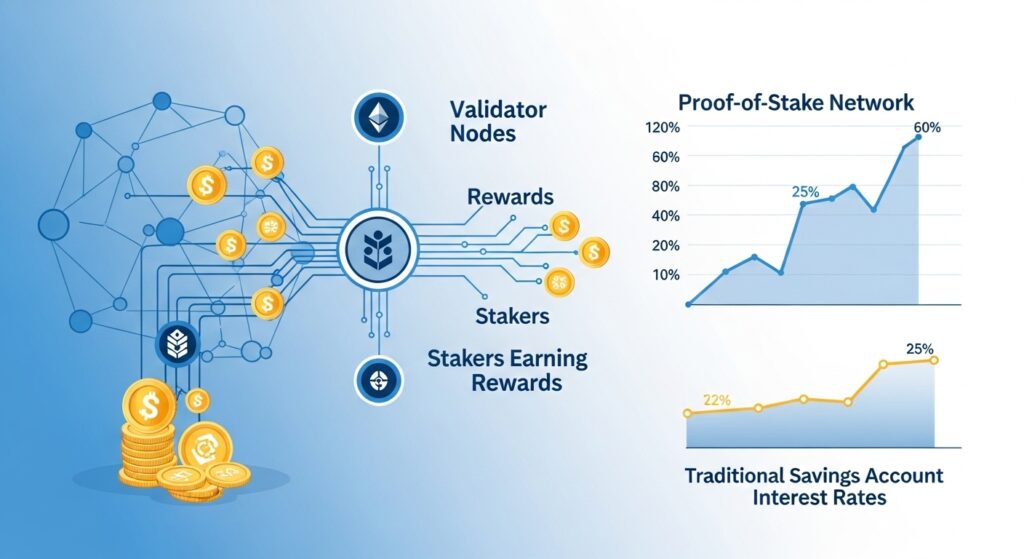
Cryptocurrency staking enables earning passive income by locking digital assets in blockchain networks supporting proof-of-stake consensus, generating returns of 3-20% annually without active trading, mining equipment, or technical expertise. Unlike traditional savings accounts offering 0.5-1% interest, staking provides significantly higher yields while supporting blockchain network security and decentralization.
The proof-of-stake revolution has transformed cryptocurrency from energy-intensive mining to efficient staking, with Ethereum’s 2022 transition alone shifting $30+ billion into staking. This created unprecedented opportunity for passive income generation: stake Ethereum for 3-5% yields, Solana for 7% returns, Cardano for 5% rewards, or explore newer chains offering 10-20%+ annual percentage yields.
However, staking carries risks that have cost investors millions: validator slashing penalties destroying portions of staked funds, exchange failures locking customer stakes, illiquid lock-up periods preventing selling during crashes, and scam staking platforms disappearing with deposits. Understanding proper staking methods, comparing custodial versus self-custody approaches, and avoiding common mistakes separates those building wealth through passive income from those losing capital.
If you’re new to crypto, learning the fundamentals of cryptocurrency trading will give you better context for staking.
This comprehensive guide explains everything you need to earn through cryptocurrency staking: how proof-of-stake works, differences between staking methods, step-by-step staking setup for major cryptocurrencies, yield optimization strategies, critical risks and mitigation, tax implications, and future staking opportunities.
Whether you’re a long-term cryptocurrency holder seeking passive income, investor comparing staking versus other yields, or beginner exploring crypto beyond trading, understanding staking fundamentals determines whether you successfully generate returns or lose capital to preventable mistakes.

I
What Is Cryptocurrency Staking?
Staking represents the process of locking cryptocurrency in blockchain networks to support operations and security, earning rewards in return. This differs fundamentally from mining and creates passive income opportunity.
Proof of Stake vs Proof of Work
Proof of Work (Mining):
Traditional blockchains like Bitcoin use proof-of-work where miners:
- Solve complex mathematical puzzles
- Require expensive specialized hardware (ASICs)
- Consume massive electricity
- Compete for block rewards
- Need technical expertise and infrastructure
Proof of Stake (Staking):
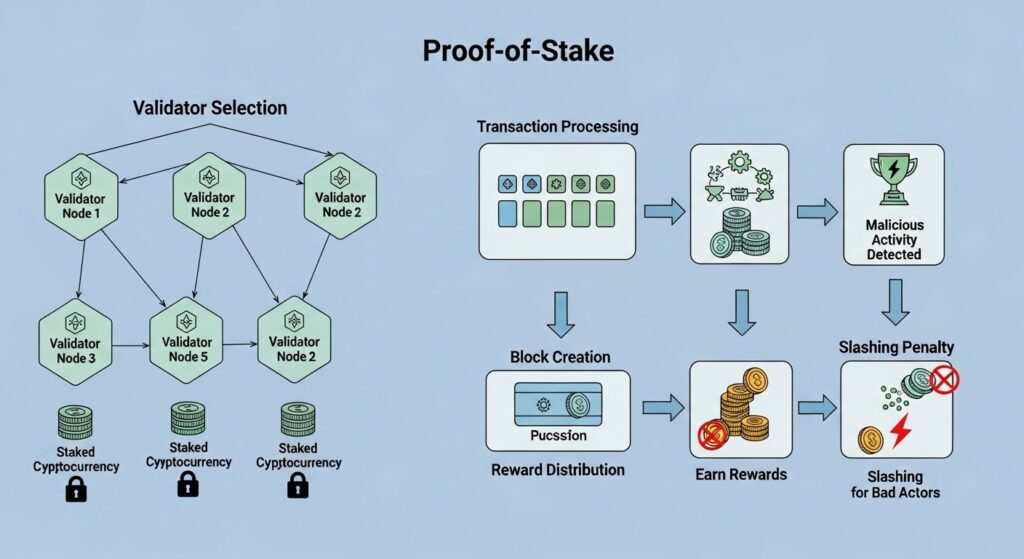
Modern blockchains like Ethereum, Cardano, and Solana use proof-of-stake where validators:
- Lock cryptocurrency as collateral
- Validate transactions and create blocks
- Require minimal computing power
- Earn rewards proportional to stake
- Anyone can participate by staking
Key Difference: Mining requires expensive equipment and electricity. Staking requires only cryptocurrency—making passive income accessible to anyone holding compatible assets.
How Staking Works
Network Perspective:
- Validators stake cryptocurrency (e.g., 32 ETH for Ethereum) as security deposit
- Network randomly selects validators to propose and validate blocks
- Honest validators earn rewards from transaction fees and new coin issuance
- Dishonest validators face slashing (partial stake confiscation)
Your Perspective as Staker:
- Lock cryptocurrency in staking contract or delegate to validator
- Earn rewards continuously (daily, weekly, or per epoch)
- Rewards compound if you restake them
- Unstake when desired (subject to lock-up periods)
Reward Source:
Transaction Fees: Users pay fees for transactions. Validators processing transactions earn these fees.
New Coin Issuance: Networks create new coins distributed to validators as rewards (inflation).
Economic Design: Staking aligns incentives—validators profit from honest behavior, lose capital from dishonest actions.
Benefits of Staking
Passive Income: Earn 3-20% annual returns without active trading or market timing.
Lower Barrier Than Mining: No expensive hardware, electricity costs, or technical setup required.
Support Network Security: Stakers directly contribute to blockchain security and decentralization.
Better Than Holding: Generate returns on assets you’d hold anyway rather than letting them sit idle.
Compounding Growth: Automatically restake rewards for compound growth.
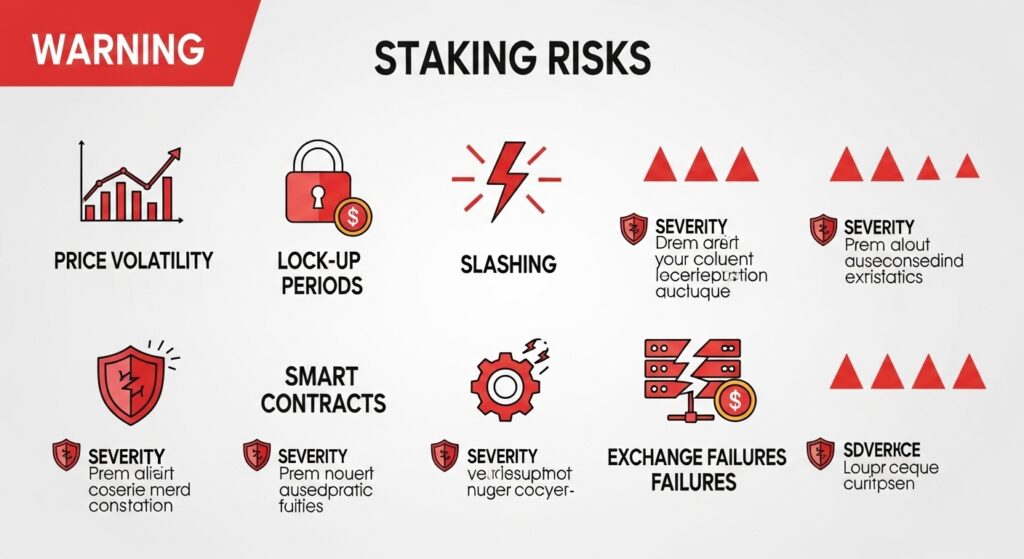
Staking Risks
Price Volatility: If cryptocurrency price drops 50%, your staking rewards don’t compensate.
Lock-Up Periods: Cannot access or sell staked assets during lock-up (days to months).
Slashing: Validators misbehaving lose portion of stake (affects delegators too).
Smart Contract Risk: Staking through protocols carries smart contract vulnerability risk.
Validator Risk: Poor validator performance reduces your rewards.

Types of Staking
Multiple staking approaches exist with different trade-offs between security, returns, and convenience.
Exchange Staking (Easiest)
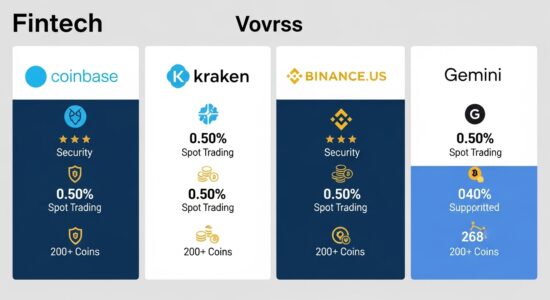
How It Works: Deposit cryptocurrency on exchange (Coinbase, Kraken, Binance.US) that handles staking for you.
Pros:
- Simplest method (one-click staking)
- No technical knowledge required
- Instant unstaking often available
- No minimum amounts usually
- Exchange handles validator operations
Cons:
- Lower returns (exchange takes commission)
- Counterparty risk (exchange controls your crypto)
- Not your keys = not your coins
- Exchange failures mean lost access
- Less control over validator selection
Typical Returns:
- Ethereum: 2-3.5% (vs 3-5% solo)
- Solana: 5-6% (vs 7% solo)
- Cardano: 3-4% (vs 5% solo)
Best For:
- Complete beginners
- Small amounts ($100-5,000)
- Those prioritizing convenience over maximum returns
Popular Platforms:
- Coinbase: 2-3.5% on ETH
- Kraken: 4-7% on various coins
- Binance.US: 5-8% on various coins
Native Wallet Staking (More Control)
How It Works: Stake directly from cryptocurrency’s official wallet, delegating to validators.
Pros:
- You control private keys
- Higher returns (no exchange fees)
- Support decentralization
- Choose specific validators
- More transparent
Cons:
- Technical setup required
- Must research validators
- Self-custody responsibility
- Network fees for staking transactions
- Minimum stake amounts sometimes
Typical Returns:
- Ethereum: 3-5%
- Cardano: 4-5%
- Polkadot: 10-14%
- Cosmos: 15-18%
Best For:
- Medium to large positions ($5,000+)
- Those comfortable with self-custody
- Users wanting maximum returns
- Long-term holders
Solo Staking (Maximum Control)
How It Works: Run your own validator node, staking directly without intermediaries.
Pros:
- Maximum decentralization
- Complete control
- Full rewards (no sharing)
- Support network most directly
Cons:
- High technical requirements
- Expensive (32 ETH minimum for Ethereum = $100,000+)
- Must maintain 24/7 uptime
- Slashing risk if offline
- Hardware and internet costs
Requirements:
- Significant cryptocurrency holdings
- Technical expertise
- Reliable hardware and internet
- Constant monitoring
Best For:
- Advanced users only
- Very large holdings
- Those prioritizing decentralization
Liquid Staking (Flexibility)
How It Works: Stake cryptocurrency through protocol (Lido, Rocket Pool) receiving liquid staking token representing your stake.
Innovation: Liquid staking tokens (stETH, rETH) can be used in DeFi while underlying assets remain staked—earning staking rewards PLUS DeFi yields.
Pros:
- No lock-up period
- Use staked assets in DeFi simultaneously
- Flexible liquidity
- Compound yields (staking + DeFi)
Cons:
- Smart contract risk
- Liquid staking token may trade at discount to underlying
- Additional complexity
- DeFi risks if using tokens there
Typical Returns:
- Staking: 3-5%
- Additional DeFi: 2-10%
- Combined: 5-15%
Best For:
- Experienced DeFi users
- Those wanting flexibility
- Users comfortable with smart contract risk
Popular Protocols:
- Lido (largest, supports ETH, SOL, MATIC)
- Rocket Pool (decentralized ETH staking)
- Marinade Finance (Solana liquid staking)
How to Stake Major Cryptocurrencies
Step-by-step staking guides for popular proof-of-stake blockchains.
Staking Ethereum (ETH)
Option 1: Exchange Staking (Easiest)
Coinbase:
- Buy ETH on Coinbase
- Navigate to “Earn” section
- Select “Ethereum staking”
- Choose amount to stake
- Confirm (one-click process)
- Earn 2.5-3.5% annually
Option 2: Liquid Staking via Lido (More Flexible)
- Set up MetaMask wallet
- Buy ETH and transfer to MetaMask
- Visit Lido.fi
- Connect wallet
- Enter ETH amount to stake
- Confirm transaction
- Receive stETH (liquid staking token)
- Earn 3-4% annually
- Use stETH in DeFi or hold
Option 3: Solo Staking (Advanced)
Requirements:
- 32 ETH minimum ($100,000+ value)
- Dedicated computer running 24/7
- Technical knowledge
- Reliable internet
Process:
- Set up validator hardware
- Install Ethereum client software
- Generate validator keys
- Deposit 32 ETH to staking contract
- Maintain validator uptime
- Earn 3-5% annually
Recommendation: Beginners: Use Coinbase
Intermediate: Use Lido
Advanced with 32+ ETH: Consider solo staking
Staking Cardano (ADA)
Native Wallet Staking:
- Download Daedalus or Yoroi wallet
- Transfer ADA to wallet
- Navigate to “Delegation” or “Staking” tab
- Browse stake pool list
- Select pool (check performance, fees, saturation)
- Delegate ADA to pool
- Earn 4-5% annually
- No lock-up period (unstake anytime)
Pool Selection Criteria:
- Performance: Near 100% uptime
- Fees: 2-5% typical
- Saturation: Under 100% (oversaturated pools have reduced rewards)
Staking Solana (SOL)
Option 1: Exchange (Coinbase, Kraken)
- Deposit SOL
- Enable staking
- Earn 5-6%
Option 2: Native Wallet (Phantom)
- Install Phantom wallet
- Transfer SOL to Phantom
- Click “Start earning SOL”
- Choose validator (research performance)
- Enter amount to stake
- Confirm transaction
- Earn ~7% annually
- Unstaking takes 2-3 days
Validator Research:
- Uptime: 99%+ preferred
- Commission: 5-10% typical
- Stake amount: Avoid over-concentrated validators
Staking Polkadot (DOT)
Requirements:
- Minimum 120 DOT (nomination pool)
- Or 10 DOT using exchanges
Native Staking:
- Download Polkadot.js wallet
- Transfer DOT
- Select “Staking” tab
- Choose validators (up to 16)
- Bond DOT
- Nominate chosen validators
- Earn 10-14% annually
- 28-day unbonding period
Exchange Alternative: Kraken offers DOT staking without minimums.
Staking Cosmos (ATOM)
Keplr Wallet Staking:
- Install Keplr wallet
- Transfer ATOM
- Click “Stake” button
- Browse validator list
- Choose validator (avoid over-concentrated)
- Enter stake amount
- Confirm
- Earn 15-18% annually
- 21-day unbonding period
High Returns Reason: Cosmos’ higher inflation rate creates higher nominal yields.
Maximizing Staking Returns
Optimize staking yields through strategic approaches.
Compounding Rewards
Manual Compounding:
- Claim staking rewards regularly
- Restake rewards immediately
- Increases total staked amount
- Future rewards calculated on larger base
Auto-Compounding: Some protocols automatically restake rewards:
- Lido compounds automatically
- Many exchange staking programs compound
- DeFi staking platforms often compound
Impact:
Without Compounding: $10,000 staked at 5% for 5 years: $12,500
With Monthly Compounding: $10,000 staked at 5% for 5 years: $12,833
Difference: $333 additional from compounding (2.7% more)
Multi-Asset Staking
Diversification Strategy:
Don’t stake only one cryptocurrency:
Example $50,000 Portfolio:
- $20,000 Ethereum (4% yield) = $800/year
- $15,000 Solana (7% yield) = $1,050/year
- $10,000 Cardano (5% yield) = $500/year
- $5,000 Polkadot (12% yield) = $600/year
Total annual income: $2,950 (5.9% blended)
Benefits:
- Risk diversification (one chain’s problems don’t destroy all income)
- Access to different yields
- Exposure to multiple ecosystems
Timing Unstaking Strategically
Market Timing: While staking is passive, strategic unstaking can enhance returns:
Bull Market Top:
- Unstake and take profits
- Accept unbonding period delay
- Preserve gains from price appreciation
Bear Market Bottom:
- Stake maximum amounts
- Price likely to recover while earning yield
- Double benefit (staking rewards + price appreciation)
Tax Efficiency:
Strategy: Unstake in years with lower income to reduce tax bracket impact.
Validator Selection
Critical for Native Staking:
Good Validators:
- 99%+ uptime
- Reasonable fees (2-10%)
- Not oversaturated
- Transparent operations
- Active community engagement
Poor Validators:
- Frequent downtime (reduces your rewards)
- Excessive fees (>15%)
- Oversaturated (dilutes rewards)
- Unknown operators
Research Tools:
- Cardano: Pooltool.io, ADApools.org
- Solana: Validators.app
- Cosmos: Mintscan.io
- Polkadot: Polkadot.js apps
Staking Risks and How to Avoid Them
Understand and mitigate staking-specific risks.
Price Volatility Risk
The Reality: Earning 5% staking rewards doesn’t help if cryptocurrency price drops 50%.
Example:
Year 1:
- Stake $10,000 ETH at $2,000 (5 ETH)
- Earn 5% staking: 0.25 ETH
- Total: 5.25 ETH
If ETH drops to $1,000:
- Value: $5,250
- Lost 47.5% despite earning staking rewards
Mitigation:
- Only stake cryptocurrency you believe in long-term
- Don’t stake purely for yield if bearish on asset
- Consider stablecoin yields instead if uncertain
- Accept that staking doesn’t eliminate price risk
Lock-Up Period Risk
The Problem: Many chains have unbonding periods preventing immediate access to funds.
Unbonding Periods:
- Ethereum: Withdrawals enabled (no lock-up now)
- Cardano: No lock-up
- Solana: 2-3 days
- Polkadot: 28 days
- Cosmos: 21 days
Scenario:
Stake $50,000 in Polkadot. Market crashes 40%. You want to sell to preserve capital.
Reality: Must wait 28 days to unbond. During that time, price may fall further.
Mitigation:
- Keep 20-30% of portfolio unstaked for liquidity
- Use liquid staking for larger positions (Lido, Rocket Pool)
- Accept lock-up only for amounts you won’t need to access
Slashing Risk
What It Is: Validators behaving maliciously or having excessive downtime face slashing—losing portion of stake.
Causes:
- Double-signing (validating conflicting blocks)
- Prolonged offline status
- Attempted network attacks
Impact on You:
Exchange/Delegated Staking: Typically insured against slashing. Exchange or validator absorbs loss.
Solo Staking: You lose slashed amount directly.
Historical Severity:
- Ethereum: 0.5-1% of stake for minor infractions, up to 100% for attacks
- Other chains: Similar ranges
Mitigation:
- Use reputable validators with strong track records
- Diversify across multiple validators
- Consider exchange staking (insured) for beginners
- If solo staking, maintain hardware reliability
Smart Contract Risk
Applies To:
- Liquid staking protocols (Lido, Rocket Pool)
- DeFi yield farming with staking tokens
- Any non-native staking
Historic Losses: Various DeFi protocols exploited for millions due to smart contract bugs.
Mitigation:
- Stick to well-audited, established protocols
- Lido and Rocket Pool have strong track records
- Start with small amounts
- Understand smart contract insurance options (Nexus Mutual)
Exchange Failure Risk
The Problem: Staking through exchanges means trusting them with custody.
Historic Examples:
- FTX collapse: Billions locked, staking rewards lost
- BlockFi bankruptcy: Customer assets frozen
- Celsius: Staking rewards halted, withdrawals blocked
Mitigation:
- Use only regulated, reputable exchanges (Coinbase, Kraken)
- Don’t stake entire portfolio on one exchange
- Consider self-custody for amounts over $10,000
- Remember: “Not your keys, not your crypto”
Tax Complexity
Staking Rewards Are Taxable:
US Tax Treatment:
- Staking rewards = ordinary income when received
- Taxed at your regular income tax rate (10-37%)
- Must report fair market value at receipt
- Later sale creates capital gain/loss
Example:
Earn 1 ETH staking reward when ETH = $2,000:
- $2,000 ordinary income (report on tax return)
- Your cost basis = $2,000
Sell that ETH later at $3,000:
- $1,000 capital gain (report on tax return)
Complexity: Frequent reward claims create many taxable events requiring detailed record-keeping.
Mitigation:
- Use crypto tax software (CoinTracker, Koinly)
- Consider qualified tax advisor for large amounts
- Maintain detailed records of all staking activity

Comparing Staking to Other Crypto Earning Methods
Understand how staking compares to alternatives.
Staking vs Lending
DeFi Lending (Aave, Compound):
- Higher yields potential (5-10%+)
- More flexibility (withdraw anytime)
- Higher smart contract risk
- Requires active management
Staking:
- Lower yields typically (3-8%)
- Lock-up periods common
- Lower risk (native blockchain)
- Passive (set and forget)
Best For:
Lending: Active investors comfortable with DeFi, wanting maximum yield
Staking: Passive investors, long-term holders, those wanting simplicity
Staking vs Yield Farming
Yield Farming:
- Very high yields (20-200%+)
- High impermanent loss risk
- Requires constant monitoring
- High gas fees
- Complex strategies
Staking:
- Moderate yields (3-20%)
- No impermanent loss
- Minimal monitoring needed
- Lower complexity
- Beginner-friendly
Reality: Yield farming’s high returns come with proportionally higher risks. Staking offers more sustainable, predictable income.
Staking vs Savings Accounts
Traditional Savings:
- 0.5-1% interest
- FDIC insured ($250,000)
- No price risk
- Instant liquidity
Cryptocurrency Staking:
- 3-20% returns
- No insurance
- High price volatility
- Lock-up periods
Hybrid Approach:
Risk-Averse:
- 70% traditional savings (emergency fund, stability)
- 30% stablecoin staking (higher yield, minimal price risk)
Moderate Risk:
- 40% traditional savings
- 30% stablecoin staking
- 30% cryptocurrency staking (ETH, ADA, SOL)
Aggressive:
- 20% traditional savings
- 80% cryptocurrency staking (diversified)
Advanced Staking Strategies
Sophisticated approaches for experienced stakers.
Tax-Loss Harvesting with Staking
Strategy: If staked cryptocurrency drops significantly, unstake and immediately rebuy (wash sale rules unclear for crypto):
- Stake $10,000 ETH at $2,000/ETH (5 ETH)
- ETH drops to $1,000
- Unstake 5 ETH (now worth $5,000)
- Sell immediately: $5,000 capital loss
- Rebuy 5 ETH immediately: $5,000
- Restake
- Use capital loss to offset other gains
Consult tax professional—crypto tax law evolving.
Governance Participation
Additional Benefit:
Many staked cryptocurrencies grant governance rights:
- Vote on protocol changes
- Influence network direction
- Early access to new features
Valuable For: Long-term believers in specific protocols wanting input on future development.
Layer 2 Staking
Opportunity:
Newer Layer 2 networks offer higher staking yields:
- Arbitrum (potential future staking)
- Optimism (future staking likely)
- Polygon (MATIC staking: 4-6%)
Higher Yields: Earlier networks often offer higher yields to attract stakers.
Higher Risk: Newer networks carry more uncertainty.
Cryptocurrency staking provides accessible passive income opportunity, enabling holders to earn 3-20% annual returns simply by locking assets in proof-of-stake networks. This represents dramatic improvement over traditional savings accounts and requires no active trading, mining equipment, or technical expertise beyond basic wallet setup and validator selection.
For long-term cryptocurrency holders, staking makes holding more profitable—earning yields on assets you’d hold anyway rather than letting them sit idle. However, staking introduces risks requiring understanding: price volatility that can overwhelm yield gains, lock-up periods preventing selling during crashes, slashing penalties from poor validators, and exchange failure risk for those using custodial staking.
Success requires starting with established cryptocurrencies on reputable platforms (Ethereum on Coinbase for beginners, native wallet staking for intermediate users), understanding lock-up periods and only staking amounts you won’t need to access, diversifying across multiple chains rather than concentrating, carefully researching validators for native staking, and accepting that 5% staking yield doesn’t eliminate 40% price crash risk.
Ready to Start Earning Through Staking?
Begin by selecting reputable exchange supporting staking: Coinbase (easiest), Kraken (more options), or Binance.US (competitive yields). Start with small amount ($100-500) of established cryptocurrency (Ethereum, Cardano, or Solana) to learn the process. Practice staking and unstaking to understand mechanics and fees. Consider native wallet staking when comfortable with self-custody for higher returns. Review our cryptocurrency wallet guide, DeFi guide, and cryptocurrency trading fundamentals for comprehensive crypto education.