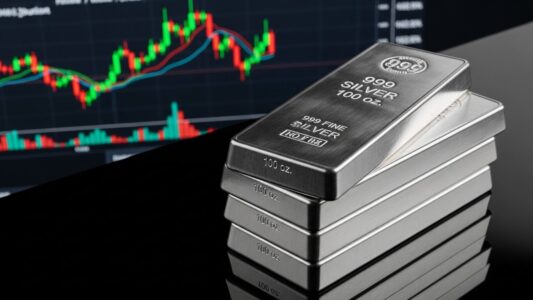
Silver represents one of the most accessible precious metals for new investors, offering both inflation protection and industrial demand that supports long-term value. Unlike gold’s $2,000+ per ounce price point, silver trades around $24-30 per ounce, allowing investors to build meaningful positions with modest capital while maintaining the tangible security of physical precious metals ownership.
This comprehensive guide explains everything you need to buy silver successfully: why silver matters as an investment, the critical differences between physical silver and paper alternatives, which forms of silver to buy, where to find reputable dealers, how to authenticate your purchases, proper storage strategies, and common mistakes that cost beginners thousands of dollars.
Whether you’re protecting against inflation, diversifying your investment portfolio, or building a precious metals position for the first time, understanding how to buy silver correctly separates successful long-term investors from those who overpay, get scammed, or make costly storage mistakes.
Why Invest in Silver?
Silver occupies a unique position as both precious metal and industrial commodity, creating dual demand drivers that support price appreciation while providing inflation protection similar to gold but at a fraction of the cost.
Silver’s Investment Advantages
Affordable Entry Point:
Where gold requires $2,000+ for a single ounce, silver allows meaningful accumulation starting with $50-200, making precious metals accessible to investors at any income level. You can build a 100-ounce silver position for under $3,000, creating substantial precious metals exposure impossible at gold prices.
Industrial Demand Foundation:
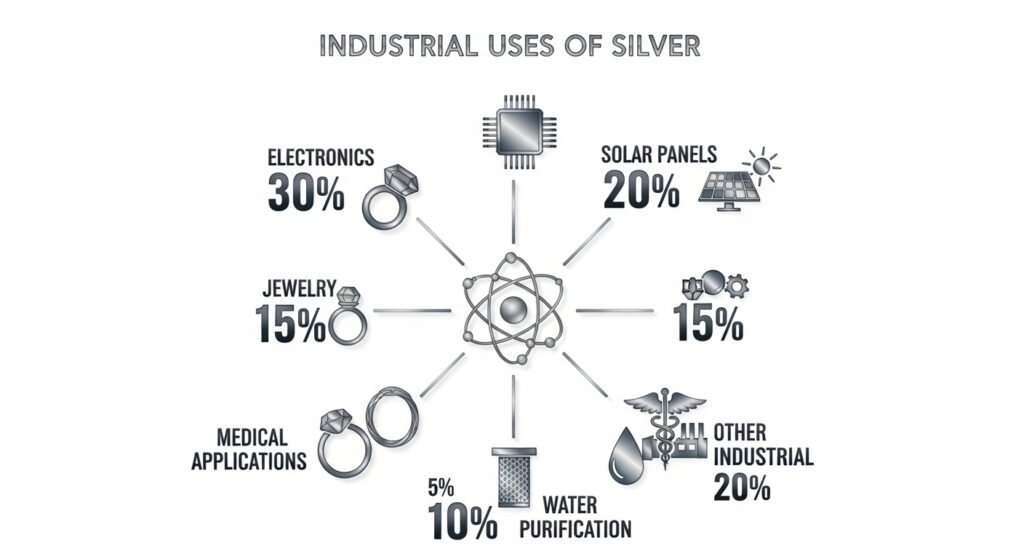
Unlike gold’s primarily monetary uses, silver serves critical industrial applications in electronics, solar panels, medical equipment, and water purification. This industrial consumption creates baseline demand independent of investment sentiment, supporting prices even during periods when precious metals fall from favor.
Gold-to-Silver Ratio Opportunity:
The historical gold-to-silver ratio averages 60-80:1, meaning 60-80 ounces of silver equal one ounce of gold. When this ratio exceeds 80:1, silver becomes historically cheap relative to gold, creating accumulation opportunities. When it contracts below 60:1, silver outperforms gold percentage-wise.
Portfolio Diversification:
Silver provides uncorrelated returns to stocks and bonds while offering protection against currency debasement and inflation. During 2020-2021, silver gained 75% as investors sought inflation hedges, outperforming most traditional assets.
Tangible Asset Without Counterparty Risk:
Physical silver exists independent of financial system performance. Unlike stocks, bonds, or even silver ETFs, physical silver cannot be devalued by corporate bankruptcy, government policy, or financial system collapse.
Industrial Demand Drivers
Electronics Manufacturing:
Silver’s superior electrical conductivity makes it irreplaceable in smartphones, computers, tablets, and virtually all consumer electronics. Each device contains small amounts of silver in circuit boards, contacts, and switches, creating massive cumulative demand.
Solar Energy Growth:
Photovoltaic solar panels use silver paste to conduct electricity, with each panel containing approximately 20 grams of silver. Global solar installation growth directly increases silver demand, with solar applications consuming 100+ million ounces annually.
Medical Applications:
Silver’s antimicrobial properties make it essential in wound dressings, catheters, medical equipment, and water purification systems. Medical demand grows with healthcare expansion, particularly in developing nations.
Water Purification:
Silver-based purification systems serve billions globally, with demand increasing as water scarcity drives infrastructure investment.
This industrial consumption means approximately 50% of annual silver supply gets permanently consumed rather than recycled like gold, creating structural supply constraints that support long-term price appreciation.
Physical Silver vs Paper Silver
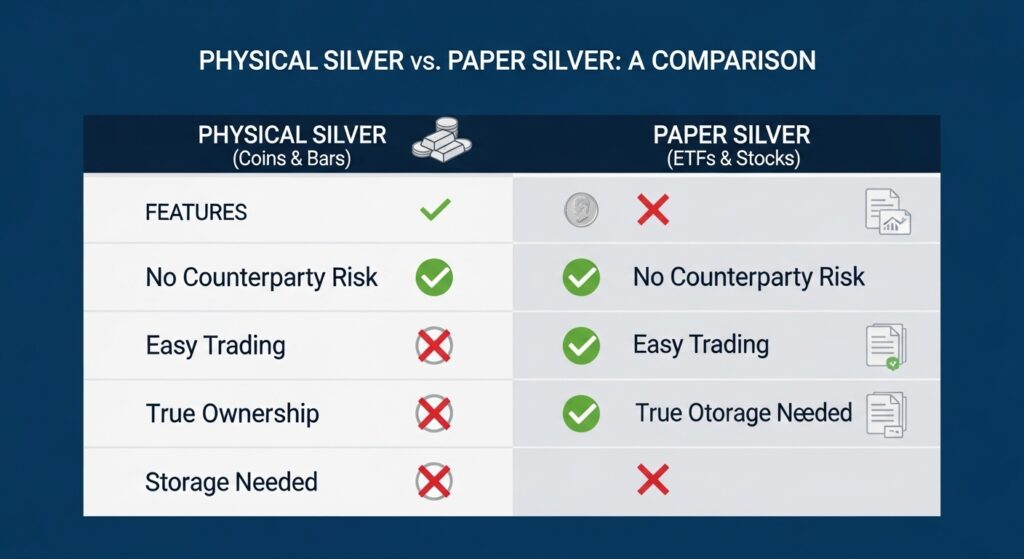
Understanding the difference between owning physical silver versus paper claims to silver determines whether you actually possess inflation protection or merely speculate on price movements.
Physical Silver Ownership
What It Means:
You purchase actual silver coins, bars, or rounds that you possess directly, store yourself or in allocated storage, and can hold in your hands. Physical ownership eliminates all intermediaries between you and your silver.
Advantages:
- Complete Control: No counterparty risk, no company bankruptcy concerns, no contract dependencies
- True Inflation Hedge: Physical silver retains purchasing power regardless of financial system performance
- No Ongoing Costs: Besides storage (which can be free if you store at home), physical silver carries no annual fees
- Privacy: Cash purchases from local dealers leave minimal records
- Emergency Liquidity: Always sellable locally without market access or functioning financial systems
Disadvantages:
- Storage Requirements: Must secure against theft, preferably in safe or vault
- Premiums Over Spot: Typically pay $2-5 over spot price for coins, $0.50-2 for bars
- Less Liquid: Selling requires finding buyer, visiting dealer, or shipping to online dealer
- Authentication Needed: Must verify authenticity when buying and selling
Best For:
Long-term wealth preservation, inflation protection, portfolio insurance, and investors prioritizing security over trading convenience.
Paper Silver Alternatives
Silver ETFs (SLV, PSLV):
These funds hold physical silver in vaults and issue shares representing fractional ownership. You trade shares like stocks but don’t possess actual silver.
- Pros: Highly liquid, no storage concerns, easy to trade, low transaction costs
- Cons: Counterparty risk, management fees (0.50% annually), cannot request physical delivery (SLV), subject to market hours
- Best Use: Trading silver price movements, retirement accounts that cannot hold physical metal
Silver Mining Stocks:
Ownership of companies that mine silver provides leveraged exposure to silver prices but introduces company-specific risks.
- Pros: Potential dividends, leverage to silver price (miners often rise/fall 2-3x silver’s move), liquid markets
- Cons: Company management risk, operational failures, political risks in mining locations, correlation breaks during company problems
- Best Use: Aggressive speculation on silver bull markets, portfolio diversification
Silver Futures Contracts:
Standardized contracts to buy/sell 5,000 ounces of silver at specified future dates, primarily used by commercial hedgers and sophisticated speculators.
- Pros: Extreme leverage, direct price exposure, high liquidity
- Cons: Requires margin account and expertise, complex rollover procedures, high risk of total loss, not suitable for physical possession
- Best Use: Professional traders and hedgers only
Which Should You Choose?
For Most Investors: Start with Physical Silver
Build your core silver position in physical coins and bars you control directly. This provides genuine inflation protection and portfolio insurance independent of financial system performance.
Add Paper Silver For:
- Trading: Use ETFs for short-term price speculation
- Retirement Accounts: Hold PSLV in IRAs where physical possession isn’t allowed
- Aggressive Growth: Allocate 10-20% to mining stocks for leverage during bull markets
Never Rely Solely on Paper Silver:
Paper alternatives introduce counterparty risk and financial system dependencies that defeat silver’s primary purpose as portfolio insurance and inflation hedge.
Types of Physical Silver to Buy
Physical silver comes in multiple forms, each with advantages, disadvantages, and appropriate use cases depending on your investment goals and budget.
Government-Minted Silver Bullion Coins
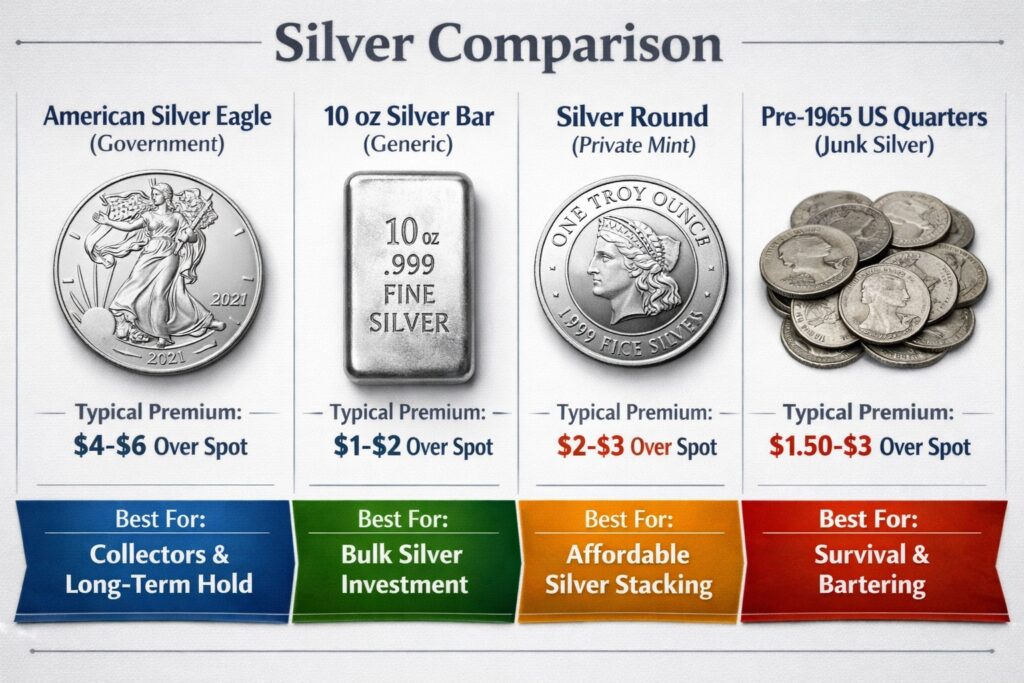
American Silver Eagle:
The most popular silver bullion coin globally, minted by the United States Mint containing exactly 1 troy ounce of .999 fine silver.
- Advantages: Highest liquidity and recognition, government-backed purity guarantee, beautiful walking liberty design, easy to authenticate
- Premiums: $3-5 over spot price typically
- When to Buy: Default choice for new silver investors prioritizing liquidity
Canadian Silver Maple Leaf:
Canada’s official silver bullion coin containing 1 troy ounce of .9999 pure silver (higher purity than Eagles).
- Advantages: Stunning design, slightly higher purity, strong anti-counterfeiting features, government guarantee
- Premiums: $2.50-4 over spot
- When to Buy: Excellent alternative to Eagles with comparable liquidity at sometimes lower premiums
Austrian Silver Philharmonic:
Europe’s most popular silver coin featuring Vienna Philharmonic orchestra design, .999 fine silver.
- Advantages: Beautiful design, high recognition in Europe and globally, government-minted quality
- Premiums: $2-4 over spot
- When to Buy: Good choice for European investors or those wanting design variety
British Silver Britannia:
United Kingdom’s official silver bullion coin with iconic Britannia design, .999 fine silver.
- Advantages: Historic design, government-backed, no capital gains tax in UK, strong anti-counterfeiting features
- Premiums: $3-5 over spot
- When to Buy: UK investors benefit from tax advantages; others consider for collection diversity
Summary: Government coins cost more than bars or rounds but provide maximum liquidity, easiest authentication, and strongest buyer confidence when selling. Start here if you’re new to silver.
Silver Bullion Bars
Sizes Available:
- 1 oz bars: Convenient and liquid, similar premium to coins
- 5 oz bars: Lower premium per ounce than 1 oz
- 10 oz bars: Popular size balancing affordability with efficiency
- 100 oz bars: Lowest premium per ounce for serious accumulation
- 1000 oz bars: Commercial/institutional size, difficult for individuals to buy/sell
Popular Refiners:
- Engelhard: Historic American refiner, highly trusted
- Johnson Matthey: Major British refiner with global recognition
- Sunshine Minting: American private mint known for quality and anti-counterfeiting features
- PAMP Suisse: Swiss refiner producing premium artistic bars
- Royal Canadian Mint: Government-backed bars with security features
Advantages:
- Lower Premiums: Typically $0.50-2 over spot versus $3-5 for coins
- Efficient Storage: Bars stack more efficiently than coins
- More Silver Per Dollar: Lower premiums mean more actual silver for your money
- Good for Large Positions: Ideal when accumulating 100+ ounces
Disadvantages:
- Less Liquid: Harder to sell than government coins
- Authentication Concerns: Must verify authenticity more carefully than government coins
- Less Flexible: 100 oz bar cannot be easily divided; you must sell entire bar
When to Buy: After establishing coin foundation, add bars to reduce premiums and maximize silver accumulation per dollar spent.
Silver Rounds
What They Are:
Privately minted coin-shaped silver pieces (not official currency) containing 1 troy ounce of .999 fine silver in various designs.
Advantages:
- Lowest Premiums: Often $1-2.50 over spot
- Same Weight/Purity: Contain same silver as government coins
- Design Variety: Thousands of designs available
Disadvantages:
- Less Recognition: Buyers less familiar with private mint products
- Harder to Authenticate: More counterfeits exist than government coins
- Lower Liquidity: Takes longer to sell than Eagles or Maples
When to Buy: Experienced buyers accumulating maximum silver on budget who understand authentication and accept slightly lower liquidity.
90% Junk Silver (US Pre-1965 Coins)
What It Is:
US dimes, quarters, and half-dollars minted before 1965 containing 90% silver, 10% copper.
Silver Content:
- $1.00 face value = 0.715 troy ounces pure silver
- $1.40 face value = approximately 1 troy ounce
- $10 face value = approximately 7.15 troy ounces
Advantages:
- Recognizable: Any American knows these coins
- Divisible: Small denominations useful in emergencies
- Lower Premiums: Often sold near melt value
- Hard to Counterfeit: Not profitable to fake worn 90% coins
Disadvantages:
- Worn Condition: Circulated coins lack collector appeal
- Calculating Content: Requires math to determine actual silver weight
- Bulky Storage: Less efficient than pure .999 bullion
When to Buy: Diversification and preparedness purposes; useful as “emergency money” in denominations smaller than 1 ounce.
Numismatic and Collectible Silver Coins
What They Are:
Rare or historic silver coins valued for rarity, condition, and collector demand beyond just silver content.
Examples:
- Pre-1933 US silver dollars
- Proof and commemorative coins
- Rare date coins in high grades
- Limited mintage special editions
WARNING FOR INVESTORS:
Numismatic coins carry markups of 50-500% above silver value based on perceived collector appeal. Unless you’re experienced in rare coin grading and markets:
- Avoid: “Rare” or “collectible” coins for investment purposes
- Stick to: Bullion priced near silver content
- Risk: Huge markups difficult to recover when selling
When to Buy: Only if you’re an experienced collector who understands grading, rarity, and numismatic markets. Not appropriate for silver investment.
What Should Beginners Buy?
Recommended Starting Strategy:
- First Purchase: 5-10 American Silver Eagles or Canadian Maple Leafs (government-minted, highest liquidity)
- Next Purchase: Add 10 oz silver bar from reputable refiner (lower premium, building position)
- Ongoing Accumulation: Mix of government coins (60%) and bars (40%) balancing liquidity and cost-efficiency
- Optional Addition: Small amount of junk silver for divisibility and emergency preparedness
Avoid When Starting:
- Numismatic/collectible coins
- Extremely large bars (100+ oz) before building experience
- Obscure private mint rounds with limited recognition
Where to Buy Silver
Selecting reputable dealers prevents costly mistakes and fraud. You have three main options: online dealers, local coin shops, or banks/financial institutions.
Online Bullion Dealers (Best for Most Buyers)
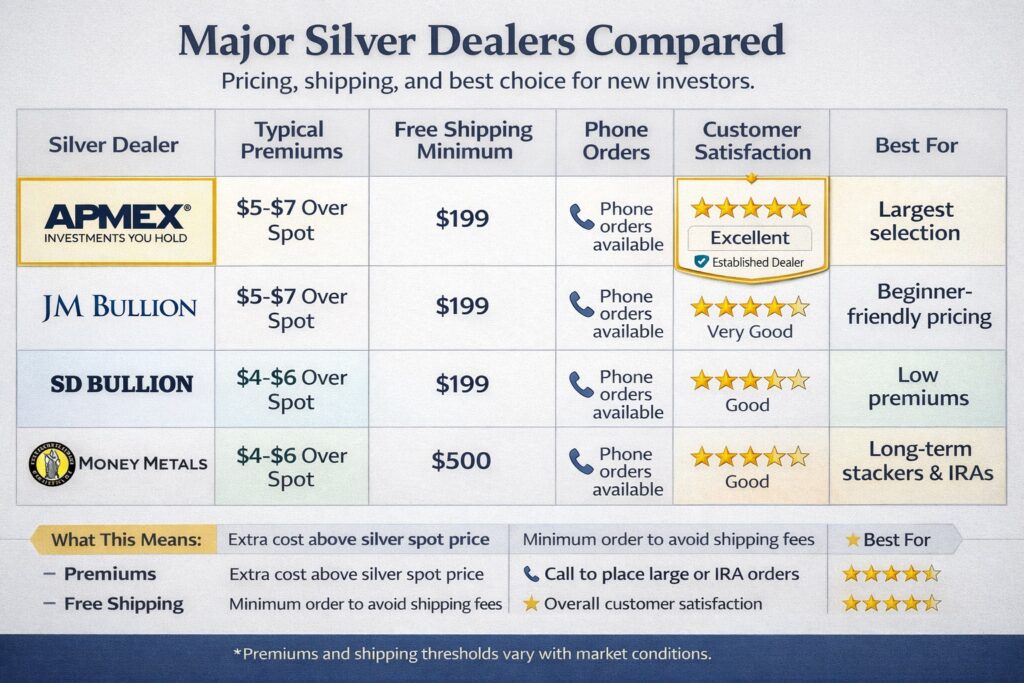
APMEX (American Precious Metals Exchange)
- Website: APMEX.com
- Phone: 1-800-375-9006
- Advantages: Largest selection in America (thousands of products), competitive pricing, excellent customer service, reliable shipping
- Shipping: Free on orders $199+, insured automatic
- Buyback: Yes, competitive pricing
- Best For: Beginners wanting maximum selection and established reputation
- Typical Premium: Eagles $3-4 over spot, bars $1-2 over spot
JM Bullion
- Website: JMBullion.com
- Phone: 1-800-276-6508
- Advantages: Very competitive pricing, clean website, fast shipping, transparent pricing
- Shipping: Free on orders $199+
- Buyback: Yes
- Best For: Price-conscious buyers wanting established dealer
- Typical Premium: Among lowest in industry for most products
SD Bullion
- Website: SDBullion.com
- Phone: 1-800-294-8732
- Advantages: Consistently lowest premiums, weekly specials, straightforward approach
- Shipping: Free on orders $199+
- Buyback: Yes
- Best For: Maximum silver per dollar, experienced buyers
- Typical Premium: Frequently beats competitors by $0.25-0.75/oz
Money Metals Exchange
- Website: MoneyMetals.com
- Phone: 1-800-800-1865
- Advantages: Monthly precious metals savings plans, excellent education, competitive pricing
- Shipping: Free on orders $500+
- Buyback: Yes, very competitive
- Best For: Dollar-cost averaging through monthly plans
- Typical Premium: Competitive, good monthly specials
Provident Metals
- Website: ProvidentMetals.com
- Advantages: Owned by JM Bullion, similar pricing and reliability
- Shipping: Free on orders $199+
- Best For: Alternative to JM Bullion with sometimes different inventory
Online Dealer Advantages:
- Best pricing (lower overhead than physical stores)
- Huge selection (thousands of products)
- Convenient (shop from home)
- Competitive markets (easy to compare prices)
- Secure shipping (fully insured)
Online Dealer Disadvantages:
- Cannot inspect before purchase
- Shipping delays possible (3-7 business days typical)
- Wire transfers or check payments for best pricing
- Minimum order sizes for free shipping
Local Coin Shops (LCS)
Finding Local Dealers:
- Google Maps: Search “coin shop near me” or “silver dealer [your city]”
- USNUG.org: Directory of numismatic dealers
- Ask local jewelers for referrals
Advantages:
- Immediate Possession: Walk in, buy, leave with silver
- Inspect Before Purchase: See exactly what you’re buying
- Build Relationships: Repeat business often gets better deals
- Private Transactions: Cash purchases leave minimal records
- Local Support: Support small business in your community
- Negotiation Possible: Sometimes negotiate pricing
Disadvantages:
- Higher Premiums: Typically $1-2 more per ounce than online
- Limited Selection: Smaller inventory than online dealers
- Inconvenient: Requires driving, limited hours
- Variable Pricing: Prices vary significantly between shops
How to Use Local Shops:
- Call First: Verify they have what you want before driving
- Visit Multiple Shops: Compare pricing and selection
- Ask About Buyback: Understand their selling policies
- Check Reviews: Google and Facebook reviews reveal reputation
- Start Small: Test dealer with small purchase before major buy
When to Use Local Shops:
- Want immediate possession
- Buying with cash for privacy
- Selling silver for quick payment
- Building local relationship for future purchases
Regional Precious Metals Shows
What They Are:
Periodic events where dozens of dealers set up temporary booths selling coins, bullion, and collectibles.
Finding Shows:
- Search “[your state] coin show schedule”
- CoinShows.com
- Local coin club websites
Advantages:
- Compare dozens of dealers in one location
- Negotiate pricing
- Inspect large inventory before purchasing
- Sometimes find below-market deals
- Network with experienced collectors
Disadvantages:
- Infrequent (quarterly or less in most cities)
- Requires travel
- Overwhelming for beginners
- Risk of impulse purchases
When to Attend:
After gaining experience with online and local purchases, shows provide opportunities to expand knowledge and potentially find competitive pricing.
Banks (Very Limited)
Reality:
Few banks sell silver anymore. Some carry American Silver Eagles but at premiums 20-50% above online dealers.
Not Recommended:
Banks charge excessive premiums and offer limited selection. Use online dealers or local coin shops instead.
What to Avoid
eBay, Craigslist, Facebook Marketplace:
- High Counterfeit Risk: Fake silver floods these platforms
- No Recourse: Difficult to recover funds from scammers
- Recommendation: Avoid entirely unless very experienced with authentication
TV Shopping Networks (QVC, HSN, ShopHQ):
- Markups: 50-200% above spot price common
- Target: Uninformed buyers who don’t compare prices
- Recommendation: Never purchase from TV shopping
“Rare Coin” Telemarketers:
- Common Scam: High-pressure sales of “collectible” coins at extreme markups
- Tactics: Create urgency, claim special deals, target elderly
- Recommendation: Hang up immediately
“Free Silver” Offers:
- Bait-and-Switch: Require purchase of overpriced products to receive “free” silver
- Reality: Hidden costs exceed silver value
- Recommendation: Ignore completely
Payment Methods and Costs
Bank Wire Transfer:
- Advantages: No fee from most dealers, fastest processing
- Disadvantages: Bank charges $15-35 wire fee
- Best For: Orders over $1,000 where fee percentage is minimal
Personal Check:
- Advantages: No fee
- Disadvantages: 5-10 day hold while check clears
- Best For: Patient buyers avoiding wire fees
Credit Card:
- Fees: 3-4% processing fee
- Advantages: Immediate processing, buyer protection, points/rewards
- Disadvantages: Fees eliminate savings from competitive pricing
- Best For: Small purchases under $500 where convenience matters
PayPal/Digital Payments:
- Availability: Limited (few dealers accept)
- Fees: Similar to credit cards when accepted
Cash (Local Shops):
- Advantages: Immediate, private, sometimes negotiable discount
- Disadvantages: Security risk carrying large amounts
- Reporting: Dealers must report cash purchases over $10,000
How to Evaluate Silver Quality and Avoid Fakes
Counterfeit silver costs buyers thousands annually. Learning basic authentication protects your investment.
Verify Purity Markings
What to Look For:
- .999 or 99.9% Pure Silver: Standard for modern bullion
- .9999 or 99.99% Pure: Higher purity (Canadian Maples, some bars)
- Troy Ounce: Weight specification (1 troy ounce = 31.1 grams)
- Mint Mark: Identifies manufacturer (important for authenticity)
Government Coins:
All legitimate government bullion includes mintmark, date, denomination, and purity.
Bars:
Should show refiner name, purity, weight, and often serial number.
Basic Authentication Tests
Visual Inspection:
- Weight: Verify on precise scale (1 troy oz = 31.1 grams exactly)
- Dimensions: Compare to published specifications
- Details: Government coins show sharp, clear details; fakes often appear soft or blurry
- Color: Real silver has distinctive white-gray color; fakes sometimes have color off
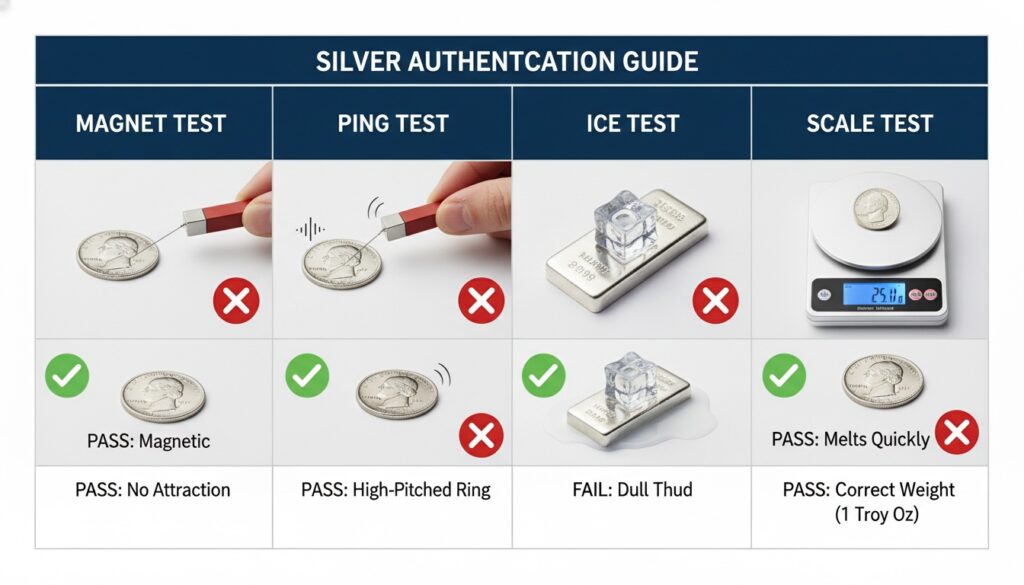
Magnet Test (Easiest):
Pure silver is non-magnetic. Run strong magnet over coin/bar:
- Slides off quickly: Likely real silver (silver is slightly repelled)
- Sticks to magnet: Definitely fake (real silver never magnetic)
- Slows down significantly: Possible fake with steel core
Note: Passing magnet test doesn’t guarantee authenticity (some fakes use non-magnetic metals), but failing means certain fake.
Ping Test (Sound Test):
Real silver produces distinctive high-pitched ringing when struck:
- Balance coin/bar on fingertip
- Tap gently with another coin/metal object
- Real Silver: Clear, sustained ring (lasts 1-2 seconds)
- Fake: Dull thud or very brief sound
Search “silver ping test” on YouTube for audio examples before trying.
Ice Test (Fun but Limited):
Silver has highest thermal conductivity of any metal:
- Place ice cube on silver coin/bar
- Real Silver: Ice melts noticeably faster than on other surfaces
- Fake: Ice melts normally
Note: This works best with larger pieces (bars) where thermal mass shows difference. Limited usefulness with coins.
Advanced Authentication
Sigma Metalytics Verifier ($800-1,200):
Professional device measuring electrical conductivity to verify precious metals:
- Accuracy: Very high for government coins and major mint bars
- Speed: Instant results
- When Worth It: Buying regularly or dealing with large amounts
Specific Gravity Test:
Measures density by weighing in air and water:
- Silver Specific Gravity: 10.5
- Process: Requires precision scale and calculations
- Accuracy: Very high when done correctly
- Complexity: More involved than other tests
X-Ray Fluorescence (XRF) Analysis:
Professional analysis accurately measuring metal composition:
- Where: Some coin shops and refiners offer testing
- Cost: $10-50 per test
- Accuracy: Definitive
Spot Common Counterfeits
Chinese Fakes:
The majority of counterfeits originate in China, often sold through eBay/Aliexpress:
- Silver-Plated Tungsten: Correct weight but steel/tungsten core plated with thin silver
- Detection: Ping test and magnet test usually reveal these
- Sophistication: Improving constantly; newer fakes pass simple tests
Wrong Specifications:
Compare dimensions and weight to official specifications:
- American Silver Eagles: 40.6mm diameter, 2.98mm thick, 31.101 grams
- Canadian Maples: 38mm diameter, 3.29mm thick, 31.39 grams
- 10 oz bars: Vary by manufacturer but should be exactly 311.03 grams
Off Weight/Size = Definite Fake
Buying Safely
Start with Government Coins:
American Eagles and Canadian Maples are hardest to fake profitably. Build experience with these before buying bars or rounds.
Buy from Reputable Dealers:
APMEX, JM Bullion, SD Bullion, and established local shops guarantee authenticity. Private sellers carry much higher risk.
If Deal Seems Too Good:
It probably is. Silver trades globally; if someone offers significantly below market price, question why.
Test Everything:
Even from reputable dealers, verify your purchases with magnet and ping tests. Mistakes happen; ensure what you received matches what you ordered.
Silver prices fluctuate constantly based on global supply, demand, economic conditions, and currency values. Understanding pricing components helps you buy at fair prices.
Spot Price Explained
What It Is:
The current market price for immediate delivery of one troy ounce of .999 fine silver, traded globally 24 hours except weekends.
Where It’s Set:
Major futures exchanges including COMEX (New York) and London Bullion Market determine spot price through trading activity.
How to Check:
- Kitco.com: Real-time spot prices, charts, market commentary
- GoldPrice.org: Multi-currency spot prices
- Dealer Websites: Most display current spot prominently
Price Movement:
Silver trades actively, moving several percent daily during volatile periods. Price changes continuously during market hours (Sunday 6 PM – Friday 5 PM ET).
Premium Over Spot
What It Is:
The additional cost above spot price you pay when buying from dealers.
What It Covers:
- Minting/Manufacturing Costs: Creating coins and bars from raw silver
- Distribution: Shipping from refineries to dealers
- Dealer Operating Costs: Rent, staff, insurance, overhead
- Dealer Profit Margin: Reasonable profit for service provided
Typical Premiums:
- American Silver Eagles: $3-5 per ounce over spot
- Canadian Silver Maples: $2.50-4 per ounce over spot
- Generic Silver Rounds: $1-2.50 per ounce over spot
- Silver Bars (10 oz): $0.75-1.50 per ounce over spot
- Silver Bars (100 oz): $0.50-1 per ounce over spot
- Junk Silver (90%): $0.50-1.50 per ounce over spot
Premium Factors:
- Product Type: Coins cost more than bars due to manufacturing complexity
- Quantity: Larger purchases reduce premiums (100 oz cheaper than 10 oz per ounce)
- Supply/Demand: High demand increases premiums; mints sometimes cannot keep up
- Dealer: Online dealers typically charge lower premiums than local shops
What’s Fair?
Compare multiple dealers. If one dealer’s premium is 50%+ higher than competitors for identical product, shop elsewhere.
Additional Costs
Shipping:
- Online Dealers: Usually $8-30 for standard shipping
- Free Shipping Minimums: Most waive shipping on orders $199-500+
- Insurance: Included automatically on bullion shipments
- Signature: Required on delivery
Payment Method Fees:
- Wire Transfer: Free from dealer; bank charges $15-35
- Check: Free but delays order 5-10 days
- Credit Card: 3-4% processing fee
- PayPal: Similar to credit cards where accepted
Sales Tax:
- Varies by State: Some states tax precious metals, others exempt
- Exemption Minimums: Many states exempt purchases over $1,000-1,500
- Online Purchases: Generally charged based on buyer’s state
- Check Your State: Verify tax law before purchasing
When to Buy Silver
Dollar-Cost Averaging (Recommended):
Buy fixed dollar amount monthly (e.g., $200/month) regardless of price. This averages out volatility and removes emotion from timing decisions.
Buy Dips (Advanced):
- Significant Corrections: When silver drops 10-20% from recent highs
- Extreme Negativity: When sentiment is extremely pessimistic
- Technical Support: Near historically significant price levels
Avoid:
- Trying to Time Bottom Perfectly: Impossible consistently
- Waiting for “Better Price” Forever: Missing accumulation entirely
- Panic Buying During Rallies: Premiums spike when prices surge; already missed move
Best Approach:
Commit to regular accumulation (monthly or quarterly) and add extra during significant corrections if able.
Silver Storage and Security
Protecting your silver from theft, damage, and loss requires thoughtful storage decisions.
Home Storage
Safe Storage:
- Bolted Safe: Minimum 500-pound safe bolted to floor/wall
- Fireproof Rating: 1-2 hour fire protection minimum
- Hidden Location: Not in master bedroom (first place burglars check)
- Cost: $500-2,000 for quality safe
Creative Hidden Storage:
- PVC pipe buried in yard (for long-term storage only)
- Fake wall outlets or air vents
- Hidden compartments in furniture
- Multiple smaller locations rather than one large stash
Advantages:
- Immediate access when needed
- No ongoing fees
- Complete privacy
- Control over security measures
Disadvantages:
- Theft risk if security inadequate
- Fire risk even with fireproof safe
- Flood/disaster risk
- Homeowner’s insurance often limits precious metals coverage to $1,000-2,000
Insurance Consideration:
Contact insurance agent about precious metals rider covering full value. Typical cost: 1-2% of value annually.
Best Practices:
- Don’t tell anyone you own silver (loose lips sink ships)
- Document with photos and serial numbers, store copies offsite
- Consider security system and cameras
- Split between multiple locations if holding substantial amounts
Bank Safe Deposit Box
What It Is:
Rental box inside bank vault where you store valuables under dual-key system (bank key + your key).
Cost:
$50-200 annually depending on box size and bank.
Advantages:
- Very secure (bank vault protection)
- Affordable
- Protected from home theft/fire
- Established legal framework
Disadvantages:
- Limited Access Hours: Bank hours only (no weekend or evening access)
- No Insurance: Banks don’t insure box contents; you must insure separately
- Privacy Concerns: Government can potentially access during investigations
- Potential Seizure: Theoretical risk of government seizure (historically rare for individuals)
What to Store:
Portion of holdings you won’t need immediate access to. Keep some at home for liquidity.
Private Vault Storage
Professional Storage Companies:
- Brinks: Global security company offering precious metals storage
- IDS (International Depository Services): Specialized precious metals storage
- Private Vaults Inc: Allocated storage with complete privacy
Allocated vs Unallocated:
- Allocated Storage: Specific bars/coins assigned to you, segregated, identifiable
- Unallocated Storage: You own quantity but not specific items (pooled storage)
- ONLY USE ALLOCATED: Unallocated carries counterparty risk; company could sell/lend your metal
Costs:
- Setup Fee: $0-100
- Annual Fee: $150-500+ depending on quantity and company
- Insurance: Usually included
Advantages:
- Maximum security (professional vaults)
- Fully insured
- Segregated storage (allocated)
- Access during business hours
- Can often ship directly to vault from dealer
Disadvantages:
- Ongoing annual costs
- Limited access (must visit facility or arrange shipping)
- Must trust storage company
When to Consider:
Holdings exceeding $25,000-50,000 where professional storage justifies cost and provides insurance coverage home insurance won’t match.
Offshore Storage
Some investors store silver in foreign vaults (Singapore, Switzerland, Hong Kong) for geographic diversification and potential privacy advantages.
Advantages:
- Geographic diversification
- Political risk mitigation
- Potential privacy benefits
Disadvantages:
- Complex logistics
- Higher costs
- Limited access
- Requires trusting foreign institution
Recommendation:
Advanced strategy for sophisticated investors with substantial holdings, not beginners.
Storage Strategy for Different Holdings
$1,000-5,000:
Home safe, document everything, add insurance rider.
$5,000-25,000:
Split between home safe (60%) and bank deposit box (40%).
$25,000-100,000:
Home safe (30%), bank deposit box (30%), private allocated storage (40%).
$100,000+:
Professional allocated storage (50%), multiple bank deposit boxes (30%), home safe (20%).
Key Principle:
Don’t keep all silver in one location. Diversify storage to reduce any single point of failure.
Common Silver Buying Mistakes
1. Paying Too Much Premium
The Mistake:
Buying collectible or numismatic coins marketed as investments when paying 50-200% above silver content.
Why It Happens:
- Dealers market “rare” or “limited edition” coins to uninformed buyers
- Telemarketers pressure with false scarcity claims
- TV shopping networks charge extreme markups
Reality:
Unless you’re experienced numismatist, collectible value rarely justifies premiums. Most “special” coins sell for melt value when you liquidate.
Solution:
Stick to bullion (coins priced near silver value). Compare dealer premiums. Never buy from TV shopping or telemarketers.
2. Not Verifying Authenticity
The Mistake:
Buying from unknown sellers without testing, assuming silver is genuine.
Why It Happens:
- Trusting “too good to be true” deals
- Buying from eBay/Craigslist without expertise
- Skipping authentication tests even from reputable dealers
Reality:
Counterfeits flood secondary markets. Even authentic-looking products can be fake.
Solution:
Buy from reputable dealers. Test everything with magnet and ping tests. If buying privately, use XRF or specific gravity testing.
3. Poor Storage Decisions
The Mistake:
- Keeping all silver in one location
- No safe or security
- Telling friends/family about holdings
- Inadequate insurance
Why It Happens:
Underestimating theft risk or not wanting to “spend” on security after buying silver.
Reality:
Home burglaries occur daily. Without proper storage and insurance, total loss is possible.
Solution:
Invest in quality safe, diversify storage locations, maintain privacy, obtain insurance coverage. Security costs are tiny compared to silver value.
4. Timing Mistakes
The Mistake:
- Waiting for “perfect price” and never buying
- Panic buying during price spikes (when premiums are highest)
- Trying to trade silver actively like stocks
Why It Happens:
Fear of buying at wrong time leads to paralysis or emotional decisions.
Reality:
Silver’s volatility makes timing impossible. Active trading generates fees and rarely outperforms buy-and-hold.
Solution:
Dollar-cost average with regular purchases. Ignore short-term volatility. View silver as long-term insurance, not trading vehicle.
5. Wrong Products for Goals
The Mistake:
- Buying 100 oz bars as beginner (illiquid, hard to sell partially)
- Buying only coins when bars offer better value for large positions
- Focusing on collectibles instead of bullion
Why It Happens:
Lack of understanding about liquidity, divisibility, and premiums.
Reality:
- Large bars difficult to sell in small amounts
- Pure bullion outperforms collectibles for investment
- Coins provide better liquidity but cost more
Solution:
Start with government coins (10-20 oz). Add bars as you accumulate. Prioritize liquidity early.
6. Ignoring Exit Strategy
The Mistake:
- No plan for eventually selling
- Buying forms difficult to liquidate
- Not understanding dealer buyback policies
Why It Happens:
Focusing only on buying without considering selling.
Reality:
You’ll eventually sell. Illiquid forms or no exit plan creates problems.
Solution:
Buy from dealers who buyback (APMEX, JM Bullion, local shops). Keep government coins for easiest selling. Understand typical bid-ask spreads (dealer pays 2-5% below spot usually).
How to Sell Your Silver
Where to Sell
Online Dealers (Best Prices Usually):
Major dealers buy back silver:
- APMEX: Competitive buyback pricing, easy online process
- JM Bullion: Good buyback prices, simple process
- SD Bullion: Competitive on larger quantities
Process:
- Get quote on dealer website
- Print shipping label
- Ship with insurance and signature
- Dealer inspects and confirms
- Payment sent (check or wire)
Advantages:
- Competitive pricing (close to spot)
- Convenient (ship from home)
- Established process
Disadvantages:
- Shipping delays (3-5 days)
- Payment delays (5-10 days for check)
- Must ship before getting paid (trust required)
Local Coin Shops:
Advantages:
- Immediate payment (cash same day)
- No shipping hassles
- Personal relationship if established
Disadvantages:
- Lower prices than online dealers (typically 5-10% less)
- Must transport silver securely
- Limited by shop’s cash availability
Private Sales:
Advantages:
- Potential best price (avoid dealer margins)
- Immediate transaction
Disadvantages:
- Finding qualified buyers
- Safety concerns (meeting with cash)
- Potential scams
- Legal reporting requirements
Not Recommended for Large Sales:
Too risky unless you have established relationships.
Getting Best Price
Compare Multiple Offers:
Contact 3-5 buyers before selling. Prices vary significantly.
Understand Bid-Ask Spread:
- Spot Price: $25/oz
- Retail Price (what you paid): $28/oz (Eagles with $3 premium)
- Dealer Buyback: $23-24/oz (dealer pays slightly below spot)
This is Normal:
Dealers must buy below spot to resell at profit. Spread of $1-2 below spot is fair.
Sell During High Demand:
- Prices rising = dealers pay more
- Supply shortages = higher buyback prices
- Monday mornings often best (weekend buying creates Monday demand)
Timing Considerations:
- Tax Year End: Some investors sell before year-end for tax purposes
- Price Spikes: Consider selling portion during 20%+ rallies
- Portfolio Rebalancing: Sell if silver exceeds target allocation
Tax Implications
Capital Gains Tax Applies:
- Profit = Sale Price – Purchase Price
- Short-term (held <1 year): Taxed as ordinary income
- Long-term (held >1 year): Taxed at capital gains rate (0-20% depending on income)
Reporting Requirements:
- Dealers must report sales over certain thresholds (1,000 oz silver, 25 oz Gold Eagles, etc.) using Form 1099-B
- You must report all capital gains on tax return regardless of reporting
- Keep purchase receipts to prove cost basis
Consult Tax Professional:
Tax laws complex. If selling substantial amounts, get professional advice to minimize legal tax liability.
Getting Started: Step-by-Step
Step 1: Set Your Budget
How Much to Invest:
- Beginners: Start with $500-1,000
- Portfolio Allocation: 5-10% of investment portfolio in precious metals (gold + silver combined)
- Regular Accumulation: Commit to monthly purchases ($100-500/month)
Don’t:
- Invest money needed for living expenses
- Borrow to buy silver
- Put entire savings into silver
Do:
- Start small and learn
- Build position gradually
- View as long-term insurance, not get-rich-quick
Step 2: Choose Your Products
First Purchase (Recommended):
- Option A: 10 American Silver Eagles (approximately $280-300)
- Option B: 5 American Eagles + 1x 10 oz bar (approximately $300-330)
- Option C: 20 Canadian Maples if wanting maximum ounces (approximately $550-600)
Why Start with Coins:
- Highest liquidity
- Easiest to authenticate
- Recognize/trust when selling
- Divisible (sell some, keep some)
Step 3: Select Your Dealer
Compare These Dealers:
- Visit APMEX.com, JMBullion.com, SDBullion.com
- Search for “American Silver Eagle”
- Compare total cost including shipping
- Read customer reviews
- Select dealer with best combination of price, reputation, service
Or Local:
- Google “coin shop near me”
- Call 2-3 shops
- Ask prices for Eagles or Maples
- Visit shop with best price
- Inspect before purchasing
Step 4: Make First Purchase
Online Process:
- Add products to cart
- Create account (name, email, address)
- Select payment method (check or wire for best price)
- Review order carefully
- Complete payment
- Receive confirmation email
- Wait for shipping (3-7 business days)
- Signature required on delivery
Local Process:
- Call to verify inventory and price
- Visit during business hours
- Inspect products before purchasing
- Pay (cash, check, or credit card)
- Get receipt
- Leave with silver immediately
Step 5: Verify and Store
Upon Receiving:
- Verify Count: Ensure you received correct quantity
- Inspect Condition: Check for damage during shipping
- Test Authenticity: Magnet test and ping test
- Photograph: Document what you received
- Store Receipt: Keep with investment records
- Secure Storage: Immediately put in safe or secure location
Step 6: Build Gradually
Ongoing Accumulation:
- Set monthly or quarterly purchase amount
- Buy consistently regardless of price (dollar-cost averaging)
- Add to position during significant dips if able
- Track total ounces and average cost
Expand Product Mix:
- After 20-50 oz in coins, add bars for lower premiums
- Consider small amount of junk silver for divisibility
- Diversify between coins and bars
Don’t:
- Try to time the market perfectly
- Skip months waiting for “better prices”
- Panic sell during corrections
Step 7: Review and Adjust
Quarterly Review:
- Calculate total ounces owned
- Verify storage security adequate
- Check insurance coverage sufficient
- Rebalance if silver exceeds target allocation
Annual Actions:
- Photograph holdings (updated records)
- Review storage strategy
- Consider tax implications if selling
- Assess whether accumulation rate appropriate
Silver offers accessible, tangible wealth preservation combining precious metal security with industrial demand fundamentals. Unlike gold’s $2,000+ entry point, silver allows meaningful position building starting with modest capital while maintaining inflation protection and portfolio diversification benefits.
Most silver buyers fail not from market timing but from paying excessive premiums for collectible coins, buying from disreputable dealers, inadequate storage security, or selling during temporary corrections. Success requires buying bullion near silver value from established dealers, verifying authenticity, storing securely with proper insurance, and viewing silver as long-term portfolio insurance rather than trading vehicle.
Start small with government-minted coins from reputable online dealers or established local shops, verify every purchase with simple authentication tests, invest in proper storage from day one, and build your position through consistent dollar-cost averaging rather than attempting perfect market timing.
Ready to Start Investing in Silver?
Begin by opening accounts at APMEX.com or JMBullion.com and comparing current pricing on American Silver Eagles or Canadian Maple Leafs. Start with 5-10 coins ($150-300 investment) to learn the buying process and authentication basics. Focus on steady accumulation through monthly purchases rather than trying to time perfect entry points. Review our How to Buy Gold guide, Gold IRA information, and Commodities section for comprehensive precious metals education.