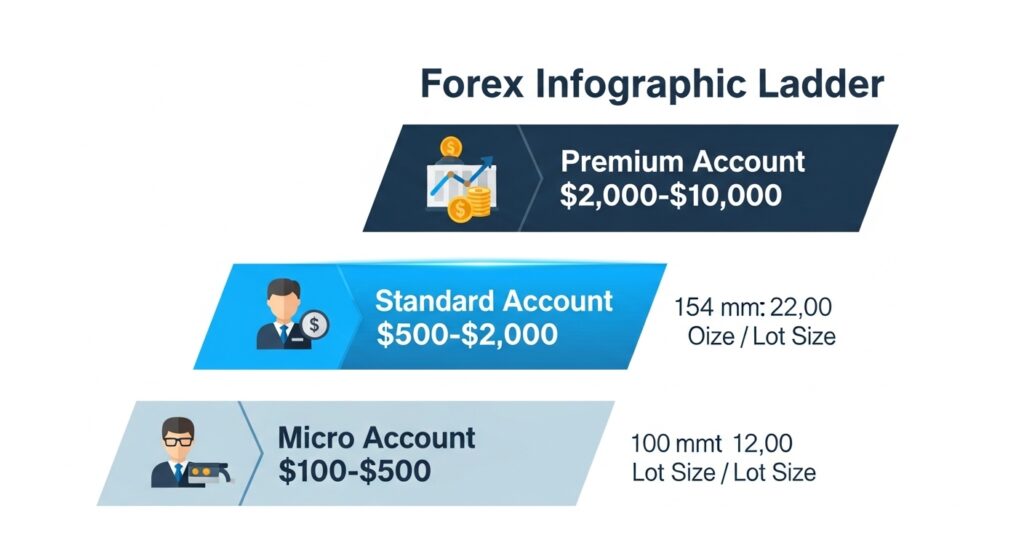
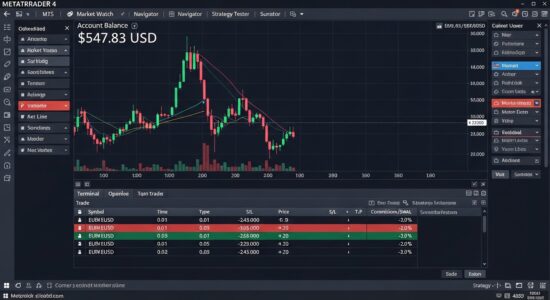
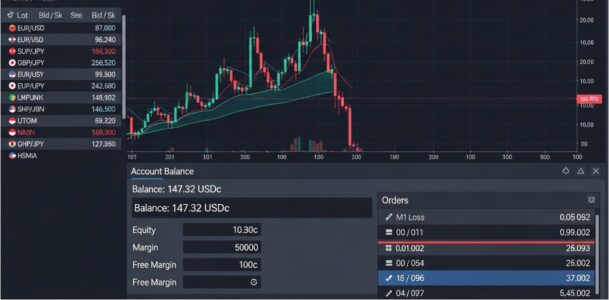
Standard forex accounts represent the bridge between beginner-level micro accounts and professional-grade premium accounts. With typical minimum deposits of $500-$2,000, standard accounts provide access to competitive spreads, full platform features, and the position sizing flexibility needed to generate meaningful returns while maintaining proper risk management.

This guide explains what standard accounts are, who should use them, and how to trade them effectively as you develop from beginner to intermediate trader.
What Are Standard Forex Accounts
Standard forex accounts are retail trading accounts offered by regulated brokers with minimum deposits typically ranging from $500 to $2,000. Unlike micro accounts that limit you to micro lots, standard accounts provide full access to mini lots (10,000 units) and standard lots (100,000 units), allowing more precise position sizing and larger profit potential.
The term “standard account” distinguishes these mainstream retail accounts from specialized account types. They offer the complete broker platform experience without the limitations of micro accounts or the premium pricing structures of professional-tier accounts.
Standard accounts represent the account type most retail traders use once they’ve proven basic competency and accumulated sufficient capital to trade with proper risk management.
According to the National Futures Association, selecting an account type appropriate to your capital and experience level is fundamental to managing trading risk effectively.
Key Features of Standard Forex Accounts
Account Size Requirements
Typical minimum deposits:
- $500: Entry-level standard accounts at most brokers
- $1,000: More comfortable starting point with adequate margin cushion
- $2,000: Ideal balance between accessibility and trading flexibility
Most brokers consider $500-$2,000 deposits as standard retail accounts, though some classify accounts under $1,000 as “starter” or “basic” accounts with slightly different fee structures.
Lot Size Access
Standard accounts typically allow:
- Micro lots (1,000 units): $0.10 per pip on major pairs
- Mini lots (10,000 units): $1.00 per pip on major pairs
- Standard lots (100,000 units): $10.00 per pip on major pairs
This flexibility allows precise position sizing. A $1,000 account can trade 1-5 mini lots comfortably, while a $2,000 account can begin exploring standard lot trading with proper risk management.
For detailed lot size mechanics, see our guide on What is a Lot in Forex.
Competitive Spreads
Standard accounts typically offer:
- EUR/USD: 0.8-1.5 pips
- GBP/USD: 1.0-2.0 pips
- USD/JPY: 0.8-1.5 pips
- AUD/USD: 1.0-2.0 pips
These spreads are significantly tighter than micro account offerings, improving profit potential by reducing transaction costs.
Full Platform Access
Standard accounts provide:
- Complete charting tools and technical indicators
- Expert Advisor (EA) compatibility
- One-click trading capabilities
- Mobile platform access
- Full order type availability (market, limit, stop, trailing stops)
Unlike some micro accounts with limited features, standard accounts offer the complete trading infrastructure needed for serious trading.
Regulatory Protection
The Commodity Futures Trading Commission regulates forex brokers serving US clients, ensuring standard accounts maintain segregated client funds and meet minimum capital requirements for broker financial stability.
Who Should Use Standard Accounts
Traders with $500-$2,000 Capital
If you’ve accumulated $500-$2,000 for trading, standard accounts provide:
- Proper position sizing flexibility
- Access to competitive spreads that don’t erode profits
- Meaningful profit potential (5-10% monthly = $25-$200)
- Room for multiple simultaneous positions
This capital range makes standard accounts practical rather than the constrained experience of micro accounts.
Graduates from Micro Accounts
Traders who have:
- Demonstrated 3-6 months of consistent profitability on micro accounts
- Grown a $200-$500 micro account to $500-$1,000
- Proven disciplined risk management (1-2% per trade)
- Developed a documented, repeatable trading strategy
Standard accounts represent the natural progression as skills and capital develop.
For complete details on micro accounts, see our Forex Micro Accounts: Complete Guide.
Part-Time Traders Seeking Supplemental Income
Those trading 1-3 hours daily benefit from standard accounts because:
- $500-$2,000 capital generates meaningful supplemental income ($50-$200 monthly at realistic 5-10% returns)
- Position sizes create sufficient profit potential to justify time investment
- Flexibility to trade multiple strategies or pairs simultaneously
- Psychological satisfaction of seeing meaningful dollar profits
Strategy Developers Testing for Scale
Traders with proven strategies on demo or micro accounts use standard accounts to:
- Validate strategy performance with realistic spreads and slippage
- Test position sizing calculations before larger capital deployment
- Evaluate broker execution quality at sizes relevant to future scaling
- Prove strategy viability generates meaningful absolute returns
Standard vs Micro vs Premium Accounts
| Feature | Micro Account | Standard Account | Premium Account |
|---|---|---|---|
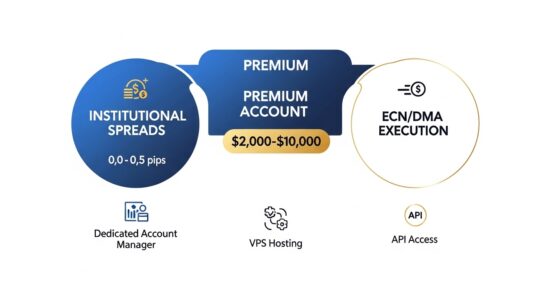
| Minimum Deposit | $100-$500 | $500-$2,000 | $2,000-$10,000 |
| Typical Balance | $100-$1,000 | $500-$5,000 | $5,000-$50,000 |
| Primary Lot Size | Micro (1,000 units) | Mini/Standard | Standard lots |
| EUR/USD Spread | 1.5-2.5 pips | 0.8-1.5 pips | 0.5-1.0 pips |
| Pip Value Range | $0.10-$1.00 | $1.00-$10.00 | $10.00-$100.00 |
| Monthly Profit Potential | $10-$50 (10%) | $50-$200 (10%) | $500-$5,000 (10%) |
| Platform Features | Sometimes limited | Full access | Full + premium tools |
| Customer Support | Standard | Priority | Dedicated account manager |
| Execution Quality | Good | Excellent | Best available |
| Commission Structure | Spread-only | Spread or commission | Usually commission-based |
The Financial Conduct Authority emphasizes that traders should select account types aligned with their capital, experience, and trading objectives.
Choosing a Standard Account Broker

Regulation and Safety
Prioritize brokers with strong regulatory oversight:
US Traders:
- NFA-registered brokers only (OANDA, FOREX.com, Interactive Brokers)
- CFTC oversight ensures client fund protection
- Limited leverage (50:1 major pairs, 20:1 others)
UK/EU Traders:
- FCA or CySEC regulated brokers
- ESMA investor protection regulations
- Negative balance protection
International Traders:
- ASIC (Australia), FSA (Japan), or equivalent top-tier regulators
- Avoid unregulated or lightly regulated offshore brokers
For comprehensive broker selection guidance, see our How to Choose a Forex Broker guide.
Spread and Commission Comparison
Compare total trading costs across brokers:
Spread-Only Brokers:
- All costs built into spread
- Simpler fee structure
- Typically 1.0-2.0 pip spreads on majors
Commission-Based Brokers:
- Raw spreads (0.0-0.5 pips) plus commission ($3-$7 per round turn)
- Often lower total cost for active traders
- More complex cost calculation
Calculate total cost per trade including both spreads and commissions to make fair comparisons.
Execution Quality
Test these factors on demo accounts:
Order Execution Speed:
- Instant execution vs market execution
- Requotes frequency during volatile periods
- Slippage on stop losses and take profits
Platform Stability:
- Uptime during major news events
- Mobile platform reliability
- Server response times
Fill Quality:
- Spread widening during news releases
- Rejection rate on limit orders
- Overnight gap handling
Platform and Tools
Evaluate platform offerings:
Trading Platforms:
- MetaTrader 4/5 (industry standard)
- Proprietary platforms (cTrader, broker-specific)
- Web-based platforms for flexibility
Analysis Tools:
- Economic calendar integration
- News feeds
- Technical analysis tools
- Trade journal features
Mobile Trading:
- Full-featured mobile apps
- Order management on mobile
- Push notifications for trade alerts
Deposit and Withdrawal Process
Assess fund management:
Deposit Options:
- Bank transfer (usually free, 1-3 day processing)
- Credit/debit card (instant, sometimes fees)
- E-wallets (Skrill, Neteller – instant, may have fees)
Withdrawal Speed:
- Processing time (same day to 5 business days)
- Withdrawal fees ($0-$30)
- Minimum withdrawal amounts
Withdrawal Restrictions:
- Must withdraw to original funding source
- Potential profit withdrawal to bank only
- Verification requirements
Effective Standard Account Strategies
Position Sizing for Different Account Balances
Proper risk management scales with account size:
$500 Account:
- Risk 1-2% per trade = $5-$10
- Typical position: 0.5-1.0 mini lots
- 30-50 pip stop losses
- Conservative approach for account preservation
$1,000 Account:
- Risk 1-2% per trade = $10-$20
- Typical position: 1-2 mini lots
- 30-50 pip stop losses
- Can begin testing standard lot positions occasionally
$2,000 Account:
- Risk 1-2% per trade = $20-$40
- Typical position: 2-4 mini lots or 0.2-0.4 standard lots
- Flexibility for multiple simultaneous positions
For detailed position sizing calculations, see our How to Calculate Position Size guide.
Risk Management Rules
Standard accounts allow implementation of professional risk management:
Per-Trade Risk:
- Maximum 1-2% of account per trade
- Never risk more than 5% total across all open positions
- Calculate position size based on stop loss distance, not lot size preference
Stop Loss Discipline:
- Every trade must have a stop loss
- Stop loss placed at technically meaningful level (support/resistance, recent swing)
- Never move stop loss further from entry to avoid being stopped out
Risk-Reward Requirements:
- Minimum 1.5:1 risk-reward ratio
- Preferably 2:1 or better
- Winning trades must offset losing trades plus spread costs
For comprehensive risk management principles, review our Forex Risk Management Guide.
Trading Frequency and Style Matching
Match trading frequency to your account size and available time:
Scalping (Higher Frequency):
- $1,000+ recommended minimum
- 5-15 pip targets, 10-30 trades daily
- Requires tight spreads (standard accounts provide this)
- Needs significant screen time (4-8 hours daily)
Day Trading (Moderate Frequency):
- $500+ adequate for beginning
- 20-50 pip targets, 2-10 trades daily
- Requires availability during active market hours
- 2-4 hours daily trading time
Swing Trading (Lower Frequency):
- $500+ adequate
- 100-300 pip targets, 2-5 trades weekly
- Can trade around work schedule
- 30-60 minutes daily for analysis and management
Position Trading (Lowest Frequency):
- $2,000+ recommended
- 500+ pip targets, 1-3 trades monthly
- Requires patience and fundamental analysis skills
- Minimal daily time commitment
Diversification Strategies
Standard accounts allow meaningful diversification:
Multiple Currency Pairs:
- Trade 2-3 pairs with low correlation
- Example: EUR/USD + USD/JPY + GBP/JPY
- Reduces risk concentration in single currency
Multiple Timeframes:
- Swing trades on daily charts
- Day trades on 4-hour charts
- Scalps on 15-minute charts
- Different timeframes smooth equity curve
Strategy Diversification:
- Trend following on one pair
- Range trading on another
- Breakout strategy on third pair
- Different approaches reduce strategy-specific risk
Position Sizing Examples

Example 1: $500 Standard Account
Setup: EUR/USD long at 1.1000
- Entry: 1.1000
- Stop loss: 1.0970 (30 pips)
- Target: 1.1060 (60 pips, 2:1 risk-reward)
- Risk amount: $10 (2% of $500)
Position size calculation:
- Risk per pip needed: $10 ÷ 30 pips = $0.33 per pip
- Mini lots: $0.33 ÷ $1.00 = 0.33 mini lots (use 0.3 or 3 micro lots)
Trade outcome if successful:
- Profit: 60 pips × $0.30 = $18
- New balance: $518 (3.6% gain)
Trade outcome if stopped out:
- Loss: 30 pips × $0.30 = $9
- New balance: $491 (1.8% loss)
This conservative position sizing allows 50+ consecutive losses before account depletion.
Example 2: $1,000 Standard Account
Setup: GBP/USD short at 1.3000
- Entry: 1.3000
- Stop loss: 1.3040 (40 pips)
- Target: 1.2920 (80 pips, 2:1 risk-reward)
- Risk amount: $20 (2% of $1,000)
Position size calculation:
- Risk per pip needed: $20 ÷ 40 pips = $0.50 per pip
- Mini lots: $0.50 ÷ $1.00 = 0.5 mini lots (5 micro lots)
Trade outcome if successful:
- Profit: 80 pips × $0.50 = $40
- New balance: $1,040 (4% gain)
Trade outcome if stopped out:
- Loss: 40 pips × $0.50 = $20
- New balance: $980 (2% loss)
Example 3: $2,000 Standard Account
Setup: USD/JPY range trade at 110.00
- Entry: 110.00 (support bounce)
- Stop loss: 109.50 (50 pips)
- Target: 111.00 (100 pips, 2:1 risk-reward)
- Risk amount: $40 (2% of $2,000)
Position size calculation:
- Risk per pip needed: $40 ÷ 50 pips = $0.80 per pip
- Mini lots: $0.80 ÷ $0.90 = ~0.89 mini lots (use 0.8 or 8 micro lots for USD/JPY)
Trade outcome if successful:
- Profit: 100 pips × $0.72 = $72
- New balance: $2,072 (3.6% gain)
Trade outcome if stopped out:
- Loss: 50 pips × $0.72 = $36
- New balance: $1,964 (1.8% loss)
Example 4: Multiple Position Management ($2,000 Account)
Three simultaneous positions with 2% total risk distributed:
Position 1 – EUR/USD Long (0.7% risk):
- Risk: $14 on 35-pip stop = 0.4 mini lots
Position 2 – GBP/JPY Short (0.7% risk):
- Risk: $14 on 40-pip stop = 0.35 mini lots
Position 3 – AUD/USD Long (0.6% risk):
- Risk: $12 on 30-pip stop = 0.4 mini lots
Total risk across all positions: $40 (2% of $2,000)
This diversification reduces single-pair exposure while maintaining total account risk at 2%.
When to Graduate to Premium Accounts
Consider upgrading when you meet these criteria:
Consistent Profitability Over 6-12 Months
Don’t rush the transition. You need:
- Minimum 6 months of documented profits on standard account
- Positive expectancy across 100+ trades
- Monthly returns averaging 3-10% consistently
- Maximum drawdown under 20%
Three to six profitable months doesn’t confirm long-term viability. Twelve months demonstrates consistency across varying market conditions.
Account Growth to $5,000+
Natural capital accumulation signals readiness:
- Starting $1,000 grown to $2,000+ = 100% gain demonstrates skill
- Starting $2,000 grown to $5,000+ = 150% gain shows strong risk management
- Growth should come from trading profits plus regular additions from outside income
If you can’t grow a standard account profitably, premium account features won’t improve results.
Trading Volume Justifies Premium Spreads
Calculate whether tighter spreads create meaningful savings:
- Trading 20+ round turns monthly on standard lots
- Spread difference (1.0 pip standard vs 0.5 pip premium) × volume
- Example: 40 trades × 1 standard lot × 0.5 pip savings = $200 monthly
If spread savings exceed premium account monthly fees or higher minimums, upgrade makes financial sense.
Need for Advanced Features
You might outgrow standard accounts when:
- Strategy requires direct market access (DMA) for better fills
- Need for VPS hosting included with premium accounts
- Require dedicated account manager for large trades
- Advanced analytics and reporting tools become valuable
Realistic Profit Expectations
Monthly Return Targets
Standard accounts allow more aggressive percentage returns than larger accounts because absolute dollar amounts remain manageable:

Conservative targets (3-5% monthly):
- $500 account: $15-$25 monthly
- $1,000 account: $30-$50 monthly
- $2,000 account: $60-$100 monthly
Moderate targets (5-10% monthly):
- $500 account: $25-$50 monthly
- $1,000 account: $50-$100 monthly
- $2,000 account: $100-$200 monthly
Aggressive targets (10-15% monthly):
- $500 account: $50-$75 monthly
- $1,000 account: $100-$150 monthly
- $2,000 account: $200-$300 monthly
Aggressive targets require exceptional skill, favorable market conditions, and higher risk-taking. Most traders should target 5-10% monthly as a sustainable goal.
Compounding Growth Potential
Standard accounts benefit from meaningful compound growth:
$1,000 starting capital at 10% monthly:
- Month 3: $1,331
- Month 6: $1,772
- Month 12: $3,138
$2,000 starting capital at 7% monthly:
- Month 3: $2,450
- Month 6: $3,001
- Month 12: $4,515
Add $200-$500 monthly from outside income and growth accelerates significantly.
Income Progression Timeline
Realistic progression for most traders:
Months 1-6 (Learning Phase):
- Target: 0-5% monthly (focus on consistency, not profits)
- Goal: Prove you can follow trading plan
- Reality: Many traders lose money during this phase
Months 7-12 (Development Phase):
- Target: 3-7% monthly
- Goal: Demonstrate consistent profitability
- Reality: Smaller gains but positive trajectory
Months 13-24 (Growth Phase):
- Target: 5-10% monthly
- Goal: Build account to $5,000+ through profits and additions
- Reality: Meaningful supplemental income ($100-$500 monthly)
Months 25+ (Scaling Phase):
- Target: 5-10% monthly on growing capital
- Goal: Transition toward full-time trading income
- Reality: $500-$2,000+ monthly as account reaches $10,000-$25,000
For comprehensive capital requirements and growth strategies, see our How Much Money to Start Forex Trading guide.
Common Standard Account Mistakes
Overleveraging Positions
The most common mistake: using maximum position sizes just because leverage permits it.
The Trap:
- $1,000 account with 50:1 leverage can control $50,000
- Temptation to trade 5 mini lots ($5 per pip) to “make real money”
- One 20-pip loss = $100 = 10% of account gone
The Solution:
- Risk-based position sizing: 1-2% per trade regardless of available leverage
- Leverage is for margin efficiency, not position sizing
- Calculate position size from stop loss distance and risk amount
Trading Too Many Pairs
Standard accounts allow trading multiple pairs, but this often becomes a liability:
The Trap:
- Trading 5-10 pairs simultaneously
- Inability to properly analyze all positions
- Correlated positions creating concentrated risk
- Overtrading from having “too many opportunities”
The Solution:
- Focus on 2-3 pairs maximum
- Ensure pairs have low correlation
- Deep knowledge of chosen pairs beats superficial knowledge of many
Neglecting Transaction Costs
Even competitive standard account spreads accumulate:
The Trap:
- Ignoring 1-2 pip spreads because they seem small
- Overtrading: 50 trades monthly × 1.5 pip average spread × 1 mini lot = $75 in costs
- $75 represents 7.5% of $1,000 account
The Solution:
- Calculate total monthly transaction costs
- Factor spreads into profit targets
- Reduce trading frequency if costs exceed 3-5% of account monthly
Emotional Position Sizing
Varying position sizes based on confidence or recent results:
The Trap:
- Doubling position size after winning streak
- Reducing position size after losses
- “Feeling confident” leading to 5% risk instead of 2%
The Solution:
- Fixed percentage risk per trade (1-2%)
- Position size determined by stop loss distance only
- No position size variation based on emotions or recent performance
Frequently Asked Questions
How long should I trade a standard account before upgrading to premium?
Minimum 12 months with consistent profitability. You need to prove your edge works across different market conditions (trending, ranging, volatile, quiet). If you can’t maintain profitability on a standard account for a full year, you’re not ready for premium accounts with larger capital at risk.
Can I make a living from a standard account?
Not yet. Even with exceptional 10% monthly returns, a $2,000 account generates $200 monthly—not livable income. Standard accounts are for skill development and capital accumulation. Most traders need $25,000-$50,000+ to generate full-time income, which requires graduating through premium accounts first.
Should I start with $500 or save to $2,000?
Both approaches work. Starting with $500 lets you begin learning immediately while continuing to save. Starting with $2,000 provides better trading conditions but delays your learning. Consider starting with $500-$1,000 while saving to add $200-$500 quarterly as you prove consistency.
What’s better—one $2,000 account or two $1,000 accounts?
One $2,000 account. Multiple accounts create management complexity without proportionate benefits. Use one account to develop one strategy consistently. Once profitable, you can diversify strategies within a single larger account rather than fragmenting capital across multiple accounts.
Do standard accounts have withdrawal minimums?
Varies by broker. Common minimums:
- $50-$100 minimum withdrawal
- Some brokers: no minimum but charge withdrawal fees under $100
- Wire transfers: often $100+ minimums
- E-wallets: usually lower or no minimums
Check your specific broker’s withdrawal policies before opening the account.
Can I use Expert Advisors on standard accounts?
Yes, most brokers allow EAs on standard accounts. Standard accounts are actually better for EA trading than micro accounts because:
- Tighter spreads improve EA profitability
- Better execution speeds
- More reliable platform uptime
- Adequate capital for proper EA position sizing
For automated trading guidance, see our Setting Up Automated Trading guide.
How do I know if I’m ready for a standard account?
You’re ready when you have:
- $500-$2,000 saved specifically for trading (money you can afford to lose)
- Completed 100+ profitable demo trades showing positive expectancy
- Understanding of position sizing and risk management
- Realistic expectations (5-10% monthly, not 50%)
- Time commitment to monitor trades and continue learning
If you haven’t proven consistent profitability on a demo account, you’re not ready for any real money account regardless of capital available.
Related Resources
- Forex Micro Accounts: Complete Guide
- Forex Cent Accounts: Complete Guide
- How Much Money to Start Forex Trading
- How to Calculate Position Size
- Forex Risk Management: Complete Guide
- How to Choose a Forex Broker
- What is a Lot in Forex?
- Understanding Leverage in Forex
Standard forex accounts bridge the gap between beginner micro accounts and professional premium accounts. With $500-$2,000 capital, competitive spreads, and full platform access, standard accounts provide the environment needed to develop from beginner to intermediate trader while generating meaningful supplemental income. Use them to prove consistent profitability over 12+ months before scaling to larger premium accounts and professional-level trading capital.