Learn How to Make Fast Money by Learning diffrent Strategies in Forex Trading and Different Investment Options
Forex Cent Accounts: Complete Guide for Beginner Traders
Starting forex trading with limited capital presents a challenge—standard account minimums often require more than beginners can comfortably risk, while demo accounts lack the psychological reality of trading with real money. Forex cent accounts solve this problem by allowing you to trade with real funds while keeping risk minimal.
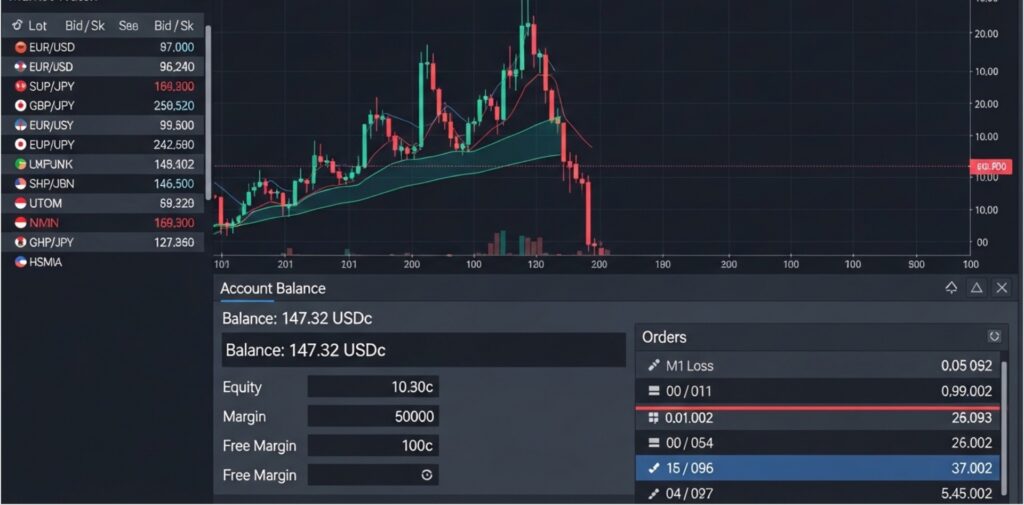
A cent account denominates your balance in cents rather than dollars, effectively dividing everything by 100. Deposit $10 and your account shows 1,000 cents. Trade 0.1 lots and your position size equals what would be 0.001 lots on a standard account. This mathematical transformation creates a unique sweet spot—real trading with real money, but at a scale that makes losses genuinely affordable during the learning phase.
This comprehensive guide explains exactly how cent accounts work, which brokers offer them, who benefits most from using them, and when to graduate to standard accounts. You’ll understand the mechanics of cent account trading, learn proper position sizing, and discover whether a cent account makes sense for your situation.
A forex cent account is a trading account where your balance and all transactions are denominated in cents (USD cents, EUR cents, etc.) instead of standard currency units. This denomination change affects how your account balance displays and how lot sizes are calculated, but the underlying trading mechanics remain identical to standard accounts.
How Cent Accounts Work
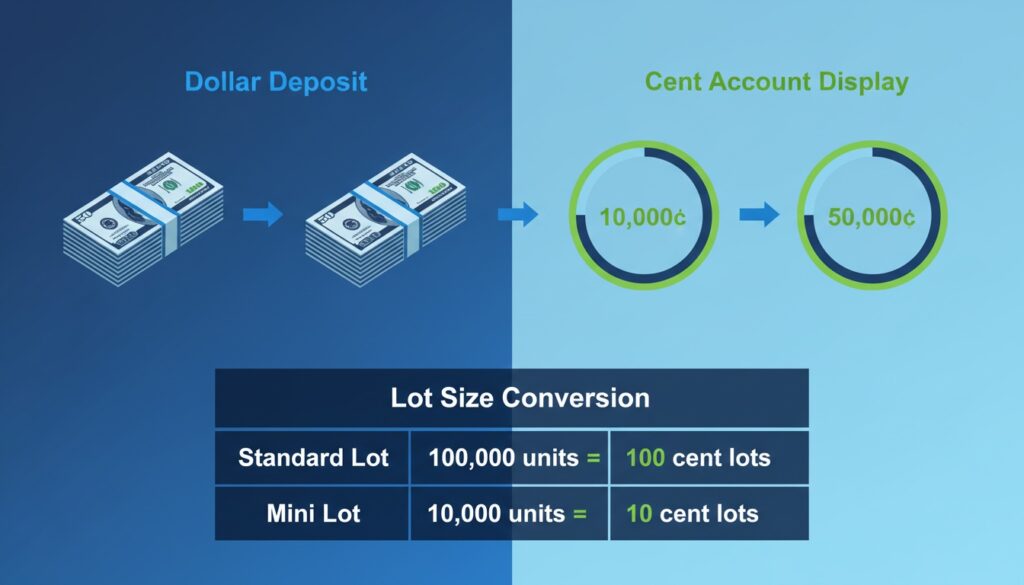
When you deposit money into a cent account, the broker converts it to cents for display purposes:
This conversion is purely cosmetic for your balance display, but it fundamentally changes position sizing. On a cent account:
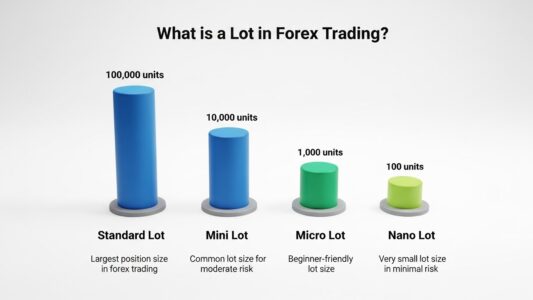
Standard lot (100,000 units) = 100 cent lotsMini lot (10,000 units) = 10 cent lotsMicro lot (1,000 units) = 1 cent lot
The smallest tradeable position on most platforms is 0.01 lots. On a cent account, 0.01 cent lots equals just 10 units of currency—100 times smaller than a standard micro lot.
Cent Accounts vs. Regular Accounts
Example: Trading EUR/USD
Standard Account:
Minimum position: 0.01 lots (1,000 units)
Pip value: $0.10 per pip
20-pip stop loss = $2.00 risk
Cent Account:
Minimum position: 0.01 cent lots (10 units)
Pip value: $0.001 per pip (0.1 cents)
20-pip stop loss = $0.02 risk (2 cents)
The cent account allows you to risk 100 times less per trade while still experiencing real market conditions and real profits/losses.
The Psychological Bridge
According to the National Futures Association, understanding account types and their risk characteristics is an important step before committing capital to forex trading.
Cent accounts serve as a transitional stage between demo trading and standard live accounts:
Demo Account: Zero emotional investment, unlimited do-overs, no real consequences. Habits developed here often don’t transfer to real trading.
Cent Account: Real money at stake (even if small amounts), genuine emotional responses to wins/losses, permanent consequences for mistakes. Habits developed here translate to larger accounts.
Standard Account: Full capital exposure, complete emotional pressure, significant financial stakes.
By trading a cent account with $50-$100, you experience the psychology of real trading—the sting of losses, the temptation to overtrade, the fear of pulling the trigger—without risking significant capital during your learning curve.
Who Should Use Cent Accounts
Cent accounts serve specific trader profiles particularly well.
Absolute Beginners ($10-$100 Starting Capital)
If you’re new to forex and have $10-$100 to start, a cent account provides:
Real Market Experience: Unlike demo accounts, you’ll experience genuine emotional responses to winning and losing real money, building psychological resilience.
Affordable Learning: Mistakes cost pennies rather than dollars. Poor risk management, strategy errors, and platform mishaps drain cents instead of meaningful capital.
Skill Development: You can execute 50-100 trades with $50-$100, gathering enough data to evaluate your strategy and identify weaknesses.
Example: With a $100 cent account (10,000 cents), risking 2% per trade means 200 cents ($2.00) per trade. You can survive 50 consecutive losses—far more room for learning than a standard account where $100 might sustain only 10-20 trades.
Strategy Testers
Experienced traders use cent accounts to:
Test New Strategies: Before deploying a new approach with significant capital, test it on a cent account for 30-50 trades to verify profitability in live conditions.
Evaluate Expert Advisors: Run automated trading systems on cent accounts to observe real-world performance without risking substantial funds.
Practice New Timeframes: Transitioning from day trading to swing trading? Test the approach on a cent account first.
Verify Broker Quality: Open a small cent account to evaluate a broker’s execution speed, spread quality, and platform reliability before depositing larger amounts.
Traders Rebuilding Confidence
After experiencing account losses or a difficult trading period:
Rebuild Psychology: Trading profitably on a cent account, even with small absolute profits, restores confidence and validates your ability to execute your plan.
Reestablish Discipline: Practice following your rules perfectly on a cent account where emotional pressure is minimal before returning to larger capital.
Prove Consistency: Demonstrate 30+ consecutive profitable weeks on a cent account before increasing position sizes.
Part-Time Traders with Limited Capital
Working professionals who can only allocate $50-$200 monthly to trading benefit from:
Meaningful Practice: Real trading experience without committing savings or emergency funds.
Gradual Capital Building: Compound small profits while adding deposits monthly, building toward a standard account over 6-12 months.
Risk-Appropriate Sizing: Position sizes that match genuinely disposable income rather than forcing undersized positions on standard accounts.
Choosing a Cent Account Broker
Not all brokers offer cent accounts. When selecting a cent account provider, evaluate these critical factors.
Regulation and Safety
Cent accounts are predominantly offered by offshore brokers or brokers regulated by less stringent authorities. This creates additional risk:
Check the broker’s regulatory body (CySEC, FSC, ASIC, etc.)
Verify the license number on the regulator’s official website
Understand your recourse if problems arise
Priority 2: Segregated Client Funds
Ensure client funds are held in segregated accounts separate from broker operating capital
Verify if any compensation scheme exists
Priority 3: Reputation Research
Read independent reviews on forex forums and review sites
Check how long the broker has operated
Search for complaint patterns or withdrawal issues
Warning: Some cent account brokers operate with minimal regulation. Even though your deposit is small ($10-$100), verify the broker is legitimate to avoid outright scams.
Trading Conditions
Cent accounts should offer competitive conditions comparable to standard accounts:
Spreads:
Compare EUR/USD spread on cent account vs. standard account
Typical range: 1-3 pips (similar to standard accounts)
Avoid brokers charging significantly wider spreads on cent accounts
Execution Quality:
Order execution speed should match standard accounts
Minimal slippage during normal market conditions
No artificial delays or requotes
Available Currency Pairs:
Access to major pairs (EUR/USD, GBP/USD, USD/JPY, etc.)
Sufficient variety for strategy testing (20-30+ pairs preferred)
Leverage:
Typical leverage: 1:100 to 1:1000
Higher leverage on cent accounts isn’t necessarily better—it simply enables smaller accounts to trade standard position sizes while maintaining proper margin
Account Features
Minimum Deposit:
Range: $1-$50 depending on broker
Lower minimums provide more accessibility
Maximum Balance Limits:
Some brokers cap cent account balances at $500-$1,000
If you grow beyond this, you’ll need to upgrade to a standard account
Platform Availability:
MetaTrader 4 (MT4) most common
MetaTrader 5 (MT5) also widely available
Mobile app access important for monitoring positions
Position size = 200 cents ÷ 20 pips = 10 cents per pip = 1 cent lot (0.01 on platform)
Risk Limits:
Maximum 1-2% risk per trade
Daily loss limit: 3-5% of account
Weekly loss limit: 10% of account
Why This Matters: If you risk 10% per trade on your cent account “because it’s only $100,” you’ll build reckless habits that destroy your standard account later. Build correct habits from day one.
Track Performance Meticulously
Maintain a detailed trading journal documenting:
For Each Trade:
Date and time
Currency pair
Direction (long/short)
Entry price, stop-loss, take-profit
Position size (in cent lots and actual currency units)
Trade rationale
Result (profit/loss in cents and dollars)
Lessons learned
Weekly Statistics:
Total trades executed
Win rate (%)
Average win vs. average loss (in cents)
Risk-reward ratio achieved
Maximum drawdown
Net profit/loss
Monthly Review:
Overall profitability trend
Strategy effectiveness evaluation
Common mistakes identified
Improvements implemented
This data proves whether you’re ready to graduate to a standard account or need more practice.
Avoid Common Cent Account Mistakes
Mistake 1: Overleveraging
The Error: Using maximum leverage (1:500 or 1:1000) to trade position sizes far beyond appropriate risk levels.
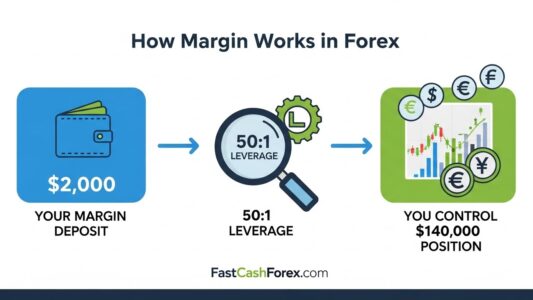
Why It’s Wrong: A 10,000 cent account ($100) with 1:500 leverage can control $50,000 in positions. One wrong trade can destroy the account. You’re building terrible habits.
The Solution: Calculate position size based on risk percentage, not maximum leverage. Leverage should be incidental, not a strategy.
Mistake 2: Not Taking It Seriously
The Error: Trading recklessly because “it’s just cents” or “I only deposited $50.”
Why It’s Wrong: You build whatever habits you practice. Careless cent trading creates careless habits that persist when you scale up.
The Solution: Treat every cent trade as if it were a $100 trade. Follow your trading plan religiously.
Mistake 3: Staying Too Long
The Error: Trading a cent account for 12-24 months because you’re comfortable with the low risk.
Why It’s Wrong: Cent accounts cannot replicate the full psychological pressure of larger accounts. Extended cent trading can create false confidence.
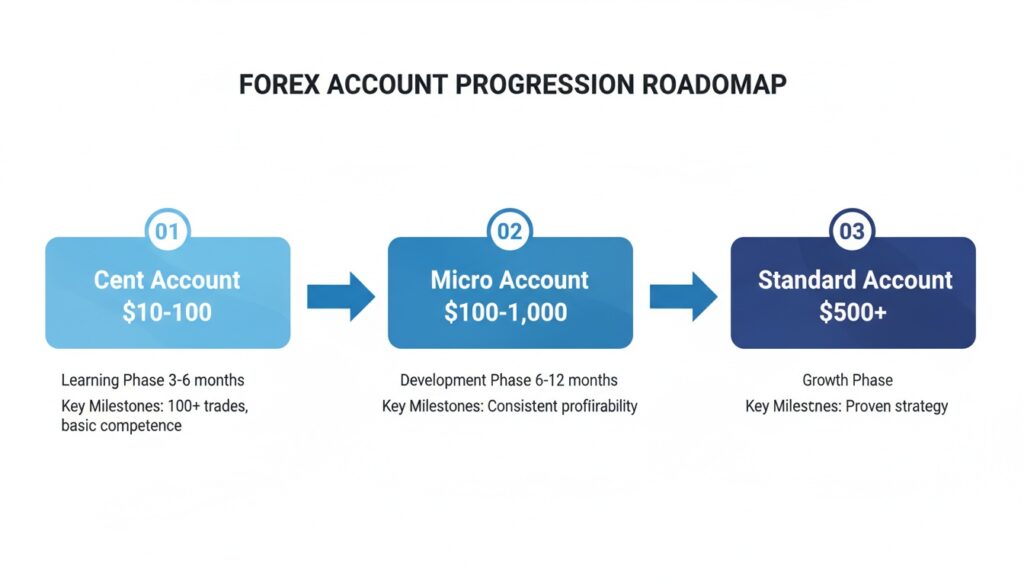
The Solution: Graduate to a standard account after 3-6 months or 100+ trades if you’re consistently profitable and following your plan.
Mistake 4: Insufficient Capital
The Error: Opening a cent account with $5-$10 and expecting meaningful learning.
Why It’s Wrong: You can’t properly practice risk management with such small amounts. You’ll either risk too much per trade or take positions so small they’re meaningless.
The Solution: Fund cent accounts with minimum $50, preferably $100-$200, to allow proper position sizing and multiple trade opportunities.
Cent Account Position Sizing Examples
Understanding position sizing on cent accounts requires adjusting your thinking from standard lot calculations.
Example 1: Conservative Trader
Account: 10,000 cents ($100) Risk per trade: 1% = 100 cents ($1.00) Strategy: Trend following with 30-pip stops
Position Size Calculation: 100 cents risk ÷ 30 pips = 3.33 cents per pip
Lot Size: 3.33 cent lots = 0.03 on platform (approximately 333 units)
Trade Outcome Examples:
30-pip win = 100 cents profit ($1.00)
30-pip loss = 100 cents loss ($1.00)
Risk-reward ratio: 1:1 minimum with tight stops and clear targets
Example 2: Moderate Risk Trader
Account: 25,000 cents ($250) Risk per trade: 2% = 500 cents ($5.00) Strategy: Swing trading with 50-pip stops
Position Size Calculation: 500 cents risk ÷ 50 pips = 10 cents per pip
Lot Size: 10 cent lots = 0.10 on platform (1,000 units = standard micro lot)
Trade Outcome Examples:
50-pip loss = 500 cents ($5.00)
100-pip win = 1,000 cents ($10.00)
Risk-reward ratio: 1:2
Example 3: Starting with Minimum
Account: 5,000 cents ($50) Risk per trade: 2% = 100 cents ($1.00) Strategy: Short-term scalping with 10-pip stops
Position Size Calculation: 100 cents risk ÷ 10 pips = 10 cents per pip
Lot Size: 10 cent lots = 0.10 on platform
Trade Outcome Examples:
10-pip loss = 100 cents ($1.00)
15-pip win = 150 cents ($1.50)
Can sustain 50 losing trades before account depletion
When to Graduate from Cent Accounts
Cent accounts serve a specific purpose—initial learning and strategy validation. Staying too long delays your development.
Readiness Indicators
Consider upgrading to a standard account when:
Performance Criteria:
Profitable over 100+ trades (positive net P/L)
Win rate aligns with strategy expectations
Following trading plan on 95%+ of trades
Maximum drawdown under control (not exceeding 20-25%)
Skill Development:
Execute all order types confidently
Calculate position sizes quickly and accurately
Comfortable with platform navigation
Journal and analyze trades systematically
Psychological Readiness:
Maintain discipline during losing streaks
Don’t revenge trade after losses
Exit losing trades without hesitation
Take profits according to plan, not greed
Capital Availability:
Saved $500-$1,000 for standard account funding
This capital represents genuinely disposable income
No pressure to “make money quickly”
The Upgrade Process
Step 1: Final Performance Review
Analyze your last 50-100 cent trades
Calculate final statistics (win rate, risk-reward, profit factor)
Identify any remaining weaknesses
Verify consistent profitability
Step 2: Choose Your Standard Account Size
Start with $500-$1,000 maximum
Lower amounts reduce psychological pressure during transition
You can always add capital after proving consistency
Step 3: Reduce Risk Initially
For your first 20-30 standard trades, risk 0.5-1% instead of 2%
This eases the psychological adjustment
Position sizes will still feel larger than cent account
Step 4: Expect Performance Variation
Your initial standard account results will likely be less consistent than cent account
The added emotional pressure affects decision-making
This is normal—give yourself 30-50 trades to adjust
Step 5: Continue Systematic Improvement
Maintain the same journaling discipline
Track emotional responses to larger wins/losses
Adjust risk management if needed based on actual emotional tolerance
Staying on Cent Accounts Too Long
Warning Signs:
Trading cent account for 12+ months
Avoiding standard accounts due to fear
Making excuses about “not being ready yet”
Achieving consistent profitability but refusing to scale
Why This Is Problematic: Cent accounts cannot fully replicate real trading psychology. The difference between risking 200 cents and $200 creates fundamentally different emotional states. You must eventually face larger capital pressure to complete your development.
The Solution: If you’ve traded profitably for 6+ months on a cent account, commit to opening a standard account. Start small ($500) to manage the transition, but make the move.
Important: These returns are achievable only by skilled traders. Most beginners will lose money initially or break even during the learning phase.
Compounding vs. Withdrawing
Compounding Approach: Leave all profits in the account, allowing exponential growth:
Month 1: 10,000 cents
Month 2: 11,000 cents (10% gain)
Month 3: 12,100 cents (10% on 11,000)
Month 4: 13,310 cents
Month 12: ~31,384 cents ($313.84)
Withdrawal Approach: Withdraw profits monthly, using cent account purely for practice:
Consistent 10% monthly on $100 = $10/month withdrawn
Annual withdrawals: $120
Account remains at $100
Recommendation for Beginners: Compound profits until you reach $250-$500, then either:
Continue compounding toward $1,000 before upgrading to standard account
Start fresh standard account with new deposit, keeping cent account for continued practice
The Real Value
Cent accounts’ primary value isn’t profit generation—it’s affordable education:
Cost Comparison:
Trading course: $500-$2,000
Mentorship program: $1,000-$5,000
Losing on standard account during learning: $1,000-$5,000+
Cent Account Alternative:
Deposit: $100
Maximum learning cost: $100 (if you lose everything)
Real market experience: Priceless
Confidence gained: Foundation for future success
Frequently Asked Questions
Can I really start forex trading with just $10?
Technically yes—several brokers accept $10 minimum deposits for cent accounts. However, $10 provides very limited learning opportunity. You can only risk 20-40 cents per trade (assuming 2% risk), which equals 2-4 pip stops at minimum position sizes. This constraint makes meaningful practice difficult. Start with $50-$100 minimum for realistic learning conditions.
How long should I trade a cent account before upgrading?
Most traders need 3-6 months or 100-150 trades to develop basic competence and prove consistent profitability. Don’t rush the transition, but also don’t stay beyond 12 months. If you’re still unprofitable after 6 months and 150+ trades on a cent account, additional practice likely won’t help—you need strategy refinement or education instead.
Can I make a living trading a cent account?
No. Even exceptional performance (20% monthly) on a $500 cent account generates only $100/month—not sustainable income. Cent accounts serve learning purposes only. To generate meaningful income, you’ll need minimum $10,000-$25,000 in capital, which requires graduating to standard accounts.
Are cent accounts the same as micro accounts?
No, though they’re similar. Both accommodate small capital, but:
Micro accounts show balance in dollars and trade micro lots (1,000 units minimum)
Cent accounts show balance in cents and trade cent lots (10 units minimum)
Cent accounts offer 100x smaller position sizing than micro accounts, making them better for extremely limited capital ($10-$100).
Do cent accounts have worse spreads or execution?
Generally no—most brokers offer similar trading conditions on cent and standard accounts. However, always verify specific broker conditions. Some brokers may widen spreads slightly on cent accounts or limit available currency pairs. Test execution quality with small trades before committing.
What happens if my cent account grows beyond $1,000?
Many brokers cap cent account balances at $500-$1,000. If you reach this limit, you’ll need to upgrade to a standard account. This is actually positive—it means you’ve proven profitability and are ready for the next stage. Some brokers allow easy balance transfers from cent to standard accounts within your account dashboard.
Can I run Expert Advisors on cent accounts?
Yes, most cent account brokers support automated trading via MetaTrader 4 or MetaTrader 5. This makes cent accounts excellent for testing Expert Advisors in live conditions without risking significant capital. Just ensure your EA’s money management settings account for cent denomination—position sizes should be 100x smaller than standard account settings.
Conclusion
Forex cent accounts provide the ideal entry point for traders with limited capital who want real trading experience without significant financial risk. By denominating your balance in cents, these accounts allow you to trade with $10-$100 while maintaining proper risk management and experiencing genuine market conditions.
The key to cent account success is treating them seriously—use realistic position sizing, maintain a trading journal, follow a written trading plan, and build the disciplined habits that will serve you on larger accounts. Cent accounts aren’t toys or games; they’re professional development tools that bridge the gap between demo trading’s emotional void and standard trading’s capital pressure.
Plan to spend 3-6 months trading a cent account with $50-$250 in capital. Execute 100-150 trades following a consistent strategy. Once you prove profitability and disciplined execution, graduate to a standard account starting with $500-$1,000.
Remember that cent accounts serve a specific purpose—learning and validation. They won’t generate meaningful income, but they can save you thousands in avoided losses while you develop real trading skill. Use them strategically, learn the lessons they offer, and move forward when you’re ready.
For most aspiring traders, a cent account represents the smartest first step into live forex trading. Start small, trade seriously, and build the foundation for long-term success.