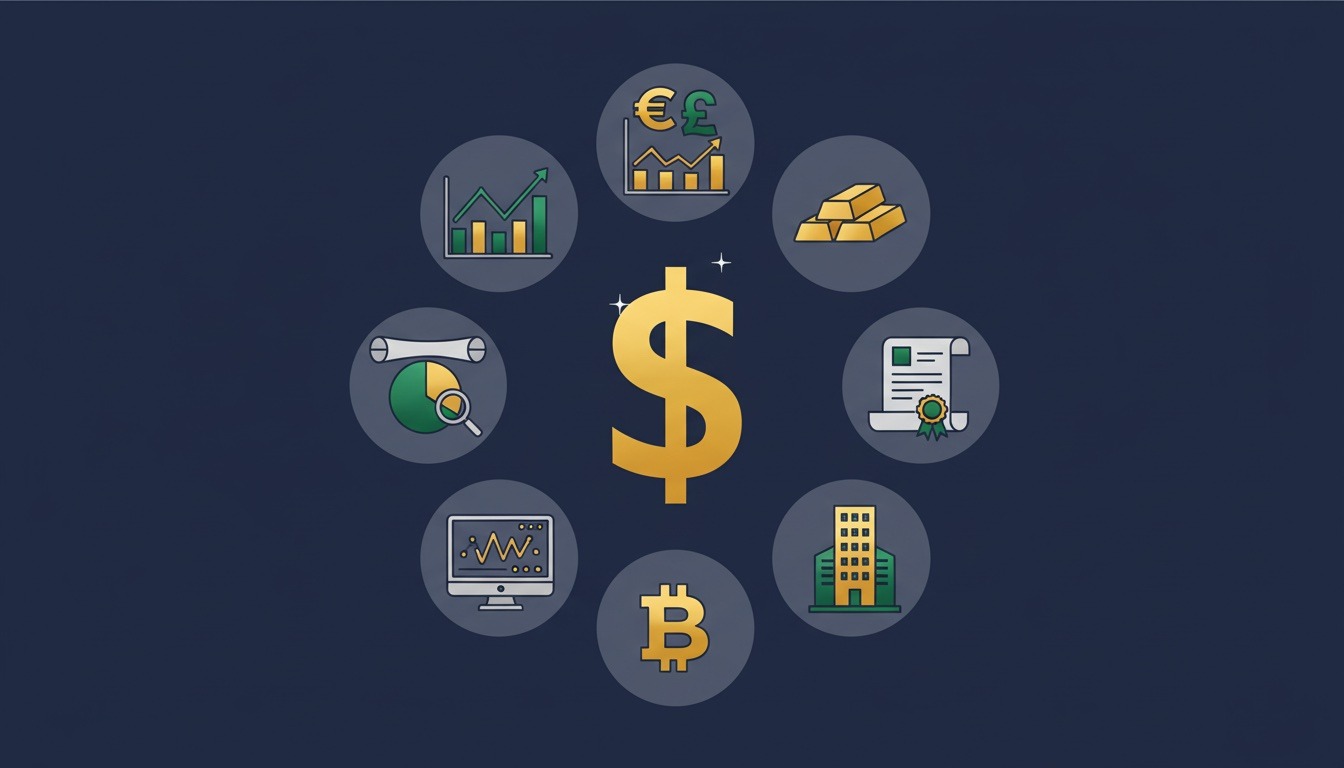
Understanding the different investment methods available to you is the foundation of building long-term wealth. Whether you have $100 or $100,000, the right investment method depends on your goals, risk tolerance, time horizon, and available capital. This guide covers every major investment method available to investors in 2026 — from the world’s largest financial market to real estate, precious metals, and beyond.
1. Forex Trading
The forex (foreign exchange) market is the largest and most liquid financial market in the world, with over $7.5 trillion traded daily. Forex trading involves buying and selling currency pairs — such as EUR/USD, GBP/USD, or USD/JPY — to profit from changes in exchange rates.
Key advantages:
- Open 24 hours a day, five days a week
- High liquidity — instant entry and exit on major pairs
- Leverage available (up to 50:1 for US retail traders)
- Low minimum capital to get started
- Transparent pricing driven by publicly available economic data
Forex is particularly suited to investors who prefer trading macro assets — currencies, rather than individual company stocks. The forex market is tightly regulated in major jurisdictions by bodies including the CFTC and NFA in the United States and the FCA in the United Kingdom.
New to forex? Start with our Forex Education Hub for a complete learning path from beginner basics to advanced trading strategies.
2. Stocks
Buying and selling stocks is one of the most popular investment methods worldwide. When you buy a share of stock, you are purchasing a small ownership stake in a company. If the company grows and becomes more valuable, your shares increase in value. Many stocks also pay dividends — regular cash payments to shareholders.
Types of stocks:
- Blue-chip stocks — large, established companies like Apple, Microsoft, and Amazon with strong track records
- Growth stocks — companies expected to grow faster than average, often reinvesting profits rather than paying dividends
- Dividend stocks — companies that pay regular income to shareholders
- Penny stocks — speculative, low-priced stocks with high risk
The SEC regulates stock markets in the United States, providing investor protections and transparency requirements for publicly listed companies.
3. Index Funds and ETFs
Index funds and Exchange-Traded Funds (ETFs) are among the most powerful investment methods for building long-term wealth. Rather than picking individual stocks, you invest in a fund that tracks a broad market index — such as the S&P 500, which holds shares in 500 of America’s largest companies.
Why index funds work:
- Instant diversification across hundreds or thousands of companies
- Very low fees (expense ratios often below 0.10%)
- Historically return approximately 10% per year on average over the long term
- No need to research individual companies
ETFs trade on stock exchanges like regular stocks, offering the same diversification as index funds with the flexibility of intraday trading. For most retail investors, a simple portfolio of low-cost index funds is one of the most effective long-term investment methods available.
4. Gold and Precious Metals
Gold has served as a store of value for thousands of years. In 2025, gold surged over 60% to an all-time high above $5,500 per ounce, driven by central bank buying, geopolitical uncertainty, and de-dollarization. Even after a correction in early 2026, gold remained one of the best-performing assets over any 18-month period.
Ways to invest in gold:
- Physical gold bars and coins
- Gold ETFs (e.g., SPDR Gold Shares)
- Gold IRA — holding physical gold in a tax-advantaged retirement account
- Forex trading — XAU/USD (gold vs. U.S. dollar)
Gold works as an inflation hedge, a safe-haven asset, and a portfolio diversifier with low correlation to stocks. See our complete Gold Trading: XAU/USD guide and our guide on why investors flee to gold during market stress.
Silver offers similar properties to gold with additional industrial demand. See our Silver Trading: XAG/USD guide for a full breakdown.
5. Mutual Funds
Mutual funds pool capital from many investors and invest it across a diversified portfolio of stocks, bonds, or other assets, managed by professional fund managers. They are one of the most popular long-term investment methods, with trillions of dollars held in mutual funds globally.
Key characteristics:
- Professional management
- Diversification across many securities
- Variety of strategies — growth, income, balanced, sector-specific
- Priced once daily at net asset value (NAV)
The main drawback of actively managed mutual funds is cost — management fees can significantly erode returns over time. Many investors prefer index funds or ETFs for lower-cost diversification.
6. Bonds and Fixed Income
When you buy a bond, you are lending money to a government or corporation in exchange for regular interest payments and the return of your principal at maturity. Bonds are generally lower-risk than stocks and provide steady income — making them a key component of balanced portfolios.
Types of bonds:
- U.S. Treasury bonds — backed by the U.S. government, considered the safest investment in the world
- Corporate bonds — higher yields than Treasuries but carry credit risk
- Municipal bonds — issued by local governments, often tax-advantaged
- TIPS (Treasury Inflation-Protected Securities) — principal adjusts with inflation
Bonds play an important role in how to invest for retirement — as you approach retirement, shifting more portfolio weight toward bonds reduces volatility and protects capital.
7. Real Estate
Real estate is one of the most time-tested investment methods for building wealth. It generates rental income, appreciates in value over time, provides inflation protection, and offers leverage through mortgages.
Ways to invest in real estate:
- Direct ownership — buying residential or commercial property to rent or resell
- REITs (Real Estate Investment Trusts) — publicly traded companies that own income-producing properties, accessible with any amount of capital
- Real estate crowdfunding — platforms that allow fractional investment in properties
- Fix and flip — buying undervalued properties, renovating them, and selling for profit
- Tax lien investing — buying tax liens from municipalities, earning guaranteed returns when property owners pay back taxes (returns of 12–30% are common in some jurisdictions)
8. Cryptocurrency
Cryptocurrency has evolved from a fringe concept to a mainstream investment method. Bitcoin, Ethereum, and other major cryptocurrencies are now held by institutional investors, central bank reserves, and millions of retail investors worldwide.
Key characteristics:
- High growth potential — Bitcoin has produced extraordinary long-term returns
- High volatility — significant price swings require careful position sizing
- 24/7 trading — markets never close
- Inflation hedge properties — Bitcoin’s fixed supply appeals to investors concerned about currency debasement
- Accessible — you can start with as little as $10
A typical allocation for most investors is 1–5% of total portfolio value in cryptocurrency. See our Cryptocurrency Trading for Beginners guide for a full introduction.
9. Day Trading and Forex Scalping
Day trading involves buying and selling financial instruments within a single trading day — closing all positions before the market closes. Forex scalping is a similar short-term approach, targeting small price movements across multiple trades throughout the day.
Day trading requires significant time commitment, discipline, and a solid understanding of technical analysis. It is not a passive investment method — it is an active trading approach that suits people who enjoy markets and can dedicate time to monitoring positions.
For those interested in automation, Expert Advisors and automated forex trading can execute trades systematically based on predefined rules.
10. Alternative Investments
Beyond the mainstream investment methods above, a range of alternative assets can provide additional diversification and uncorrelated returns:
- Private equity — investing in companies not listed on public exchanges
- Hedge funds — sophisticated strategies including long/short, global macro, and managed futures
- Commodities — oil, agricultural products, industrial metals
- Collectibles — art, wine, rare coins, luxury watches
- Infrastructure — toll roads, airports, utilities
See our Alternative Investments: Complete Guide for a full breakdown of these options.
Choosing the Right Investment Method for You
No single investment method is right for everyone. Here is a framework to help you choose:
| Investment Method | Best For | Risk Level | Liquidity |
|---|---|---|---|
| Forex Trading | Active traders, macro investors | Medium–High | Very High |
| Stocks | Long-term wealth building | Medium | High |
| Index Funds / ETFs | Passive investors, beginners | Medium | High |
| Gold / Silver | Inflation hedge, diversification | Medium | High |
| Bonds | Income, capital preservation | Low–Medium | High |
| Real Estate | Income, long-term appreciation | Medium | Low |
| Cryptocurrency | High-growth allocation | Very High | High |
| Day Trading | Active traders with time to dedicate | High | Very High |
| Alternative Investments | Accredited investors, diversification | Varies | Low |
The most effective approach for most investors is a diversified portfolio combining several of these methods — core index funds for growth, bonds for stability, gold for inflation protection, and forex or cryptocurrency for alternative exposure.
Final Thoughts About Different Investment Methods
The best investment method is the one you understand, can manage consistently, and that aligns with your financial goals. Start with the basics — learn how each method works before committing capital — and build your portfolio gradually over time.
Explore our guides on each investment method to deepen your knowledge:
- Forex Education Hub
- Gold Trading Guide
- How to Invest for Retirement
- How to Invest With Little Money
- Alternative Investments Guide