Learn How to Make Fast Money by Learning diffrent Strategies in Forex Trading and Different Investment Options
Best Forex Brokers That Allow Scalping
Not all forex brokers that allow scalping are created equal. Some welcome scalpers with tight spreads and fast execution. Others technically permit scalping but make it unprofitable through wide spreads, slow fills, and hidden restrictions. This guide explains what to look for in forex brokers that allow scalping, which broker types are best suited for scalping strategies, and the key features that determine whether a broker will actually support your scalping approach.
This post is part of our complete scalping guide covering strategies, position sizing, and session timing for scalpers.
Forex brokers that allow scalping permit traders to open and close positions within seconds or minutes, targeting small price movements of 2-10 pips per trade. However, “allowing” scalping and “supporting” scalping are very different things.
A broker may not prohibit scalping in their terms but still make it unviable through:
Wide spreads that eat into small profit targets
Slow execution with frequent requotes
Dealing desk intervention on profitable scalping accounts
Minimum hold time requirements buried in the terms of service
Always read the broker’s terms carefully and test execution speed on a demo account before scalping with real money.
Types of Forex Brokers That Allow Scalping
Understanding broker types is essential before choosing one for scalping.
ECN Brokers (Best for Scalping)
ECN (Electronic Communications Network) brokers connect traders directly to the interbank market. They are the best forex brokers that allow scalping because:
Raw spreads from 0.0 pips on major pairs
No dealing desk intervention
Fast execution with no requotes
Transparent pricing from multiple liquidity providers
ECN brokers charge a small commission per trade (typically $2-7 per round turn per standard lot) instead of marking up the spread. For scalpers targeting 3-5 pips, raw spreads with a small commission are far more cost-effective than wide spread-only accounts.
STP Brokers (Good for Scalping)
STP (Straight Through Processing) brokers pass orders directly to liquidity providers without a dealing desk. They offer:
Competitive spreads (typically 0.5-1.5 pips on EUR/USD)
Fast execution
No conflict of interest with traders
STP brokers are good forex brokers that allow scalping, though spreads are slightly wider than true ECN accounts.
Market Makers (Avoid for Scalping)
Market maker brokers take the opposite side of your trades. They may technically allow scalping but often:
Widen spreads during fast markets
Requote orders during volatile conditions
Slow execution on profitable scalping accounts
Restrict or ban consistently profitable scalpers
Market makers are generally not suitable as forex brokers that allow scalping if you plan to trade frequently or profitably.
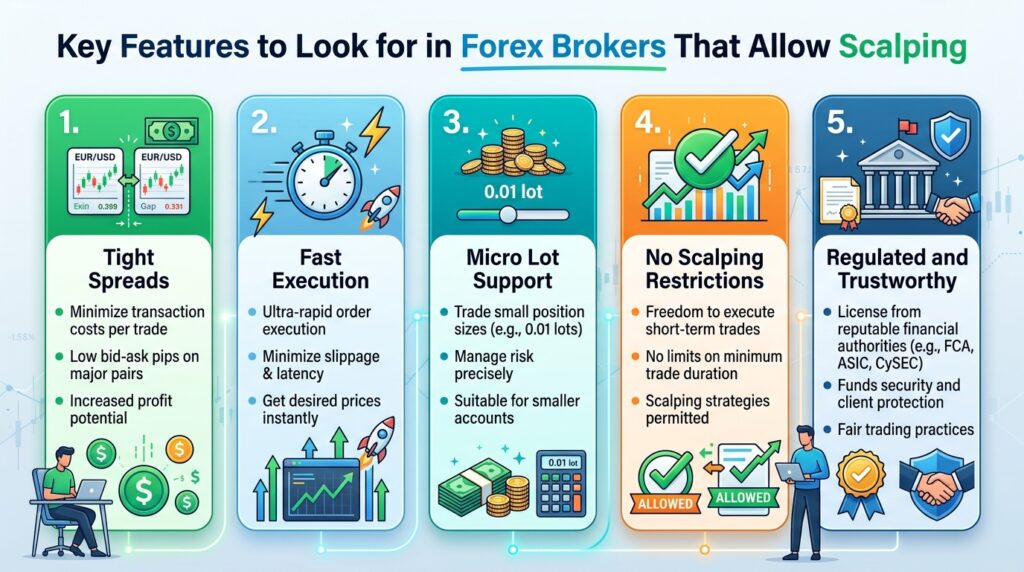
Key Features to Look for in Forex Brokers That Allow Scalping
1. Tight Spreads
For scalpers targeting 3-5 pips, spread costs are critical. Look for:
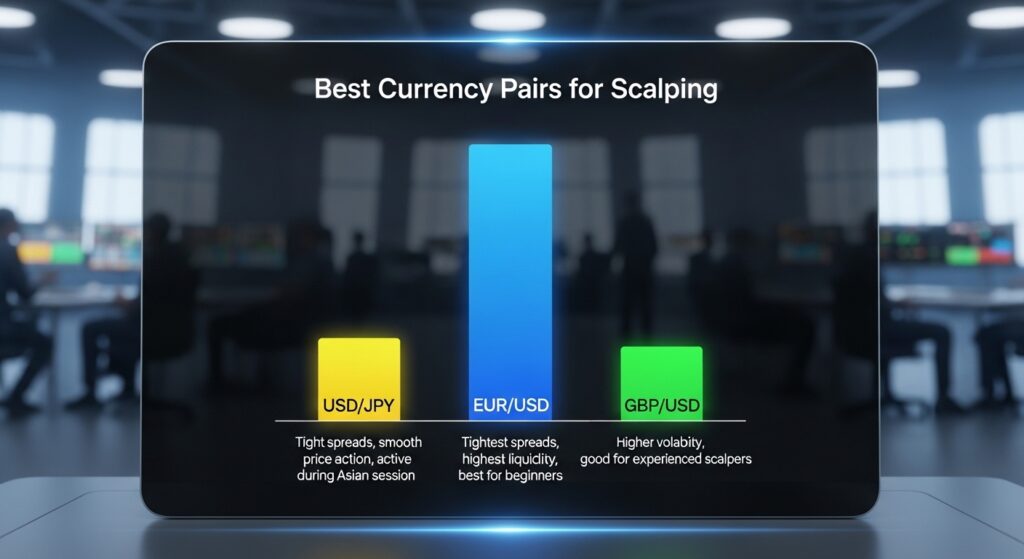
EUR/USD: 0.0-0.5 pips (ECN) or 0.5-1.0 pips (STP)
GBP/USD: 0.5-1.5 pips
USD/JPY: 0.0-0.5 pips
A 1.5-pip spread on a 3-pip target means you need a 4.5-pip move just to break even. Always check live spreads during your trading session — spreads often widen during off-hours.
2. Fast Execution
Scalping requires execution speeds under 100 milliseconds. Slow execution causes:
Slippage (entering at a worse price than intended)
Missed entries on fast-moving setups
Wider effective spreads due to price movement during order processing
Test execution speed on a demo account during your intended trading hours before going live.
3. No Requotes
A requote occurs when your broker cannot fill your order at the requested price and offers a different price instead. Frequent requotes destroy scalping profitability. ECN and STP brokers rarely requote because they pass orders directly to liquidity providers.
4. Micro Lot Support
Forex brokers that allow scalping for small accounts must support micro lots (0.01 lot minimum). Brokers requiring 0.1 lot minimums are unsuitable for accounts under $1,000. Always verify the minimum position size before opening an account.
5. No Scalping Restrictions
Some brokers prohibit:
Closing trades within a minimum time period (e.g., 2 minutes)
High-frequency trading above a certain number of trades per day
News scalping around major economic releases
Read the terms of service carefully. Any broker with minimum hold time requirements is not a true scalping-friendly broker.
6. Regulated and Trustworthy
Only trade with regulated brokers. In the US, forex brokers must be registered with the CFTC and be members of the NFA. International traders should look for brokers regulated by the FCA in the UK, ASIC in Australia, or CySEC in Cyprus.
Regulation protects your funds and ensures the broker operates to minimum standards of conduct.
What to Avoid in Forex Brokers That Allow Scalping
High Minimum Deposits
Some brokers require $500-2,000 minimum deposits for ECN accounts. If you’re starting with $100-500, look for brokers offering ECN-style accounts with lower minimums.
Variable Spreads That Widen During News
Many brokers advertise tight spreads but widen them significantly during major news events like NFP, FOMC, and CPI releases. Since scalpers often trade during high-volatility London-New York overlap sessions, check how spreads behave during active market hours — not just in static advertising.
Bonus Restrictions
Brokers offering large deposit bonuses often attach withdrawal restrictions. Avoid bonus-heavy brokers if you plan to withdraw profits regularly from a scalping account.
How to Test a Broker Before Scalping Live
Before committing real money, always:
Open a demo account and trade during your intended session
Record execution speed on 10-20 demo trades
Check spreads at different times of day
Attempt to close trades within 30 seconds and verify no restrictions apply
Different account types within the same broker can have very different conditions for scalping.
Raw Spread / ECN Accounts
These accounts offer the tightest spreads with a per-trade commission. Best for scalpers trading 10+ times per day. The commission structure is transparent and predictable, making it easier to calculate true trading costs.
Standard Accounts
Standard accounts include the broker’s markup in the spread with no separate commission. Spreads are typically 1-2 pips on EUR/USD. Acceptable for occasional scalping but not ideal for high-frequency scalping strategies.
Micro Accounts
Micro accounts allow very small position sizes (0.001 lots in some cases) with lower minimum deposits. These are ideal for beginners learning scalping with minimal risk.
Questions to Ask Before Choosing Forex Brokers That Allow Scalping
Before opening an account with any broker, ask or verify the following:
Is scalping explicitly permitted in the terms of service?
What is the minimum trade hold time, if any?
What is the average EUR/USD spread during London-NY overlap (8 AM-12 PM EST)?
What is the minimum lot size?
Is the broker an ECN, STP, or market maker?
What regulatory body oversees the broker?
Is there a commission per trade, and if so, how much?
Are there any restrictions on the number of trades per day?
Getting clear answers to these questions before depositing will save significant time and money.
Scalping Costs: How to Calculate Your Real Trading Expenses
Understanding your true cost per trade is essential when evaluating forex brokers that allow scalping.
ECN broker example:
Spread: 0.2 pips on EUR/USD
Commission: $3 per round turn per standard lot
Position size: 0.10 lot (mini)
Commission on 0.10 lot: $0.30
Spread cost on 0.10 lot: $0.20
Total cost per trade: $0.50
Standard account example:
Spread: 1.5 pips on EUR/USD
No commission
Position size: 0.10 lot
Spread cost: $1.50
Total cost per trade: $1.50
The ECN account costs 3x less per trade — critical when making 20-30 trades per day.
Risk Management When Scalping
Even with the best forex brokers that allow scalping, risk management determines long-term success. Key rules:
Never risk more than 1-2% of your account per trade
Set a daily loss limit of 5-6% and stop trading if you hit it
Final Thoughts on Forex Brokers That Allow Scalping
Choosing the right broker is one of the most important decisions a scalper will make. Forex brokers that allow scalping must offer more than a simple “yes” to scalping — they must provide the tight spreads, fast execution, micro lot support, and transparent regulation that make scalping viable and profitable.
Focus on ECN or STP brokers with verifiable regulation, test thoroughly on demo before going live, and calculate your true cost per trade before committing capital. The broker you choose will directly impact every scalping trade you make — choose carefully.