Learn How to Make Fast Money by Learning diffrent Strategies in Forex Trading and Different Investment Options
Investment Diversification: How to Build and Diversify Your Portfolio in 2026
investment is the process of putting money to work with the goal of growing wealth over time. Whether you are just starting out or looking to improve an existing portfolio, understanding the fundamentals of investment — risk, investment diversification, asset classes, and strategy — is essential before committing capital to any market.
This guide covers the core principles of investment, the main asset classes available to individual investors in 2026, and how to build a diversified portfolio that matches your financial goals and risk tolerance.
Investment diversification is the practice of spreading capital across multiple asset classes to reduce risk and improve long-term returns.
Investment means allocating money into assets with the expectation of generating a return — either through income (dividends, interest, rent) or capital appreciation (the asset increasing in value over time).
Unlike saving, which preserves capital in low-risk accounts, investing involves accepting some level of risk in exchange for the potential of higher returns. The key is managing that risk intelligently rather than avoiding it entirely.
All investing involves risk. There is no such thing as a completely risk-free investment — even cash held in a bank loses purchasing power over time due to inflation. The goal is not to eliminate risk but to understand it, manage it, and ensure your potential rewards justify the risks you are taking.
Why Investment Diversification Is the Foundation of Smart Investing
Investment diversification is not just a strategy — it is the single most important principle separating successful long-term investors from those who suffer devastating losses
The most fundamental principle in investment is diversification — spreading your capital across different asset classes, sectors, and geographies so that no single loss can devastate your portfolio.
The classic principle applies: never put all your eggs in one basket. A portfolio concentrated in one stock, one sector, or one asset class is vulnerable to a single event wiping out significant value. A diversified portfolio absorbs shocks from individual holdings while other positions hold or gain.
Investment Diversification works because different assets respond differently to economic conditions:
Stocks may fall during recessions while bonds hold value
Gold often rises when currencies weaken
Real estate provides income regardless of stock market performance
Forex markets move on interest rate differentials independent of equity markets
A well-diversified portfolio combines assets with low or negative correlation — meaning when one falls, others are less likely to fall at the same time.
Main Investment Asset Classes
Stocks and Equities
Stocks represent ownership in publicly traded companies. They offer the highest long-term return potential of traditional asset classes but come with significant short-term volatility. The S&P 500 has historically returned approximately 10% annually over long periods, though individual years vary dramatically.
Stocks suit investors with long time horizons who can tolerate short-term fluctuations in exchange for long-term growth potential.
Bonds and Fixed Income
Bonds are loans made to governments or corporations in exchange for regular interest payments and return of principal at maturity. They provide more stable, predictable returns than stocks and act as a portfolio stabilizer during equity market downturns.
US Treasury bonds are considered among the safest investments globally, though yields are lower than stocks. Corporate bonds offer higher yields with slightly more risk.
Real Estate
Real estate provides both income (rental yield) and capital appreciation. Direct property ownership requires significant capital but offers leverage through mortgages. REITs (Real Estate Investment Trusts) provide real estate exposure with stock-like liquidity and are required to distribute 90% of taxable income as dividends.
Real estate tends to perform well during inflationary periods, making it a valuable portfolio component when inflation is elevated.
Gold and Precious Metals
Gold is the original alternative investment — a store of value that has preserved purchasing power across thousands of years of economic history. Gold performs best during periods of currency weakness, geopolitical instability, and financial crisis.
In 2025, gold surged over 60% as central bank buying, de-dollarization, and geopolitical uncertainty drove demand to historic levels. Most financial advisors recommend 5-15% allocation to precious metals as portfolio insurance.
For traders, gold can be traded as XAU/USD on the forex market. See our gold trading guide for strategies and technical analysis.
Forex Trading
The foreign exchange market is the world’s largest financial market with over $7.5 trillion traded daily. Forex trading allows investors to profit from currency movements driven by interest rate differentials, economic data, and geopolitical events — forces entirely independent of stock market performance.
Forex is particularly valuable as a portfolio diversifier because currency markets operate 24 hours a day, 5 days a week, and respond to different economic drivers than equities. See our forex education hub for a complete introduction to currency trading.
Cryptocurrency
Cryptocurrency has evolved from a speculative asset to a mainstream portfolio component. Bitcoin’s fixed supply and decentralized nature appeal to investors concerned about currency debasement and inflation. Most advisors recommend limiting crypto exposure to 1-5% of a portfolio given its volatility.
Commodities
Oil, natural gas, agricultural products, and industrial metals provide inflation protection and diversification from financial assets. Commodity prices are driven by supply and demand dynamics independent of stock market performance, making them valuable during inflationary periods.
How to Build a Diversified Investment Portfolio
Building a proper investment diversification strategy starts with understanding your time horizon, risk tolerance, and financial goals.
Building a portfolio starts with understanding three key factors:
1. Time Horizon How long before you need the money? Longer time horizons allow more risk-taking because you have time to recover from short-term losses. Shorter horizons require more conservative allocations.
2. Risk Tolerance How much volatility can you handle emotionally and financially? An investor who sells during every market dip will not benefit from long-term equity returns regardless of asset allocation.
3. Financial Goals Are you investing for retirement, income, wealth preservation, or growth? Different goals require different asset allocations and investment strategies.
Sample Portfolio Allocations
Goal
Stocks
Bonds
Gold/Commodities
Real Estate
Alternative
Conservative
30%
50%
10%
5%
5%
Moderate
50%
25%
10%
10%
5%
Aggressive
65%
10%
10%
10%
5%
These are starting frameworks — individual circumstances will vary significantly.
Risk Management in Investment
Investment diversification reduces overall portfolio risk but must be combined with disciplined risk management at the individual position level.
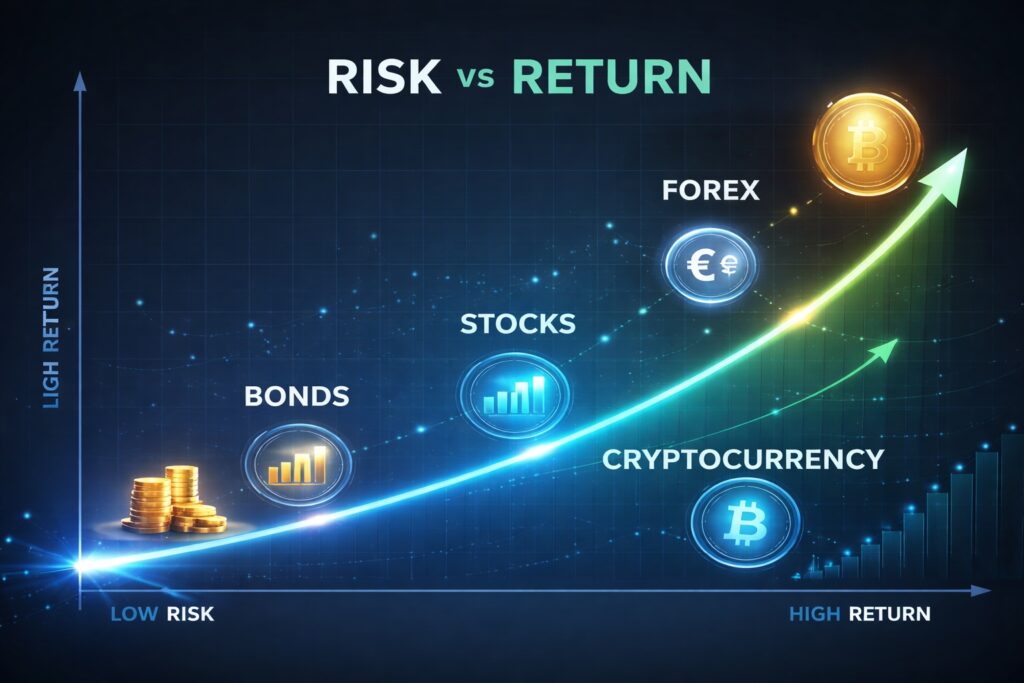
The relationship between risk and return is a fundamental principle in investing, as illustrated in the chart below.
As shown above, lower-risk assets like bonds typically offer more stable but lower returns, while higher-risk investments such as cryptocurrencies and forex trading can deliver higher potential returns with increased volatility.
Managing risk is as important as selecting investments. Key principles:
Position Sizing — Never allocate so much to a single investment that its failure would be catastrophic. Most professional investors limit single-position exposure to 5-10% of total portfolio value.
Stop-Loss Discipline — Know in advance at what point you will exit a losing position. Letting losses run is one of the most common and costly investor mistakes.
Regular Rebalancing — Over time, winning positions grow larger than intended, increasing concentration risk. Rebalancing — selling some winners to buy underweight positions — maintains your intended risk profile.
Avoid Leverage Unless Experienced — Leverage amplifies both gains and losses. Beginning investors should build portfolios without leverage until they have a thorough understanding of risk management. In forex trading, leverage is common but requires strict position sizing — use our position size calculator to manage risk on every trade.
Timing the Market — Trying to buy at the bottom and sell at the top consistently fails. Time in the market beats timing the market for most investors.
Emotional Decision-Making — Panic selling during downturns and euphoric buying during rallies leads to buying high and selling low — the opposite of profitable investing.
Ignoring Fees — High management fees compound over decades into massive return reductions. Favor low-cost index funds where active management doesn’t justify the premium.
Neglecting Tax Efficiency — Investment returns are what you keep after taxes. Tax-advantaged accounts (IRA, 401k) and tax-loss harvesting strategies significantly improve after-tax returns.
Overconcentration — Holding too much in a single stock, sector, or asset class creates unnecessary risk. See our alternative investments guide for ways to diversify beyond traditional stocks and bonds.
Investment Resources on FastCashForex
FastCashForex has been providing free investment and forex education since 2010. Key resources:
US investors should review investment guidelines from the CFTC and NFA for forex-related investments, and the FCA for international regulatory guidance.
Final Thoughts
Investment diversification is the foundation of every successful long-term portfolio — no single asset class performs well in all market conditions.
Successful investing is not about finding the one perfect asset or timing the market perfectly. It is about building a diversified portfolio aligned with your goals and risk tolerance, managing risk consistently, and staying disciplined through inevitable market cycles.
Start with the basics — understand each asset class, allocate according to your time horizon and risk tolerance, diversify across multiple assets and geographies, and review your portfolio regularly. The investors who build lasting wealth are those who invest consistently, manage risk carefully, and resist the emotional impulses that lead most retail investors to under perform the market.
FastCashForex has been providing free learning resources on currency trading and investing since 2010. This article is for educational purposes only and should not be considered investment advice. Always consult a licensed financial advisor before making investment decisions.