Forex pips are the universal language of currency trading — every profit, loss, spread and risk calculation depends on understanding them.. A pip represents the smallest price movement in a currency pair, and understanding how pips work is essential for calculating profits, losses, position sizes, and managing risk effectively.
This guide explains what pips are, how to calculate pip values, and why they matter for your trading success.
What Is a Pip in Forex?
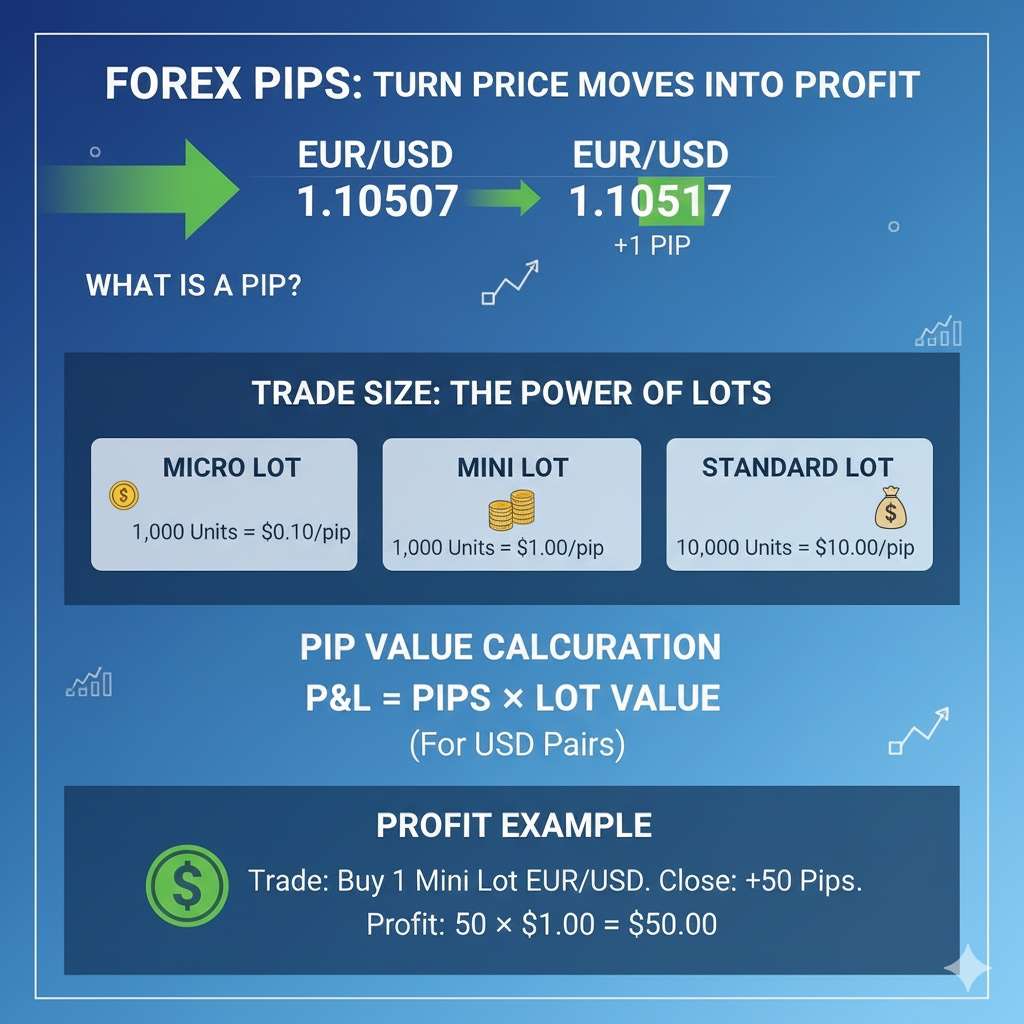
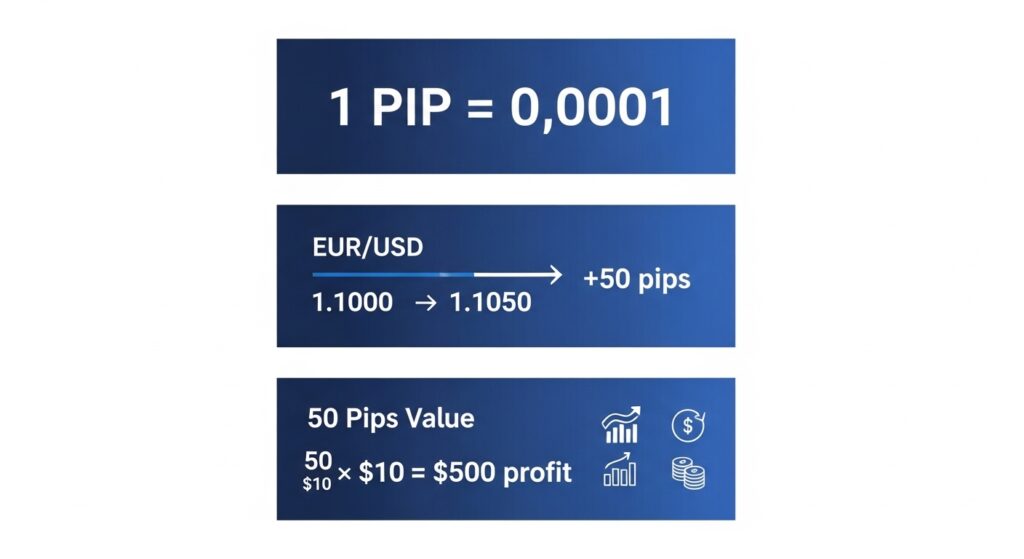
A pip (percentage in point or price interest point) represents the smallest standardized price movement in a currency pair. For most currency pairs, a pip equals 0.0001, or one one-hundredth of one percent. For currency pairs quoted in Japanese yen, a pip equals 0.01.
Examples:
If EUR/USD moves from 1.1000 to 1.1001, it has moved 1 pip. If USD/JPY moves from 110.00 to 110.01, it has moved 1 pip. If GBP/USD moves from 1.3000 to 1.3025, it has moved 25 pips.
The pip is typically the fourth decimal place in most currency pairs and the second decimal place in yen pairs. This standardization allows traders to communicate price movements consistently regardless of the specific currency pair or price level.
Understanding Pipettes (Fractional Pips)
Many brokers now quote currency pairs to an additional decimal place beyond the standard pip. This fractional pip is called a pipette and represents one-tenth of a pip.
Examples:
EUR/USD quoted as 1.10015 shows 5 pipettes beyond the standard pip USD/JPY quoted as 110.015 shows 5 pipettes beyond the standard pip
While pipettes provide more precise pricing, most traders still reference full pips when discussing price movements. A 25.5 pip movement is often simply called a 25 or 26 pip movement depending on rounding.
For position sizing and risk management calculations, full pips remain the standard measurement.
How to Calculate Pip Value
The value of a pip varies depending on the currency pair you’re trading, the size of your position, and your account currency. Understanding pip value is essential for proper position sizing and risk management.
Pip Value Formula
For pairs where USD is the quote currency (second currency):
Pip Value = (Pip Size / Exchange Rate) × Position Size
For pairs where USD is the base currency (first currency):
Pip Value = Pip Size × Position Size
Standard Lot Pip Values
A standard lot equals 100,000 units of the base currency. Here are the pip values for major pairs when trading one standard lot:
USD Quote Currency Pairs (1 standard lot):
- EUR/USD: $10 per pip
- GBP/USD: $10 per pip
- AUD/USD: $10 per pip
- NZD/USD: $10 per pip
USD Base Currency Pairs (1 standard lot):
- USD/JPY: $9.09 per pip (approximately, varies with exchange rate)
- USD/CHF: $10.24 per pip (approximately, varies with exchange rate)
- USD/CAD: $7.46 per pip (approximately, varies with exchange rate)
Cross Pairs (neither currency is USD):
Pip values vary based on both the current exchange rate and your account currency. Most trading platforms calculate these automatically.
Mini Lot Pip Values
A mini lot equals 10,000 units of the base currency. Pip values are one-tenth of standard lot values:
- EUR/USD: $1 per pip
- GBP/USD: $1 per pip
- USD/JPY: $0.91 per pip (approximately)
Micro Lot Pip Values
A micro lot equals 1,000 units of the base currency. Pip values are one-tenth of mini lot values:
- EUR/USD: $0.10 per pip
- GBP/USD: $0.10 per pip
- USD/JPY: $0.091 per pip (approximately)
For more details on lot sizes and their implications for account management, see our guide on what is a lot in forex.
Calculating Profit and Loss Using Pips
Every trade you make generates profit or loss measured in pips, which then translates to dollar profit or loss based on your position size.
Example 1: EUR/USD Standard Lot
Setup:
- Position: Long 1 standard lot EUR/USD at 1.1000
- Exit: Close at 1.1050
- Movement: 50 pips profit
- Pip value: $10 per pip
Calculation: 50 pips × $10 per pip = $500 profit
Example 2: GBP/USD Mini Lot
Setup:
- Position: Short 5 mini lots GBP/USD at 1.3000
- Exit: Close at 1.2950
- Movement: 50 pips profit (price moved down)
- Pip value: $1 per pip per mini lot × 5 lots = $5 per pip
Calculation: 50 pips × $5 per pip = $250 profit
Example 3: USD/JPY Micro Lot Loss
Setup:
- Position: Long 10 micro lots USD/JPY at 110.00
- Exit: Close at 109.70
- Movement: 30 pips loss
- Pip value: $0.091 per pip per micro lot × 10 lots = $0.91 per pip
Calculation: 30 pips × $0.91 per pip = $27.30 loss
Understanding these calculations is essential because your risk management strategy depends on knowing exactly how many dollars you’re risking per pip before you enter a trade.
Why Forex Pips Matter for Risk Management
Forex pips provide a standardized way to measure and manage risk across all currency pairs and position sizes.
Professional traders think in pips when managing risk because it provides a standardized way to measure trade performance regardless of position size or account balance.
Position Sizing Based on Pip Risk
Proper position sizing requires knowing:
- How many pips your stop loss represents
- The dollar amount you’re willing to risk
- The pip value of your proposed position size
Example: 2% Risk Rule
Account: $5,000 Risk tolerance: 2% = $100 Stop loss distance: 20 pips Calculation: $100 ÷ 20 pips = $5 per pip Position size: 5 mini lots (where each pip = $1, so 5 lots = $5 per pip)
This calculation ensures you risk exactly $100 (2% of your account) regardless of whether the trade wins or loses.
For detailed position sizing strategies, review our guide on how to calculate position size.
Comparing Trade Quality
Pips provide a standardized measure for evaluating trade quality. A 50-pip winner is a 50-pip winner whether you traded 1 micro lot or 10 standard lots. This allows you to:
- Track your average win size in pips
- Calculate your average loss size in pips
- Determine your win rate
- Assess whether your edge actually exists
A trader consistently averaging 60 pips on winners and 40 pips on losers with a 50% win rate has a mathematical edge. The same trader with a 40-pip average win and 60-pip average loss does not, regardless of position size.
Common Pip-Related Mistakes
Mistake 1: Confusing Pips with Dollars
New traders often focus on dollar profits rather than pip profits. A $100 profit on a 10-pip movement with overleveraged position sizing is far worse than a $50 profit on a 100-pip movement with proper sizing.
Focus on capturing pips with sound strategy. Dollar profits follow naturally from consistent pip capture combined with appropriate position sizing for your account.
Mistake 2: Ignoring Pip Value Differences
Not all currency pairs have the same pip value. Trading USD/CAD with the same position size as EUR/USD means different dollar risk per pip. Always calculate pip values for the specific pair you’re trading.
Mistake 3: Overleveraging to “Make More Pips Worth More”
Increasing position size doesn’t increase the number of pips you capture—it only increases the dollar value of each pip. A bad trade that loses 50 pips still loses 50 pips whether you trade 1 lot or 100 lots. The difference is whether you lose $500 or $50,000.
Position size should be determined by your risk management rules, not by how much profit you want from a specific number of pips.
Mistake 4: Setting Stop Losses Based on Dollars Instead of Pips
Effective stop loss placement depends on chart structure, volatility, and technical levels—all measured in pips. Setting a stop loss at “I’ll risk $50” without considering whether that represents 10 pips or 100 pips in the current pair leads to either overleveraging or underleveraging.
Always determine your stop loss distance in pips first, then calculate the appropriate position size based on your dollar risk tolerance.
Pips and Different Trading Styles
How you use forex pips as a target depends entirely on your trading style and time commitment.
Different trading styles target different pip objectives based on timeframe and strategy.
Scalping
Scalpers target 5-15 pips per trade, executing multiple trades daily. Success requires:
- Very tight spreads (0.0-0.5 pips on majors)
- Fast execution
- High win rate (60%+) due to small risk-reward ratios
- Significant time commitment
A scalper might execute 20 trades daily, targeting 10 pips each for a 200-pip daily target. With 5 mini lots, this represents $1,000 daily profit potential.
Day Trading
Day traders target 20-50 pips per trade, holding positions for minutes to hours. This style requires:
- Moderate spreads (0.5-1.5 pips acceptable)
- Good execution
- Moderate win rate (50-60%)
- Several hours of daily availability
A day trader might execute 5 trades daily, targeting 30 pips each for a 150-pip daily target.
Swing Trading
Swing traders target 100-300 pips per trade, holding positions for days to weeks. This approach requires:
- Spreads less critical (1-3 pips acceptable)
- Less frequent execution
- Moderate win rate (45-55%)
- Patience to hold through pullbacks
A swing trader might execute 2-3 trades weekly, targeting 200 pips each.
Position Trading
Position traders target 500-1,000+ pips per trade, holding positions for weeks to months. This style requires:
- Spreads minimally relevant
- Very infrequent execution
- Lower win rate acceptable (40-50%)
- Significant capital and patience
Position traders might execute 1-2 trades monthly, targeting major trend movements.
For more on trading styles and capital requirements, see our guide on how much money to start forex trading.
Spread Costs in Pips
Every trade you enter costs you the spread—the difference between the bid and ask price measured in pips. Understanding spread costs is essential because they directly impact profitability.
Typical Spreads by Account Type
Cent and Micro Accounts:
- EUR/USD: 1.5-3 pips
- GBP/USD: 2-4 pips
- USD/JPY: 1.5-3 pips
Standard Accounts:
- EUR/USD: 0.8-1.5 pips
- GBP/USD: 1.0-2.0 pips
- USD/JPY: 0.8-1.5 pips
Premium Accounts:
- EUR/USD: 0.0-0.5 pips
- GBP/USD: 0.3-0.8 pips
- USD/JPY: 0.0-0.5 pips
Impact on Strategy:
A scalper targeting 10 pips per trade with a 2-pip spread must capture 12 pips of market movement to net 10 pips profit. This 20% hidden cost makes tight spreads essential for short-term strategies.
A swing trader targeting 200 pips per trade with the same 2-pip spread pays only 1% in spread costs, making spread size less critical.
For details on account types and their spread characteristics, see our guides on forex cent accounts, micro accounts, standard accounts, premium accounts, and institutional accounts.
Tracking Your Pip Performance
Tracking your forex pips performance is what separates traders who improve from those who repeat the same mistakes.
Successful traders track their performance in pips to identify strengths and weaknesses in their trading approach.
Key Pip Metrics to Track
Average Win Size (pips): Total winning pips ÷ number of winning trades Average Loss Size (pips): Total losing pips ÷ number of losing trades Win Rate: Winning trades ÷ total trades Profit Factor (in pips): Total winning pips ÷ total losing pips Risk-Reward Ratio: Average win ÷ average loss
Example Performance Analysis
Trader A – 100 trades:
- 55 wins averaging 40 pips = 2,200 pips
- 45 losses averaging 30 pips = 1,350 pips
- Net: 850 pips
- Profit factor: 1.63
- Risk-reward: 1.33:1
Trader B – 100 trades:
- 40 wins averaging 80 pips = 3,200 pips
- 60 losses averaging 40 pips = 2,400 pips
- Net: 800 pips
- Profit factor: 1.33
- Risk-reward: 2:1
Both traders captured similar net pips, but Trader A achieved it with higher win rate and smaller average loss, while Trader B achieved it with larger winners despite lower win rate. Neither approach is inherently superior—what matters is consistency and positive expectancy.
Frequently Asked Questions
What does pip stand for?
Pip stands for “percentage in point” or “price interest point.” It represents the smallest standardized price movement in forex trading.
How many pips equal one percent?
For most currency pairs, 100 pips equal 1% movement. For example, EUR/USD moving from 1.1000 to 1.1100 represents a 100-pip or 1% change. For yen pairs, 100 pips also equal approximately 1% (USD/JPY from 110.00 to 111.00).
Is capturing more pips always better?
Not necessarily. Capturing 100 pips with proper position sizing and risk management is far better than capturing 200 pips with overleveraged positions that one bad trade can destroy. Focus on consistent pip capture with appropriate risk management rather than maximum pips.
How many pips should I target per day?
This depends entirely on your trading style and account size. Scalpers might target 50-100 pips daily with multiple trades. Day traders might target 30-60 pips. Swing traders don’t think in daily pips but weekly or monthly totals. Focus on executing your strategy consistently rather than arbitrary daily pip targets.
Do all brokers calculate pips the same way?
Yes, the definition of a pip is standardized across the industry. However, brokers may differ in:
- Whether they quote to fractional pips (pipettes)
- The spreads they charge (measured in pips)
- How they display pricing on their platforms
The actual pip movement in the market is the same regardless of broker.
How do I calculate pips for crypto or gold?
Cryptocurrencies and commodities like gold aren’t quoted in pips—they use different price increments. Bitcoin might move in $1 increments, gold in $0.10 increments. These markets use “points” or dollars rather than pips. The pip measurement system is specific to forex currency pairs.
Forex pips and all related trading calculations are subject to regulatory oversight; US traders should review guidelines from the CFTC and NFA, while international traders can refer to the FCA.
Related Resources
- What Is a Lot in Forex Trading
- How to Calculate Position Size
- Forex Risk Management Guide
- How Much Money to Start Forex Trading
- Understanding Currency Pairs
- Technical Analysis Guide
Understanding pips is foundational to forex trading success. Master pip calculations, use them for proper position sizing and risk management, and track your performance in pips to develop consistent profitability over time.