Learn How to Make Fast Money by Learning diffrent Strategies in Forex Trading and Different Investment Options
What is Bitcoin?
What is Bitcoin is the world’s first and most widely recognized cryptocurrency — a form of digital money that exists entirely online, with no physical coins or banknotes. It operates without the need for any central authority such as a government, central bank, or financial institution to issue or manage it. Instead, it runs on a global network of computers that collectively maintain and verify every transaction ever made.
Bitcoin was introduced in 2009 by an anonymous individual or group operating under the name Satoshi Nakamoto. The true identity of its creator has never been confirmed. What Nakamoto left behind, however, changed the world of finance permanently: a decentralized digital currency system powered by a technology called the blockchain. In a white paper published in October 2008, Nakamoto described Bitcoin as “a peer-to-peer electronic cash system” — a way for people to send money directly to one another without going through a bank or payment processor.
In the years since its launch, Bitcoin has grown from a niche experiment among cryptographers and tech enthusiasts into a globally recognized financial asset held by individuals, corporations, and institutional investors alike.
At the heart of Bitcoin is the blockchain — a public, permanent, and tamper-resistant digital ledger that records every single Bitcoin transaction ever made. When you send Bitcoin to another person, that transaction is broadcast to a network of computers called nodes, which verify its validity. Once confirmed, it is added to the blockchain as part of a “block” of transactions, forming a chain that stretches back to the very first Bitcoin transaction in 2009.
Because the blockchain is maintained simultaneously by thousands of computers around the world, no single entity controls it. There is no company headquarters, no CEO, and no customer service department. The network is maintained by participants called miners, who use powerful computers to solve complex mathematical puzzles that validate transactions and add new blocks to the chain. In return, miners are rewarded with newly created Bitcoin. This process is known as proof-of-work, and it is what makes the Bitcoin network both secure and decentralized.
Bitcoin’s total supply is permanently capped at 21 million coins. This scarcity is built into the code and cannot be changed. Roughly every four years, the reward given to miners is cut in half in an event known as the “halving.” The most recent halving took place in April 2024, reducing the block reward to 3.125 BTC. This controlled supply is one of the reasons many investors view Bitcoin as a hedge against inflation — unlike traditional currencies, no government can print more of it. Economists who support Bitcoin often compare its scarcity to that of gold, which is why Bitcoin is frequently referred to as “digital gold.”
How to Buy Bitcoin
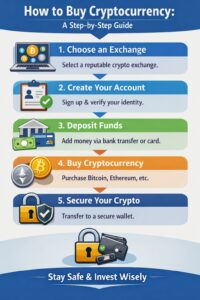
Bitcoin can be purchased through cryptocurrency exchanges — online platforms where buyers and sellers trade digital currencies using traditional money. The largest and most established exchanges include Coinbase, Binance, and Kraken. To get started, you typically need to create an account, verify your identity in accordance with Know Your Customer (KYC) regulations, and connect a payment method such as a bank transfer or debit card.
Once purchased, your Bitcoin is credited to your exchange account. From there, you can leave it on the exchange — which carries some custodial risk — or transfer it to a personal wallet that you control directly.
It is also possible to buy fractional amounts of Bitcoin. You do not need to purchase an entire coin. Bitcoin is divisible down to eight decimal places, with the smallest unit called a satoshi (0.00000001 BTC), making it accessible to investors of any budget. Someone investing $50 receives the equivalent fraction of a Bitcoin at the current market price, just as they would with any other divisible asset.
In January 2024, the U.S. Securities and Exchange Commission approved the first spot Bitcoin ETFs (Exchange-Traded Funds), allowing everyday investors to gain exposure to Bitcoin’s price through regulated brokerage accounts without holding the cryptocurrency directly. This was a landmark development that brought Bitcoin within reach of a much broader pool of institutional and retail investors.
How Bitcoin is Stored
Bitcoin is stored in digital wallets, which come in two main types. A hot wallet is connected to the internet and is typically offered by exchanges or as a standalone app on your phone or computer. Hot wallets are convenient for frequent transactions but are more vulnerable to hacking and phishing attacks.
A cold wallet, also known as a hardware wallet, stores your Bitcoin offline on a physical device similar to a USB drive. Cold wallets are considered the most secure method of storing Bitcoin because they are not connected to the internet and therefore cannot be accessed remotely by hackers. Popular hardware wallet brands include Ledger and Trezor. For anyone holding a significant amount of Bitcoin, using a hardware wallet is strongly recommended.
It is critical to understand that Bitcoin wallets are not insured by any government body. Unlike a bank account protected by federal deposit insurance, if your Bitcoin is lost, stolen, or you lose access to your wallet’s private key or seed phrase, there is no authority to recover it. The phrase “not your keys, not your coins” is widely used in the crypto community to emphasize the importance of controlling your own wallet rather than relying on a third party.
Why People Use Bitcoin
So what is Bitcoin andy people use them? Bitcoin serves different purposes for different people. For some, it is primarily an investment and a store of value — a way to hold wealth outside of the traditional banking system. Its fixed supply and decentralized nature make it attractive to those who are concerned about currency debasement or inflation in their home country.
For others, Bitcoin is a payment tool. It allows money to be sent across borders quickly and at relatively low cost compared to traditional wire transfers. In countries with unstable currencies or limited banking infrastructure, Bitcoin has become an important financial alternative. In nations experiencing hyperinflation, residents have turned to Bitcoin to preserve purchasing power when their local currency is rapidly losing value.
Institutional interest in Bitcoin has grown significantly in recent years. Major companies, asset managers, and even some governments now hold Bitcoin as part of their treasury or investment portfolios. El Salvador became the first country to adopt Bitcoin as legal tender in 2021. More recently, several U.S. states and national governments have explored holding Bitcoin as a strategic reserve asset, signaling a shift in how governments view the cryptocurrency.
The development of the Lightning Network — a payment layer built on top of Bitcoin — has also made Bitcoin transactions faster and cheaper for everyday use, addressing one of the longstanding criticisms that Bitcoin was too slow and expensive for small, everyday payments.
Risks Every Investor Should Understand
Bitcoin is one of the most volatile assets in existence. Its price has historically experienced dramatic swings — rising thousands of percent in bull markets and falling 70 to 80 percent from peak to trough in bear markets. Anyone investing in Bitcoin must be fully prepared for the possibility of significant losses. Price movements can be triggered by regulatory announcements, macroeconomic developments, large whale transactions, or simply market sentiment.
Regulatory risk is another important consideration. Governments around the world are still developing frameworks for regulating cryptocurrency. Changes in tax law, trading restrictions, or outright bans in certain jurisdictions can affect the value and usability of Bitcoin at any time. In the United States, the CFTC and other agencies continue to develop oversight frameworks for digital assets. In the United Kingdom, the FCA has implemented strict rules around the marketing and sale of crypto assets to retail consumers. The NFA also plays a role in overseeing certain crypto-related derivatives products in the United States.
Security risk is real and should not be underestimated. Exchange hacks, phishing attacks, and scams targeting crypto holders are common. Protecting your Bitcoin requires strong security habits including two-factor authentication, secure and unique passwords, and ideally the use of a hardware wallet for any significant holdings. Never share your seed phrase with anyone under any circumstances.
Finally, while Bitcoin has the largest market share and the strongest brand recognition in the cryptocurrency space, competition from other blockchain platforms continues to grow. Ethereum, Solana, and other networks offer different functionalities and continue to attract developer and investor attention. Whether Bitcoin maintains its dominance long-term is a question that even the most experienced analysts debate.
Bitcoin and Financial Regulation
Because Bitcoin operates outside the traditional banking system, regulators worldwide have taken a close interest in how it is used. In the United States, Bitcoin is treated as property for tax purposes, meaning capital gains taxes apply when it is sold at a profit. The IRS requires all cryptocurrency transactions to be reported on tax returns, and failure to do so can result in penalties.
In Europe, the Markets in Crypto-Assets (MiCA) regulation came into full effect in 2024, establishing the most comprehensive legal framework for cryptocurrency in the world at a regional level. MiCA requires crypto asset service providers operating in the EU to obtain proper authorization, meet capital requirements, and adhere to consumer protection standards.
In the Middle East, countries such as the UAE have positioned themselves as crypto-friendly jurisdictions, with clear licensing frameworks for exchanges and crypto service providers. Dubai’s Virtual Assets Regulatory Authority (VARA) has become one of the world’s more progressive crypto regulators, attracting major exchanges and blockchain companies to the region.
Understanding the regulatory environment in your own country before investing in Bitcoin is essential. Regulations continue to evolve rapidly, and what is permitted today may be subject to change.
Bitcoin vs. Other Cryptocurrencies
Bitcoin was the first cryptocurrency, but today it exists alongside thousands of others. Ethereum, the second-largest cryptocurrency by market capitalization, introduced the concept of smart contracts — self-executing agreements coded directly onto the blockchain. This enabled an entirely new ecosystem of decentralized applications, NFTs, and decentralized finance (DeFi) protocols that go far beyond what Bitcoin was originally designed to do.
Bitcoin’s supporters argue that its simplicity and focus — acting purely as a store of value and medium of exchange — is precisely what makes it the most trustworthy and secure cryptocurrency. Its code changes very slowly and deliberately, which critics sometimes see as a weakness but supporters view as a strength. In a space defined by hype and rapid change, Bitcoin’s conservative approach has earned it a degree of credibility that newer cryptocurrencies have not yet matched.
Is Bitcoin Right for You?
Bitcoin is not for everyone. It is a high-risk, high-volatility asset that requires careful consideration of your financial situation, risk tolerance, and investment goals before committing any capital. Those who choose to invest in Bitcoin are generally advised to allocate only a portion of their portfolio that they can afford to lose entirely, to use reputable exchanges and secure storage, and to take a long-term perspective rather than trying to time short-term price movements.
Whether you view Bitcoin as the future of money, a speculative asset, or simply a fascinating technology, understanding how it works is increasingly important in today’s financial landscape. The cryptocurrency market is maturing, institutional adoption is growing, and regulatory clarity is slowly improving — making this a space worth watching regardless of your investment stance.
Disclaimer: This article is for informational and educational purposes only and does not constitute financial or investment advice. Cryptocurrency investments are highly speculative and carry significant risk of loss. Always conduct your own research and consult a qualified financial advisor before making any investment decisions.