XRP has emerged as one of the most actively traded cryptocurrencies, attracting both experienced traders and newcomers to the crypto market. Originally created by Ripple Labs to facilitate fast, low-cost international payments, XRP has evolved into a widely traded digital asset with significant market capitalization and daily trading volume.
For traders familiar with forex markets, XRP presents both familiar patterns and unique characteristics. Like currency pairs, XRP exhibits technical price movements that respond to chart analysis, support and resistance levels, and momentum indicators. However, cryptocurrency markets operate 24/7, experience higher volatility than traditional forex, and face different fundamental drivers including regulatory developments, technological adoption, and broader crypto market sentiment.
This comprehensive guide covers everything you need to start trading XRP, from understanding what makes it unique among cryptocurrencies to developing practical trading strategies. Whether you’re transitioning from forex trading or completely new to financial markets, this guide provides the foundation for informed XRP trading decisions.
Understanding XRP’s role in both the cryptocurrency ecosystem and the broader financial system helps traders anticipate price movements, identify trading opportunities, and manage the unique risks associated with digital asset trading.
What is XRP?
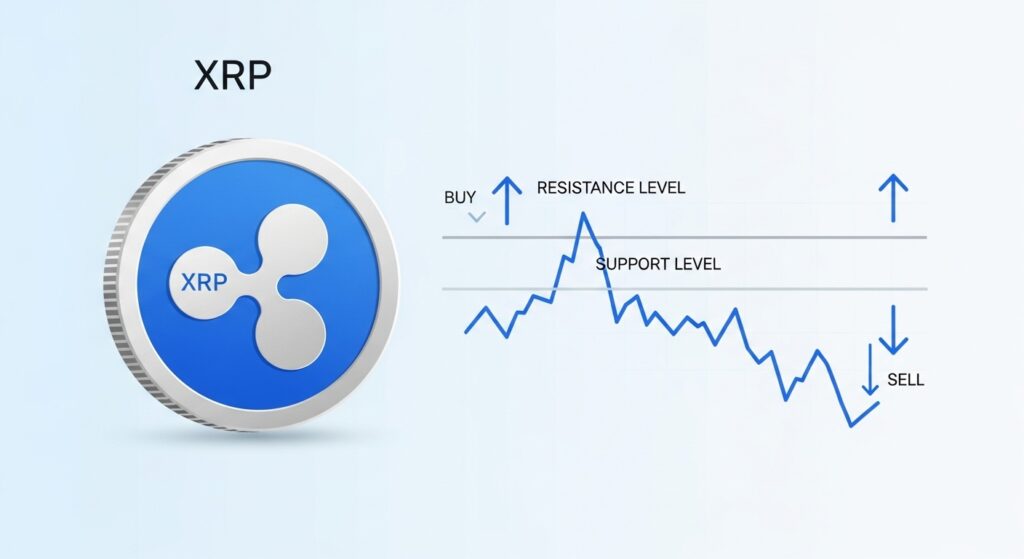
XRP is a digital asset created in 2012 by Ripple Labs, designed specifically to solve problems in international money transfers. Unlike Bitcoin, which primarily serves as a store of value, or Ethereum, which functions as a platform for smart contracts, XRP focuses on enabling fast, low-cost cross-border payments between financial institutions.
The XRP Ledger operates using a unique consensus mechanism that differs from Bitcoin’s proof-of-work or Ethereum’s proof-of-stake. This consensus protocol allows XRP transactions to settle in 3-5 seconds with minimal energy consumption, making it significantly faster and more efficient than many other cryptocurrencies.
Ripple Labs, the company behind XRP, maintains a significant portion of the total XRP supply, which has been a point of both criticism and strategic advantage. The company uses XRP in its payment products, selling portions to fund operations and partnering with financial institutions worldwide to integrate XRP into cross-border payment systems.
Understanding this institutional focus distinguishes XRP from purely decentralized cryptocurrencies like Bitcoin. XRP’s price often responds to news about Ripple’s partnerships with banks, regulatory clarity around its legal status, and adoption of Ripple’s payment technologies by financial institutions.
XRP vs Other Cryptocurrencies
XRP occupies a unique position in the cryptocurrency market, differing from Bitcoin and Ethereum in fundamental ways that affect its trading characteristics.
XRP vs Bitcoin: Bitcoin functions primarily as “digital gold”—a store of value and hedge against inflation. Its supply is capped at 21 million coins, and its value proposition centers on scarcity and decentralization. XRP, conversely, focuses on utility for payments, with 100 billion total supply (though much remains in escrow). Bitcoin’s slower transaction times (10-60 minutes) and higher fees contrast sharply with XRP’s 3-5 second settlements and fractional-cent costs.
XRP vs Ethereum: Ethereum serves as a platform for decentralized applications and smart contracts, with its native token (ETH) fueling network operations. XRP doesn’t support complex smart contracts, instead optimizing specifically for payment transfers. Ethereum’s transition to proof-of-stake reflects its focus on supporting a broader ecosystem, while XRP’s consensus mechanism prioritizes transaction speed and efficiency.
Trading Implications: These differences create distinct trading patterns. Bitcoin often leads broader crypto market movements, with other cryptocurrencies (including XRP) following its trends. However, XRP can decouple from Bitcoin during major partnership announcements, regulatory developments, or adoption news specific to Ripple’s payment solutions. Traders must monitor both general crypto market sentiment and XRP-specific catalysts.
The correlation between XRP and Bitcoin typically ranges from 0.6 to 0.8, meaning XRP often (but not always) moves in the same direction as Bitcoin. During periods of XRP-specific news—positive or negative—this correlation can temporarily break down, creating unique trading opportunities.
How XRP Trading Works
XRP trading operates through cryptocurrency exchanges, which function similarly to forex brokers but with some important differences. Understanding these mechanics helps traders execute effectively and avoid common pitfalls.
Trading Pairs: XRP trades against various currencies and cryptocurrencies, creating multiple trading pairs:
- XRP/USD or XRP/USDT: Trading XRP against the US dollar or Tether (a stablecoin pegged to USD). This is the most straightforward pair for understanding XRP’s dollar value.
- XRP/BTC: Trading XRP against Bitcoin. This pair reflects XRP’s performance relative to Bitcoin, independent of dollar movements.
- XRP/EUR, XRP/GBP: Trading against other fiat currencies, useful for traders in those regions.
Market Hours: Unlike forex markets that close on weekends, cryptocurrency markets operate 24 hours a day, 7 days a week, 365 days a year. This continuous operation creates both opportunities (trade anytime) and challenges (markets can move significantly while you sleep).
Order Types: Cryptocurrency exchanges support similar order types to forex platforms:
- Market Orders: Execute immediately at current market price
- Limit Orders: Execute only at specified price or better
- Stop-Loss Orders: Automatically close positions to limit losses
- Take-Profit Orders: Automatically close positions to lock in gains
Liquidity Considerations: XRP generally maintains high liquidity on major exchanges, but liquidity varies significantly across different platforms and trading pairs. Major exchanges like Binance, Coinbase, and Kraken offer the deepest liquidity for XRP/USD and XRP/USDT pairs. Smaller exchanges or less common pairs may have wider spreads and slippage.
Settlement: Unlike forex, which settles trades in two business days (T+2), cryptocurrency trades settle almost instantly. When you buy XRP, you can immediately withdraw it to your wallet. This instant settlement provides greater control but also eliminates the protection period available in traditional markets.
Major Factors Affecting XRP Price
XRP price movements result from a complex interplay of factors unique to both cryptocurrency markets and XRP’s specific role in cross-border payments.
Regulatory Developments: XRP faces ongoing regulatory scrutiny, particularly in the United States. The SEC lawsuit against Ripple Labs, alleging XRP is an unregistered security, has significantly impacted price volatility since December 2020. Court rulings, regulatory clarity, or settlement announcements can trigger massive price movements—sometimes 20-50% in a single day. Traders must stay informed about legal developments and anticipate potential volatility around court dates and regulatory announcements.
Ripple Partnership Announcements: When Ripple announces partnerships with major financial institutions, payment providers, or central banks, XRP typically experiences short-term price increases. However, traders should distinguish between meaningful partnerships involving actual XRP usage and general collaborations that may not directly impact XRP demand. The market has become more sophisticated in discounting partnership announcements that don’t involve XRP integration.
Broader Crypto Market Sentiment: Bitcoin’s price movements heavily influence the entire cryptocurrency market, including XRP. Major Bitcoin rallies or crashes typically drag XRP and other altcoins in the same direction. However, during Bitcoin consolidation periods, XRP can establish independent trends based on its own catalysts.
Technical Adoption Metrics: Real-world usage metrics provide fundamental value signals. XRP Ledger transaction volume, number of active addresses, and integration into payment systems like RippleNet reflect actual adoption. Increasing usage suggests growing utility and potential long-term value, while stagnant or declining metrics may indicate weakening fundamentals.
Market Liquidity and Trading Volume: XRP’s high trading volume across multiple exchanges generally provides good liquidity, but volume spikes often precede significant price movements. Monitoring 24-hour volume changes helps identify periods of increased interest and potential breakouts.
Token Supply Dynamics: Ripple Labs holds approximately 50 billion XRP in escrow, releasing up to 1 billion monthly (though usually returning most to escrow). These releases can create selling pressure, though the market has largely adapted to this predictable schedule. Unexpected changes to release patterns or announcements of supply burns could significantly impact price.
XRP Trading Strategies
Successful XRP trading requires strategies adapted to cryptocurrency market characteristics, including 24/7 operation, high volatility, and rapid price movements.
Day Trading XRP
Day trading involves opening and closing positions within the same day, capitalizing on intraday price movements without holding overnight risk.
Optimal Timeframes: Most XRP day traders focus on 15-minute, 1-hour, and 4-hour charts. These timeframes balance noise filtering with responsiveness to price movements. The 1-hour chart often provides the best combination of actionable signals and manageable position monitoring.
Key Indicators for Day Trading:
- Moving Averages: 20-period and 50-period exponential moving averages (EMAs) on hourly charts help identify short-term trends. Price crossing above both EMAs suggests bullish momentum; crossing below suggests bearish momentum.
- RSI (Relative Strength Index): Identifies overbought (above 70) and oversold (below 30) conditions. In strong trends, RSI can remain in extreme zones longer than traditional forex, so combine with price action confirmation.
- Volume Analysis: Increasing volume during price movements confirms strength; declining volume suggests weakening momentum. Look for volume spikes on breakouts to validate genuine moves versus fake-outs.
Day Trading Approach:
- Identify the dominant 4-hour trend
- Wait for pullbacks to key support in uptrends or resistance in downtrends
- Enter when 1-hour chart shows reversal signals (candlestick patterns, momentum shift)
- Set stop-loss beyond the most recent swing point
- Target 2-3% gains, exiting at resistance in uptrends or support in downtrends
Risk Management: Day traders should risk no more than 1-2% of capital per trade. With XRP’s volatility, a 3-5% stop-loss is typically appropriate for 1-hour timeframe trades. This allows enough room for normal price fluctuation while protecting against significant adverse moves.
Swing Trading XRP
Swing trading holds positions for several days to weeks, capturing larger price movements while requiring less intensive monitoring than day trading.
Timeframe Focus: Swing traders primarily analyze daily charts, using 4-hour charts for entry timing and weekly charts for broader context. This multi-timeframe approach identifies the bigger trend while optimizing entry points.
Swing Trading Strategies:
Trend Following: Identify established trends on the daily chart using the 50-day and 200-day moving averages. When price trades above both moving averages and they’re positively sloped, the trend is bullish. Enter on pullbacks to the 20-day or 50-day moving average, placing stop-losses below recent swing lows. Target major resistance levels or trailing stops to capture extended moves.
Range Trading: When XRP consolidates between clear support and resistance levels, swing traders can buy near support and sell near resistance. This works best when daily RSI oscillates between 30-70, confirming the ranging environment. Risk management requires tight stops below support for long positions and above resistance for short positions.
Breakout Trading: XRP periodically experiences strong breakouts from consolidation periods, offering significant swing trading opportunities. Identify consolidation zones on daily charts, then wait for high-volume breakouts above resistance or below support. Enter on breakout confirmation (close above/below the level), setting stops back inside the previous range.
Position Sizing: Swing traders can afford wider stop-losses (5-10%) to accommodate multi-day price fluctuations. However, this requires smaller position sizes to maintain the same risk per trade. If day trading 10% of your account per position with 2% stops, swing trading might use 2-4% position size with 5-10% stops, keeping total risk around 1-2% of account value.
News-Based Trading
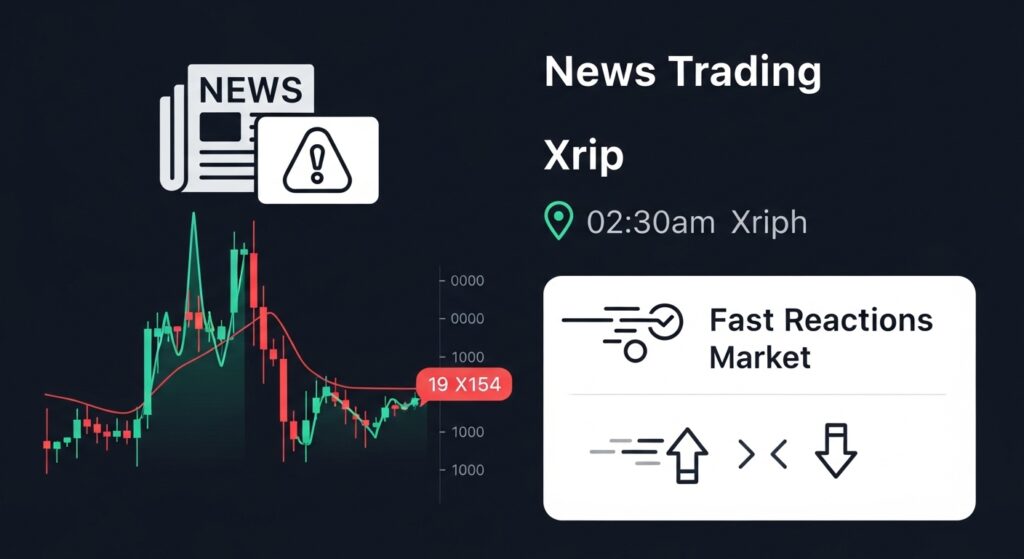
XRP’s price responds dramatically to regulatory news, partnership announcements, and major market developments, creating opportunities for news-based trading strategies.
Event Preparation: Traders should maintain a calendar of known events:
- Court dates in the SEC lawsuit
- Scheduled regulatory hearings or announcements
- Ripple quarterly reports or major conferences
- Central bank digital currency (CBDC) announcements involving Ripple technology
Trading Regulatory News: Regulatory developments create the most significant XRP price movements. Positive news (favorable court rulings, regulatory clarity) typically triggers sharp rallies. Negative news (adverse rulings, increased restrictions) causes rapid selloffs.
The challenge with news trading is that major announcements often occur outside traditional trading hours or develop rapidly. Traders must either:
- Position ahead of anticipated positive news (risking losses if news disappoints)
- React quickly when news breaks (risking poor entry due to gaps and volatility)
- Wait for initial volatility to settle, then trade the trend that develops
Partnership and Adoption News: Partnership announcements create temporary price spikes that often fade within hours or days. Successful news traders distinguish between truly significant developments (actual XRP usage by major institutions) versus routine partnerships (collaborations that may never integrate XRP).
A proven approach: Wait 2-4 hours after partnership announcements to see if price holds gains. If price consolidates at higher levels with declining volatility, the news may have fundamental impact. If price quickly retraces to pre-announcement levels, the market has dismissed the news as insignificant.
Technical Analysis for XRP
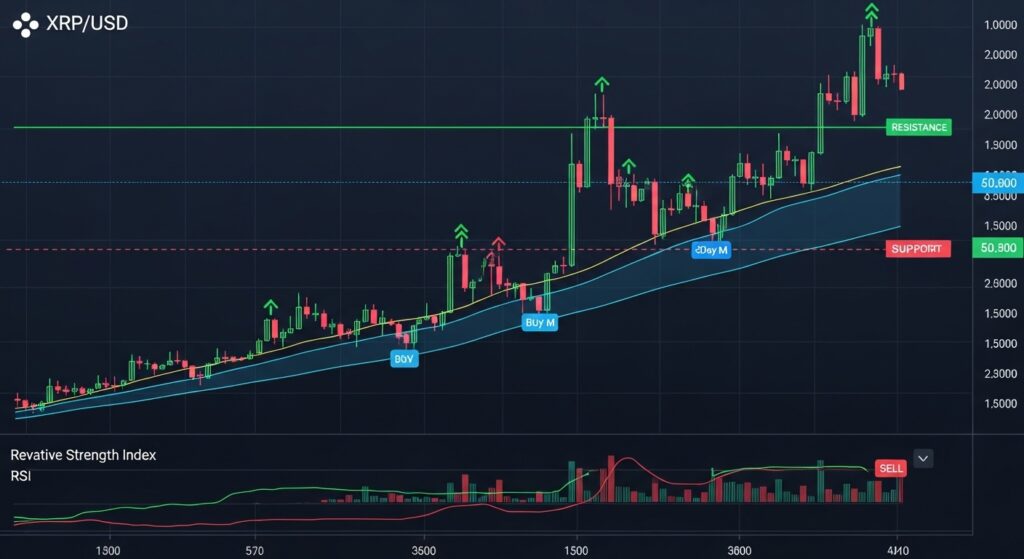
Technical analysis principles apply to XRP trading just as they do to forex, though cryptocurrency markets’ higher volatility and thinner liquidity create some differences in application.
Support and Resistance Levels: XRP respects major support and resistance levels, often established during previous significant price movements. Identify these levels on daily and weekly charts by marking previous peaks and troughs where price reversed. Round numbers (like $0.50, $1.00, $2.00) also function as psychological support/resistance.
Unlike forex major pairs that often have well-defined ranges, XRP can trend strongly for extended periods, making dynamic support/resistance (like moving averages) more useful than fixed levels during trending markets.
Chart Patterns: Classic chart patterns work on XRP charts, including:
- Head and Shoulders: Reversal pattern signaling trend changes
- Double Tops/Bottoms: Another reversal indicator when price fails to break previous highs/lows
- Triangles: Continuation or reversal patterns depending on context
- Flags and Pennants: Short-term continuation patterns during strong trends
Due to 24/7 trading and retail-heavy participant base, cryptocurrency charts sometimes show less reliable pattern formations than traditional markets. Confirm patterns with volume and multiple timeframe analysis before trading.
Moving Averages: The 50-day and 200-day moving averages serve as dynamic support/resistance and trend indicators. When the 50-day crosses above the 200-day (golden cross), it signals potential long-term bullish trends. When the 50-day crosses below the 200-day (death cross), it warns of bearish conditions.
For shorter-term trading, the 20-period EMA on 4-hour or daily charts helps identify the immediate trend direction. Price trading above the 20 EMA suggests buying dips; price below suggests selling rallies.
Momentum Indicators:
- RSI (Relative Strength Index): Particularly useful for identifying divergences where price makes new highs/lows but RSI doesn’t confirm, suggesting momentum weakness and potential reversals.
- MACD (Moving Average Convergence Divergence): Crossovers of the MACD line and signal line provide trade signals. MACD histogram declining while price rises warns of weakening momentum.
- Stochastic Oscillator: Useful in ranging markets for timing entries near support (oversold readings) and exits near resistance (overbought readings).
Volume Analysis: Volume confirms price movements. Breakouts with high volume have higher probability of continuation than low-volume breakouts, which often reverse. Watch for volume spikes during trends—increasing volume confirms trend strength, while declining volume suggests weakening momentum and potential trend exhaustion.
Risk Management in XRP Trading
Cryptocurrency markets’ extreme volatility makes disciplined risk management essential for long-term trading success.
Position Sizing: Never risk more than 1-2% of total trading capital on any single XRP trade. With XRP’s volatility potentially reaching 10-30% daily moves, even small position sizes can generate significant profits or losses. Calculate position size based on the distance to your stop-loss:
Position Size = (Account Balance × Risk %) ÷ (Entry Price – Stop Loss Price)
For example, with a $10,000 account, 2% risk ($200), entry at $0.50, and stop at $0.45: Position Size = $200 ÷ $0.05 = 4,000 XRP (worth $2,000)
This approach automatically adjusts position size based on volatility—wider stops require smaller positions to maintain constant risk.
Stop-Loss Placement: Every XRP trade requires a predetermined stop-loss. Place stops beyond recent swing points, support/resistance levels, or key moving averages. Avoid placing stops at obvious levels where many other traders likely have stops, as large players may target these levels to trigger stop-loss cascades before reversing direction.
Consider using a trailing stop once positions move in your favor. For swing trades, a trailing stop at the 20-day EMA or 10% below current price allows profits to run while protecting against major reversals.
Take-Profit Strategy: Determine exit targets before entering trades. Options include:
- Fixed Targets: Exit at predetermined resistance levels or percentage gains (3%, 5%, 10%)
- Scaling Out: Take partial profits at multiple levels, securing gains while maintaining exposure to extended moves
- Trailing Stops: Let winners run while using trailing stops to lock in profits as price advances
Many successful XRP traders scale out, taking 30-50% of position at first target, moving stop to breakeven, and letting the remainder run with trailing stops.
Avoiding Overtrading: Cryptocurrency’s 24/7 availability tempts traders to constantly monitor markets and overtrade. Successful traders maintain discipline by:
- Trading only during planned sessions (like specific hours each day)
- Requiring clear setups meeting all criteria before entering
- Accepting that sometimes the best trade is no trade
- Tracking all trades to identify patterns in winning versus losing trades
Managing Emotional Risk: XRP’s dramatic price swings—sometimes 20-50% in a day—can trigger emotional decision-making. Combat this by:
- Trading with capital you can afford to lose completely
- Accepting that losses are part of trading and don’t reflect personal failure
- Taking breaks after significant wins or losses to reset emotionally
- Following your trading plan regardless of FOMO (fear of missing out) or panic
Choosing an XRP Trading Platform
Selecting the right cryptocurrency exchange significantly impacts trading costs, security, and execution quality.
Major Exchanges for XRP Trading:
Binance: The world’s largest cryptocurrency exchange by volume offers deep XRP liquidity across multiple pairs (XRP/USDT, XRP/BTC, XRP/EUR). Features include:
- Advanced charting with TradingView integration
- Low trading fees (0.1% standard, lower with BNB discounts)
- Futures and margin trading for advanced strategies
- Mobile app for trading on the go
Coinbase: Popular among US traders, Coinbase provides a user-friendly interface ideal for beginners:
- Simple buying and selling for new traders
- Coinbase Pro offers lower fees for active traders
- Strong regulatory compliance and security
- Higher fees than Binance but easier for beginners
Kraken: A well-established exchange with strong security reputation:
- Competitive fees and good liquidity
- Advanced order types and margin trading
- Strong customer support
- Available in most countries including the US
Selection Criteria:
Fees: Trading fees typically range from 0.1% to 0.5% per trade. For active traders, these fees compound quickly. Compare maker/taker fee structures and any volume discounts. Some exchanges charge deposit/withdrawal fees while others don’t.
Liquidity: Higher liquidity means tighter bid-ask spreads and better fill prices, especially for larger orders. Check 24-hour XRP trading volume on your preferred pair—higher volume indicates better liquidity.
Security: Look for exchanges with:
- Two-factor authentication (2FA)
- Cold storage for customer funds
- Insurance funds to protect against hacks
- Clean security history without major breaches
Regulatory Compliance: Exchanges operating in your jurisdiction with proper licensing provide greater legal protection and lower regulatory risk. US traders should use exchanges registered with FinCEN and compliant with state regulations.
Geographic Restrictions: Some exchanges restrict access based on location. US traders face more limitations than European or Asian traders due to stricter regulations. Verify an exchange accepts customers from your country before registering.
XRP Wallets and Security
Unlike forex trading where your broker holds positions, cryptocurrency trading offers the option (and often the wisdom) of withdrawing XRP to personal wallets you control.
Types of XRP Wallets:
Hot Wallets (Internet-Connected):
- Exchange Wallets: Leaving XRP on exchanges provides instant trading access but exposes you to exchange hacks or closures
- Software Wallets: Desktop or mobile apps you control, like Toast Wallet or Exodus
- Web Wallets: Browser-based wallets accessible from any device
Hot wallets suit active traders who need quick access to trade, but they carry higher security risk due to internet connectivity.
Cold Wallets (Offline Storage):
- Hardware Wallets: Physical devices like Ledger or Trezor that store private keys offline
- Paper Wallets: Private keys printed or written on paper, completely offline
Cold wallets provide maximum security for long-term holdings but are impractical for frequent trading.
Security Best Practices:
Separate Trading and Storage: Keep only the XRP you actively trade on exchanges. Move the rest to hardware wallets you control. This limits exposure to exchange hacks while maintaining trading flexibility.
Enable All Security Features: Use two-factor authentication (2FA) on exchange accounts, preferably with authentication apps rather than SMS. Set up withdrawal whitelist addresses on exchanges that offer this feature.
Backup Your Wallets: Hardware and software wallets require backing up recovery phrases (typically 12-24 words). Store these backups securely offline, preferably in multiple physical locations. Never store recovery phrases digitally or take photos of them.
Beware of Phishing: Cryptocurrency scams frequently use phishing emails and fake websites mimicking real exchanges. Always verify website URLs carefully, bookmark legitimate exchange sites, and never click email links claiming to be from exchanges.
Private Key Control: “Not your keys, not your coins” is a cryptocurrency maxim. When you control private keys (through hardware or software wallets), you truly own your XRP. Leaving it on exchanges means trusting the exchange’s security and solvency.
XRP vs Forex Trading
For traders experienced in forex markets, XRP trading presents both familiar territory and new challenges.
Similarities:
- Technical analysis principles apply similarly
- Chart patterns, support/resistance, and indicators work on both
- Risk management fundamentals remain identical
- Order types and execution mechanics are comparable
Key Differences:
Market Hours: Forex markets close weekends and holidays, while cryptocurrency trades 24/7/365. This creates gap risk in crypto (prices can move significantly while you sleep) but also allows trading anytime.
Volatility: XRP commonly experiences 5-10% daily price swings, sometimes 20-50% on major news. Forex major pairs typically move 0.5-1% daily. This higher volatility offers greater profit potential but demands wider stops and smaller position sizes.
Liquidity: Major forex pairs like EUR/USD offer massive liquidity with minimal slippage even on large orders. XRP liquidity is good on major exchanges but pales compared to forex majors. Slippage can occur on larger orders or during high volatility.
Fundamental Drivers: Forex responds to economic data, central bank policy, and geopolitical events. XRP responds to regulatory developments, adoption news, and broader crypto sentiment. The skill of reading economic indicators doesn’t directly transfer to analyzing cryptocurrency fundamentals.
Leverage: Forex commonly offers 50:1 to 500:1 leverage. Cryptocurrency leverage is typically capped at 5:1 to 20:1. Lower leverage reduces both profit potential and risk of account wipeout.
Regulation: Forex markets in major economies operate under strict regulatory oversight. Cryptocurrency regulation remains evolving and varies dramatically by jurisdiction. This creates both opportunity and risk—less regulation means more freedom but less protection.
Correlation Patterns: Forex pairs have well-established correlations (EUR/USD and GBP/USD move together; EUR/USD and USD/CHF move inversely). Cryptocurrency correlations are less stable, with XRP sometimes following Bitcoin closely and other times moving independently.
Common XRP Trading Mistakes
Learning from common mistakes helps new XRP traders avoid costly errors.
Trading Without Stop-Losses: XRP’s volatility can turn winning trades into disasters in hours. Always use stop-losses, no matter how confident you feel about a trade. Hope is not a strategy—protect your capital with predetermined exits.
Overleveraging: High leverage amplifies both gains and losses. While 20:1 leverage can turn 5% moves into 100% gains, it can just as easily wipe out accounts on adverse 5% moves. Start with low or no leverage until consistently profitable.
Emotional Trading: Seeing XRP surge while you’re on the sidelines creates FOMO (fear of missing out), leading to chasing price at tops. Conversely, panic selling during dips locks in losses unnecessarily. Successful trading requires following your plan regardless of emotions.
Ignoring Fees: Trading fees of 0.1-0.5% per trade compound quickly with frequent trading. Making 10 round-trip trades weekly costs 1-5% of capital in fees—requiring 1-5% weekly gains just to break even. Factor fees into profit targets and avoid overtrading.
Following Social Media Hype: Crypto Twitter, Reddit, and YouTube are filled with predictions, rumors, and hype. Most are wrong, many are deliberately manipulative. Do your own analysis rather than following crowd sentiment.
Neglecting Bitcoin’s Influence: Assuming XRP will move independently despite Bitcoin’s overwhelming influence on crypto markets leads to mistimed trades. Always check Bitcoin’s trend before entering XRP positions.
Trading Without a Plan: Successful traders have clear entry criteria, exit targets, stop-losses, and position sizing rules before entering trades. Trading based on hunches or impulse consistently loses money.
Tax Considerations for XRP Trading
Cryptocurrency trading creates tax obligations that vary by country but generally include capital gains taxes.
United States: The IRS treats cryptocurrency as property, meaning every trade triggers a taxable event. Trading XRP for USD, trading XRP for Bitcoin, or using XRP to purchase goods all create capital gains or losses. Gains are taxed as short-term (ordinary income tax rates) if held less than one year or long-term (lower capital gains rates) if held longer.
Traders must track the cost basis (purchase price) and sale price of every transaction to calculate gains/losses. Frequent traders may owe taxes even on small gains across hundreds of trades. Many traders are shocked by tax bills exceeding their account balances if they failed to set aside money for taxes.
Record Keeping: Maintain detailed records of:
- Every XRP purchase (date, amount, price, fees)
- Every sale or trade (date, amount, price, fees)
- Transfers between wallets and exchanges
- Any XRP received as income
Many cryptocurrency tax software solutions (CoinTracker, Koinly, CryptoTrader.Tax) import exchange data and calculate taxes automatically.
Tax Planning Strategies:
- Harvest tax losses late in the year by selling losing positions to offset gains
- Hold profitable positions over one year to qualify for lower long-term capital gains rates
- Consider trading through tax-advantaged retirement accounts where legal
- Consult tax professionals familiar with cryptocurrency, as rules continue evolving
International Variations: Tax treatment varies by country. Some nations don’t tax cryptocurrency gains at all. Others tax every transaction heavily. Research your jurisdiction’s specific rules and maintain compliant records from the start.
The Future of XRP
Understanding potential future developments helps traders anticipate trends and position accordingly.
Regulatory Clarity: The ongoing SEC lawsuit represents XRP’s biggest near-term uncertainty. A favorable outcome could trigger significant price increases as US exchanges relist XRP and institutional investors enter the market. An unfavorable outcome might cause sharp selloffs and limit US market access. Regardless of the lawsuit’s outcome, increased regulatory clarity should reduce volatility and support more stable long-term trends.
Institutional Adoption: Ripple’s partnerships with banks and payment providers could drive XRP demand if these institutions actively use XRP for cross-border transfers. However, many partnerships to date involve RippleNet technology without XRP integration. Traders should monitor whether partnership announcements specify actual XRP usage or merely collaboration on blockchain technology.
Central Bank Digital Currencies (CBDCs): Many central banks are exploring or developing digital currencies. Ripple has positioned itself as a technology provider for CBDC initiatives. While CBDCs likely won’t use XRP directly, Ripple’s involvement could enhance its reputation and indirectly support XRP’s value.
Competition: XRP faces competition from other payment-focused cryptocurrencies like Stellar (XLM) and traditional fintech solutions like SWIFT’s improvements to existing systems. XRP’s success depends on demonstrating superior speed, cost, and reliability compared to alternatives.
Technology Development: The XRP Ledger continues evolving with new features like federated sidechains and NFT support. These developments expand XRP’s use cases beyond payments, potentially increasing demand and value.
Frequently Asked Questions
Is XRP a good investment for beginners?
XRP can be suitable for beginners who understand cryptocurrency basics and can tolerate significant volatility. Its high liquidity and established market presence make it easier to trade than smaller cryptocurrencies. However, beginners should start with small positions, use proper risk management, and thoroughly understand cryptocurrency markets before trading significant capital. Consider starting with our Cryptocurrency Trading Beginners Guide before trading XRP specifically.
What’s the minimum amount to start trading XRP?
Most exchanges allow purchasing as little as $10-25 worth of XRP. However, practical trading considering fees and volatility typically requires at least $500-1,000. Smaller accounts face challenges with position sizing and fee impact. Starting with a few hundred dollars lets you learn without significant financial risk while experiencing real market exposure.
How does XRP compare to Bitcoin for trading?
Bitcoin offers higher liquidity and acts as the crypto market’s primary trend driver, making it somewhat more predictable. XRP provides more volatility (higher profit potential but also higher risk) and can move independently of Bitcoin during XRP-specific news. For beginners, Bitcoin’s greater stability and clearer market structure may be preferable. Experienced traders can capitalize on XRP’s volatility and lower correlation periods.
Can I day trade XRP with a small account?
Day trading XRP with accounts under $1,000 is challenging due to fee impact and position sizing constraints. However, it’s possible if you maintain strict risk management (1-2% risk per trade) and accept that fees will consume a larger percentage of profits. Consider starting with swing trading on small accounts, as wider stops and less frequent trading reduce fee impact while building your account.
What’s the best time of day to trade XRP?
Unlike forex with distinct session overlaps, cryptocurrency trades 24/7 with generally higher volume during US and European business hours (8 AM – 6 PM EST). However, significant moves can occur anytime, particularly when news breaks or Asian markets are active. Rather than focusing on specific hours, trade when you can monitor positions and when clear technical setups appear.
Do I need to withdraw XRP to a wallet or can I keep it on exchanges?
For active trading, keeping XRP on exchanges provides necessary liquidity. For longer-term holdings you’re not actively trading, withdrawing to a hardware wallet offers better security. Many traders split holdings—keeping 20-30% on exchanges for trading and 70-80% in cold storage for security. This balances trading flexibility with security.
Looking to expand your trading knowledge? Explore our comprehensive guides on Technical Analysis and Risk Management to develop skills applicable across forex and cryptocurrency markets.
By: Donna D.