Most retail traders eventually consider getting outside help. The market is complex, the learning curve is steep, and the temptation to hand the work to someone with experience is real. That’s where forex advisory services come in — a broad category of providers offering guidance, signals, managed accounts, and analytical support to traders who want help.

The catch is that this category contains some of the best resources in retail forex and some of the worst scams. Knowing which forex advisory services are legitimate, what each type actually does, and how to evaluate providers safely can save you years of expensive mistakes.
This guide breaks down the main types of forex advisory services, what each offers, what they cost, and how to verify whether a provider is worth trusting with your money.
What Is Forex Advisory?
Forex advisory refers to any service or relationship where a third party provides guidance, recommendations, or active management to help you trade or invest in currency markets. The category covers everything from a $10/month signal subscription to a $50,000 minimum managed forex account run by licensed professionals.
The defining feature is that someone other than you is contributing to your trading decisions — through analysis, signals, automated systems, or direct trade execution.
Forex advisory services exist because most retail traders aren’t profitable on their own. The 70-90% retail trader loss rate creates demand for help, and the industry has filled that demand with both genuine experts and outright fraudsters. Understanding the categories helps you separate the two.
The Main Types of Forex Advisory Services
Different services do different things, and they’re priced and regulated very differently. Here’s how the landscape actually breaks down.
1. Forex Signal Services
A forex signal is a trade recommendation — usually a specific currency pair, entry price, stop-loss level, and take-profit target. Signal services deliver these via email, app, Telegram, or messaging platform, and you decide whether to act on each one.
What it costs: Free signals are common but generally low quality. Paid services range from $30 to $500+ per month.
Who it’s right for: Intermediate traders who want analytical support but want to keep control of their actual trades.
The catch: Most signal services have unverified track records. The few that genuinely work tend to be expensive and limit subscribers to maintain edge. Even good signals only help if you follow them with discipline — most subscribers second-guess and modify trades, which usually destroys results.
How to evaluate: Look for verified track records on platforms like Myfxbook (not screenshots, not internal claims). Avoid services that promise specific monthly returns. Skip anything with high-pressure sales tactics or “limited spots” pitches.
2. Managed Forex Accounts
A managed account is exactly what it sounds like: you fund the account, but a professional money manager makes the trades. You pay management fees plus performance fees on profits.
What it costs: Significant capital (often $10,000 minimum, sometimes $50,000+). Fees typically 20-30% of profits plus 1-2% annual management fee.
Who it’s right for: Investors with substantial capital who want professional management and don’t want to learn to trade themselves.
The catch: This is the most scam-heavy category in retail forex. Many “managed account” services are unregulated, promise unrealistic returns, and either lose money or run outright Ponzi schemes. Even legitimate managers have losing years — and the fees still apply.
How to verify: Look for managers regulated by the CFTC and NFA in the US, the FCA in the UK, or ASIC in Australia. Demand audited track records, not screenshots. Be deeply suspicious of consistent returns above 5-10% monthly. For more, see our warning signs of forex fraud guide.
3. PAMM and MAM Accounts
PAMM (Percentage Allocation Management Module) and MAM (Multi-Account Manager) accounts pool multiple investors with one manager. Profits and losses distribute proportionally based on each investor’s contribution.
What it costs: Lower minimums than direct managed accounts ($500-$5,000 typically). Fees similar (20-30% performance fees).
Who it’s right for: Investors who want professional management with smaller capital. The broker hosting the account adds a layer of accounting transparency.
The catch: Manager skill still matters enormously. Past performance doesn’t guarantee future results. The broker’s accounting handles transparency, but doesn’t filter for skill.
How to evaluate: Use brokers that publicly list PAMM managers with verified track records. Look for managers with multi-year histories, not three-month hot streaks. Pay attention to maximum drawdown, not just total return.
4. Copy Trading Platforms
Copy trading is a more transparent version of managed accounts. You connect your account to a platform that automatically copies the trades of experienced traders. When they enter a position, your account enters proportionally. When they exit, you exit.
What it costs: Lower minimums than managed accounts (sometimes $200). Platform fees plus possible spread markups.
Who it’s right for: Beginning to intermediate investors who want to learn while leveraging others’ experience.
The catch: Top-ranked traders on these platforms often blow up eventually — hot streaks attract followers right before reversals. You also stay exposed to platform risk if the provider has issues.
How to evaluate: Diversify across multiple traders. Look at three-year track records, not three-month ones. Pay attention to maximum drawdown. Major platforms include eToro, ZuluTrade, and MetaTrader’s signal marketplace.
For our deeper coverage of these options, see our ways to invest in forex guide.
5. Robo-Advisors and Automated Forex Advisory
Robo-advisors use algorithms to manage accounts based on your stated goals, risk tolerance, and time horizon. Pure-play forex robo-advisors are rare; more commonly, you’ll find general investment robo-advisors that include some currency exposure.
What it costs: Typically 0.25%-0.50% annual management fee. Lower than human advisors.
Who it’s right for: Hands-off investors who want algorithmic portfolio management without paying full advisory fees.
The catch: Robo-advisors don’t actively trade forex the way managed accounts do — they typically use currency-related ETFs as part of broader portfolios. If you want active forex returns, this isn’t the right category.
6. Independent Financial Advisors
A licensed financial advisor or investment professional can include forex strategy as part of broader financial planning. Unlike forex-specific managers, financial advisors look at your overall situation — retirement, taxes, risk profile — and may include or exclude forex exposure based on what makes sense for you.
What it costs: Typically 1% annual fee on assets managed, sometimes hourly consulting rates.
Who it’s right for: Investors who want forex as one component of a broader financial strategy, not as an isolated investment.
The catch: Most general financial advisors don’t specialize in forex and may not actively trade currencies. They’re better for portfolio integration than active forex management.
How to verify: Use the SEC Investment Advisor Public Disclosure tool to check any US-licensed advisor.
How to Evaluate Any Forex Advisory Service
Whatever category of forex advisory you’re considering, the same evaluation framework applies.
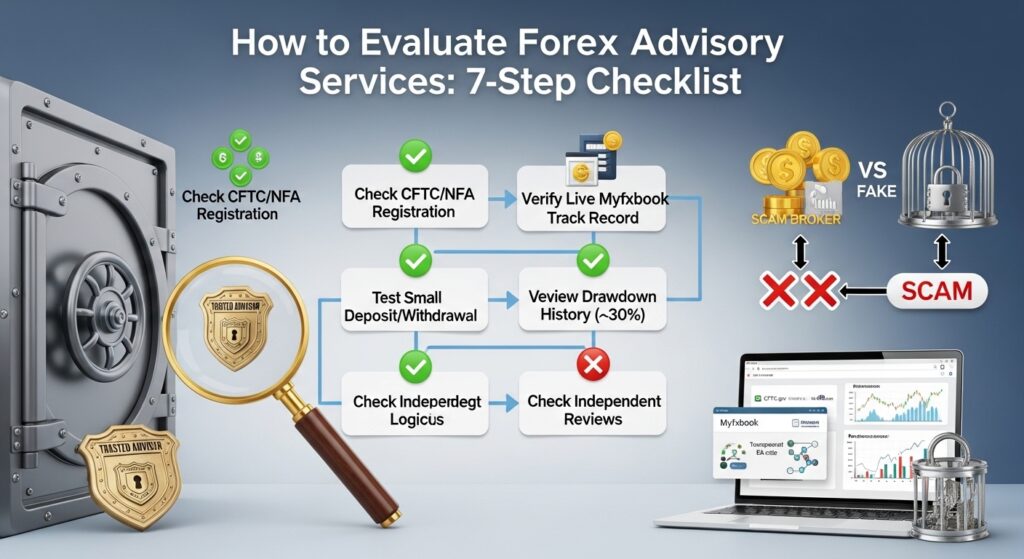
Verify Regulation First
Before sending any money, verify the provider’s regulatory status:
- US-based services: Check the CFTC and NFA registration tools
- UK-based services: Check the FCA register at fca.org.uk
- Australian services: Check ASIC’s professional registers
- EU services: Check national regulators (BaFin in Germany, AMF in France)
Unregulated providers may not be illegitimate, but they offer no protection if something goes wrong. The risk-adjusted return on unregulated forex advisory is almost always worse than regulated alternatives.
Demand Verified Track Records
A legitimate forex advisory service will provide:
- Multi-year performance data (3+ years minimum for serious evaluation)
- Maximum drawdown statistics (the worst peak-to-trough loss)
- Verified results (Myfxbook, FxBlue, or third-party audited)
- Honest reporting of losing periods
Be deeply suspicious of:
- Screenshots of profitable trades (anyone can cherry-pick)
- Backtested results presented as real returns
- Three-month or six-month performance windows
- “Internal records” not shareable with prospects
Understand the Fee Structure
Legitimate forex advisory fees are clear and reasonable. Watch for:
- Management fees: 1-2% of assets under management is normal
- Performance fees: 20-30% of profits is standard for managed accounts
- Subscription fees: $30-500/month for signal services depending on quality
- Hidden fees: Spread markups, withdrawal fees, inactivity fees
Red flag: any service that won’t give you a clear, written fee disclosure before you sign up.
Test With Small Amounts First
Even a verified, regulated forex advisory service should be tested with small amounts before larger commitments. Most managed account agreements allow you to start with the minimum and scale up. Most signal services offer trial periods. Use these.
A service that performs well at $1,000 will probably perform well at $10,000. A service that won’t let you test small is signaling something.
Forex Advisory Red Flags
Some warning signs apply to every category of forex advisory service:

Guaranteed returns. No legitimate forex advisory promises guaranteed profits. The market doesn’t allow it. Anyone making the promise is either lying or doesn’t understand markets.
Pressure to invest immediately. “This opportunity closes Friday” is a sales tactic, not an investment reality. Take the time you need.
Anonymous principals. If you can’t find out who actually runs the service, with verifiable backgrounds, walk away. Real money managers have public credentials.
Unrealistic monthly returns. 30%+ monthly returns aren’t sustainable in any market, including forex. Anyone advertising those numbers is either falsifying results or running a scheme that will eventually collapse.
Reluctance to discuss losses. Every legitimate trader and manager has losing periods. Services that won’t honestly discuss when and why they’ve lost money are hiding something.
Recruiting commissions. If a forex advisory service pays you to bring in friends and family, you’re looking at multi-level marketing structure rather than a legitimate trading operation.
For comprehensive fraud warnings, see our guide on warning signs of forex fraud.
Should You Use a Forex Advisory Service?
Honest answer: most retail traders are better off learning to trade themselves than paying for forex advisory services. Here’s why:
Cost compounds. A 30% performance fee on a 10% gross return leaves you with 7% — and you still bear all the risk.
Skill compounds, too. Time spent learning makes you better. Time spent paying advisors keeps you dependent.
Most services don’t outperform self-directed trading. Independent studies routinely find that retail traders following signal services don’t significantly outperform retail traders who don’t.
There are exceptions. PAMM accounts run by genuinely skilled managers can outperform what most retail traders achieve alone. Robo-advisors integrated into broader portfolios make sense for hands-off investors. Financial advisors who include forex as one component of a diversified strategy provide genuine value.
The right question isn’t “which forex advisory service should I use?” — it’s “should I be paying for outside forex help at all?”
When Forex Advisory Makes Sense
Despite the warnings, there are situations where forex advisory services are a smart choice:
- You have substantial capital ($50,000+) and don’t want to learn to trade actively. Managed accounts with regulated managers can fit.
- You want to learn while having some skin in the game. Copy trading platforms offer real-time visibility into what experienced traders actually do.
- You’re integrating forex into a broader portfolio. A licensed financial advisor with currency expertise adds genuine value.
- You’re testing strategies. Signal services can be useful as a sounding board for your own analysis, even if you don’t follow blindly.
Match the service to your actual situation. The forex advisory category is broad enough that the right answer depends on what you specifically need.
Final Thoughts
Forex advisory is a legitimate category populated with both excellent services and outright frauds. The difference between them comes down to regulation, transparency, and verifiable performance.
Before paying for any forex advisory service, verify regulation, demand audited track records, understand fee structures completely, and test with small amounts. The forex market doesn’t care whether you trade alone or with help — it punishes the unprepared either way.
If you’re newer to forex, our beginner’s guide to forex trading and currency trading tips provide foundation knowledge that makes evaluating any forex advisory service easier.
What to Read Next
- 6 Smart, Easy Ways to Invest in Forex
- Best Forex Brokers: How to Choose the Right One
- Warning Signs of Forex Fraud
- Best Forex Websites: Smart Picks for Every Trader
Disclaimer: Forex trading involves substantial risk of loss and isn’t suitable for everyone. The information provided about forex advisory services is for educational purposes only and shouldn’t be taken as investment advice. Always verify regulatory status and demand audited performance records before sending money to any forex advisory service. Never trade or invest more than you can afford to lose.